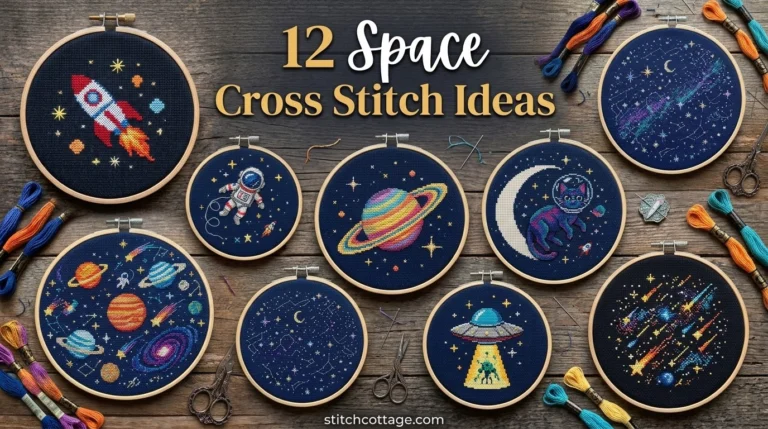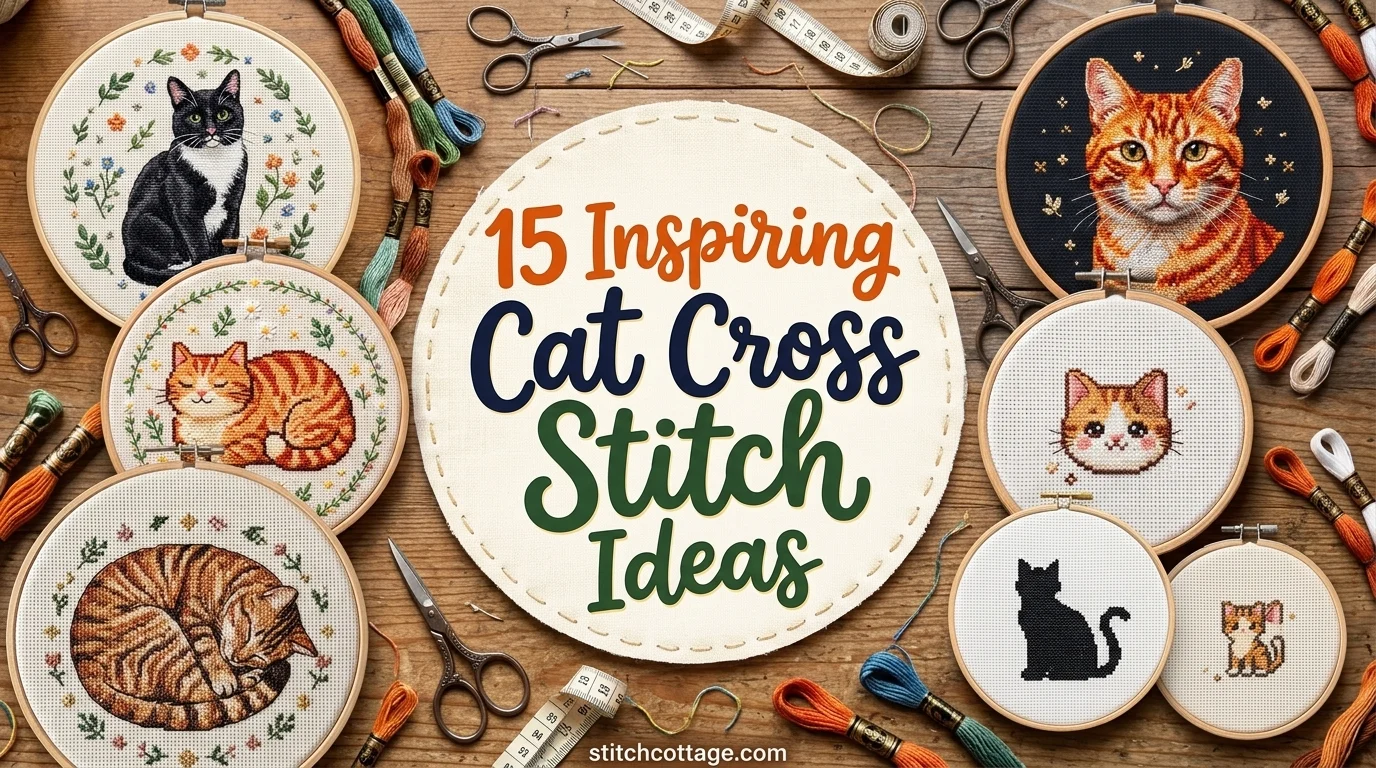
Cat cross stitch tends to go wrong in a dull place: the numbers on the cat cross stitch chart don’t agree with each other.
You cut your aida to the stated size. Only then do you find that the page and the grid give different widths for the cat.
One free kitten chart gives its size as 42 x 40 stitches in the details. Its description calls it 42 x 42.
A free black cat shows 103 x 67 in one place and 103 x 103 in another. Free cat charts often disagree with themselves like this.
Quick answer: choose the cat to fit the time you have. To get inches on 14 ct aida, divide the chart’s width in stitches by 14.
A cat 36 stitches wide finishes near 2.6 inches. One 200 wide finishes near 14.3.
I only stitch cats from charts that print their stitch count on the file. If you’d rather not hunt, cat charts with a stated stitch count and licence are one search away.
What is a cat cross stitch that reads as a cat?
Three marks carry the whole animal. They come down to placement, not skill.
Every kit in this row ships with fabric, sorted floss and a needle, so a cat cross stitch hoop can start the day it arrives. Picked by rating and number of reviews, not by price.
Printed kits suit a first project, counted kits suit a stitcher who reads charts.
KRAFUN Animal Cross Stitch Keyring Kit for Kids Ages 7-13

KRAFUN Animal Cross Stitch Keyring Kit for Kids Ages 7-13
Dimensions Stamped Cross Stitch Baby Quilt 34" X 43"

Dimensions Stamped Cross Stitch Baby Quilt 34" X 43"

- The ears. Two triangles with pointed tips, set well apart on top of the head. Round the tips and you get a bear.
- The head sitting low. A cat’s head is wider than its neck and sits almost on the shoulders. A long neck breaks it.
- The tail line. One curved line, one stitch wide. That stitch tells people they’re looking at a cat.
Everything else is colour, and colour pushes the stitch count up. My hearts cross stitch guide and star cross stitch guide apply the same checks to other shapes.
You can spot all three marks before you buy any floss. Cat charts with the grid and count shown make that quick.
Ears, a low head and one curved tail line. The rest is how many colours you’ll buy.
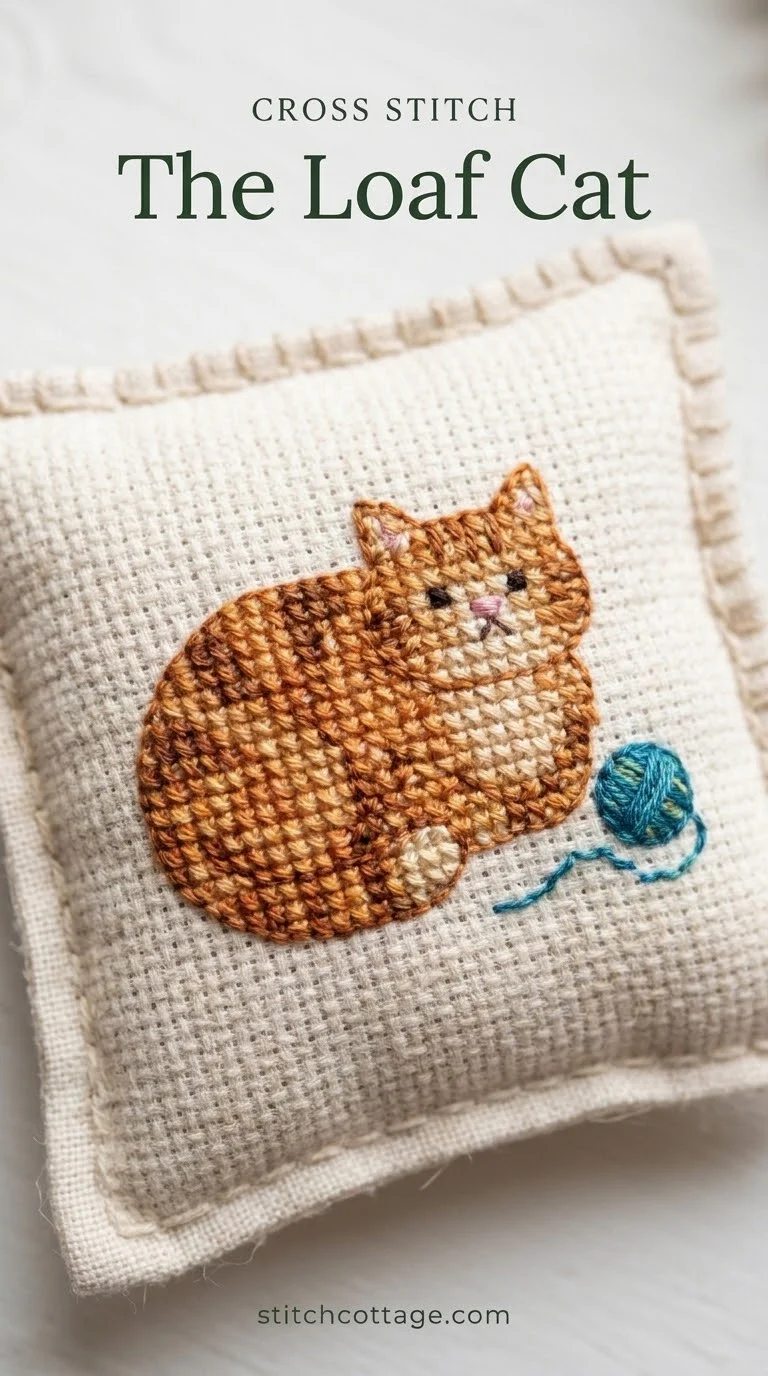
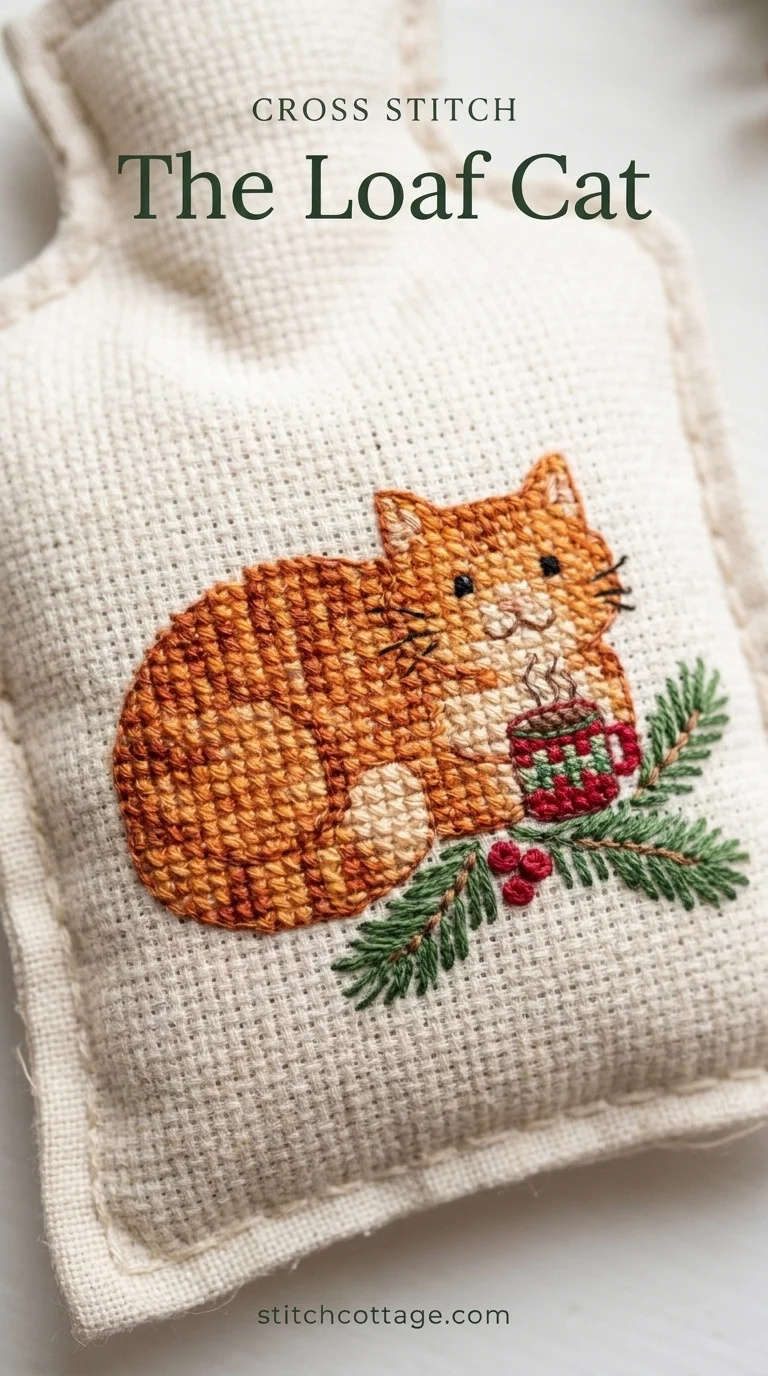
1. The loaf cat: the one-evening version
A loaf cat is right for a birthday card to the friend who talks about her cat. Stitch it on Friday night and post it on Saturday.
The cat sits with its paws tucked under, so the body is one rounded block.
You’ll want DMC 741 and 721 for the orange stripes, 3865 for the cream chest and 310 for the eyes.
The free chart is 36 by 33 stitches, about 2.6 by 2.4 inches on 14 ct aida. The tricky spot is the stripes on a round back.
I do the outline row first and fill each stripe from there. A small cat chart that names its colour count saves you a surprise.
- Best for: a card you finish in one evening
- Avoid for: a framed wall piece that has to be seen from across a room
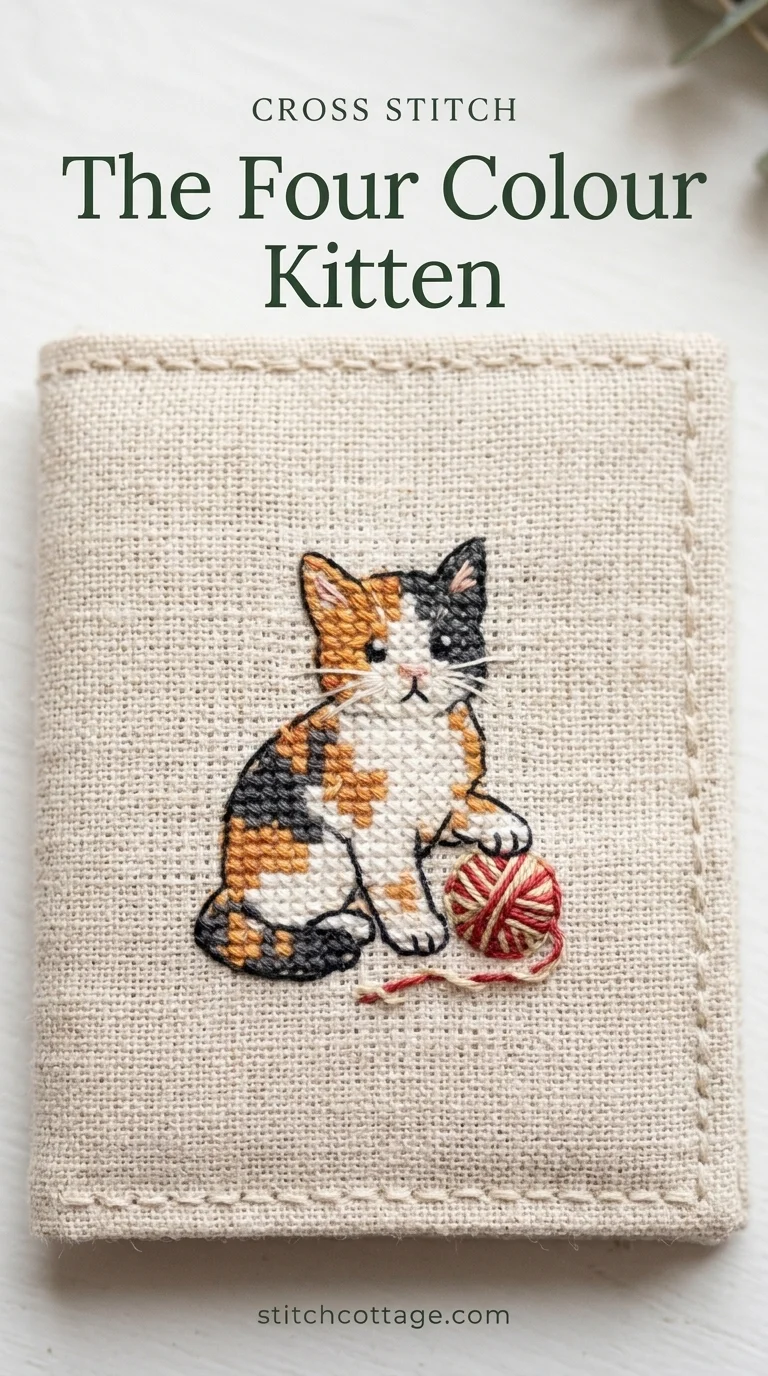
2. The four colour kitten
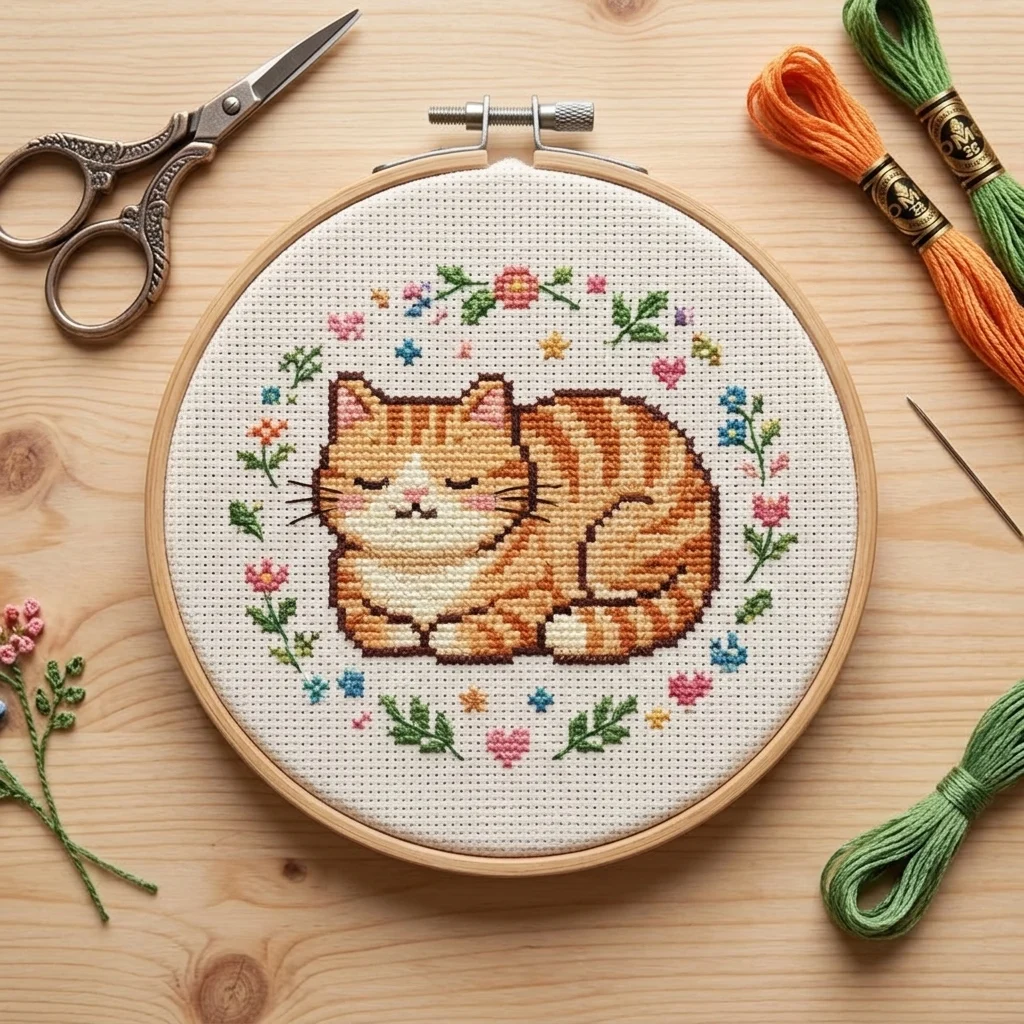
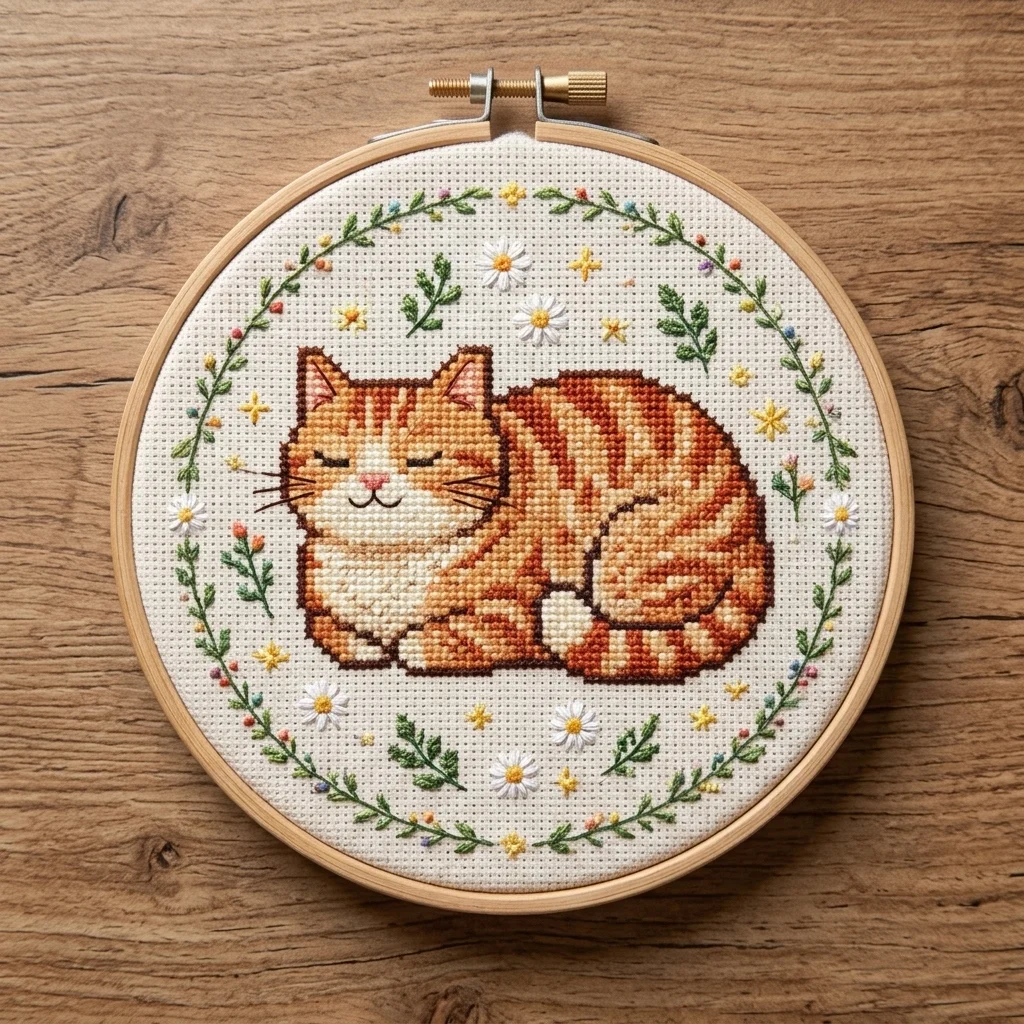
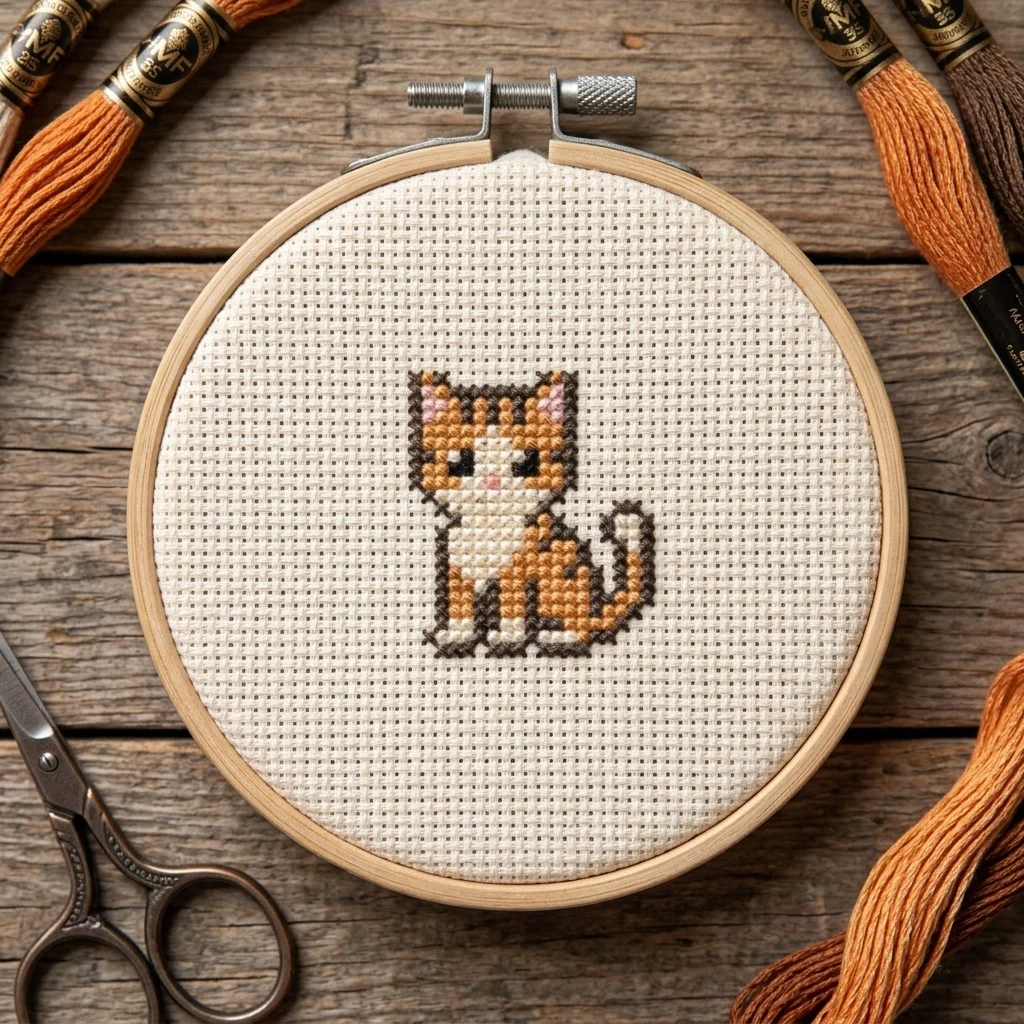
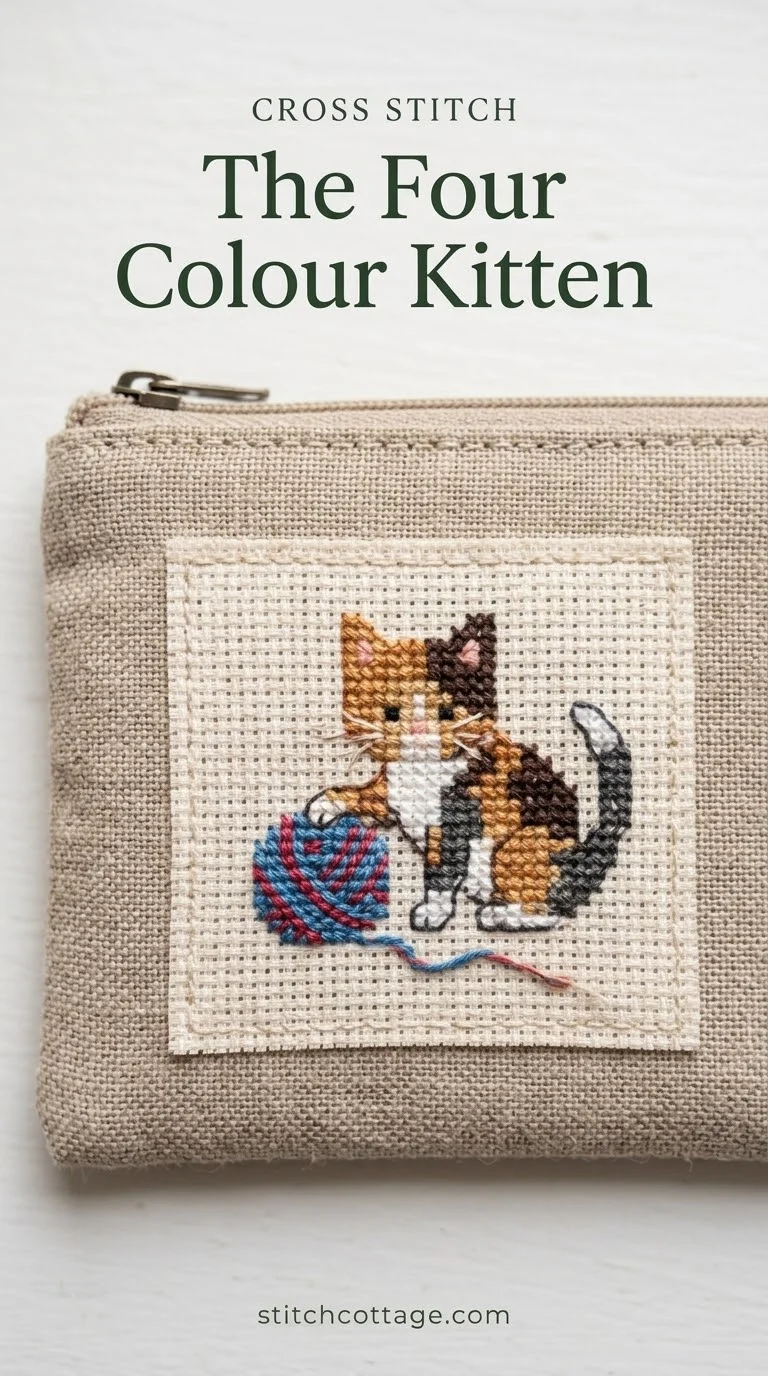
A kitten looks right on a nursery wall, framed in a 4-inch hoop before the baby comes.
A kitten is a cat with a bigger head and a shorter body.
I’d use DMC 743 for the coat, 741 for the stripes, 3865 for the muzzle and 310 for the eyes.
The free yellow kitten is 42 by 40 stitches, about 3 by 2.9 inches on 14 ct aida. The tricky spot is the size itself, because the description says 42 by 42.
Two rows are enough to ruin a border you’ve planned. I count the grid height myself before I cut the fabric.
- Best for: a baby gift you can finish over a weekend
- Avoid for: a planned border that needs an exact height
3. The one colour black cat
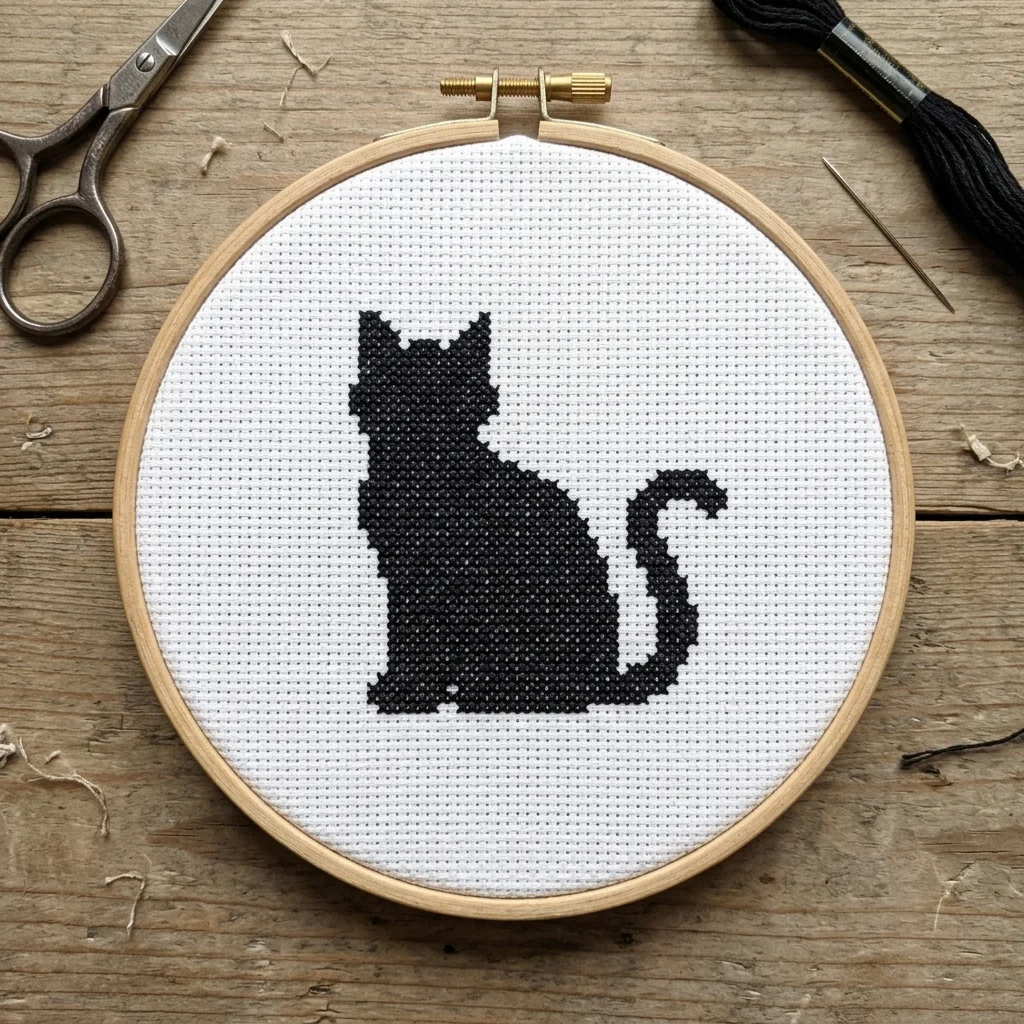
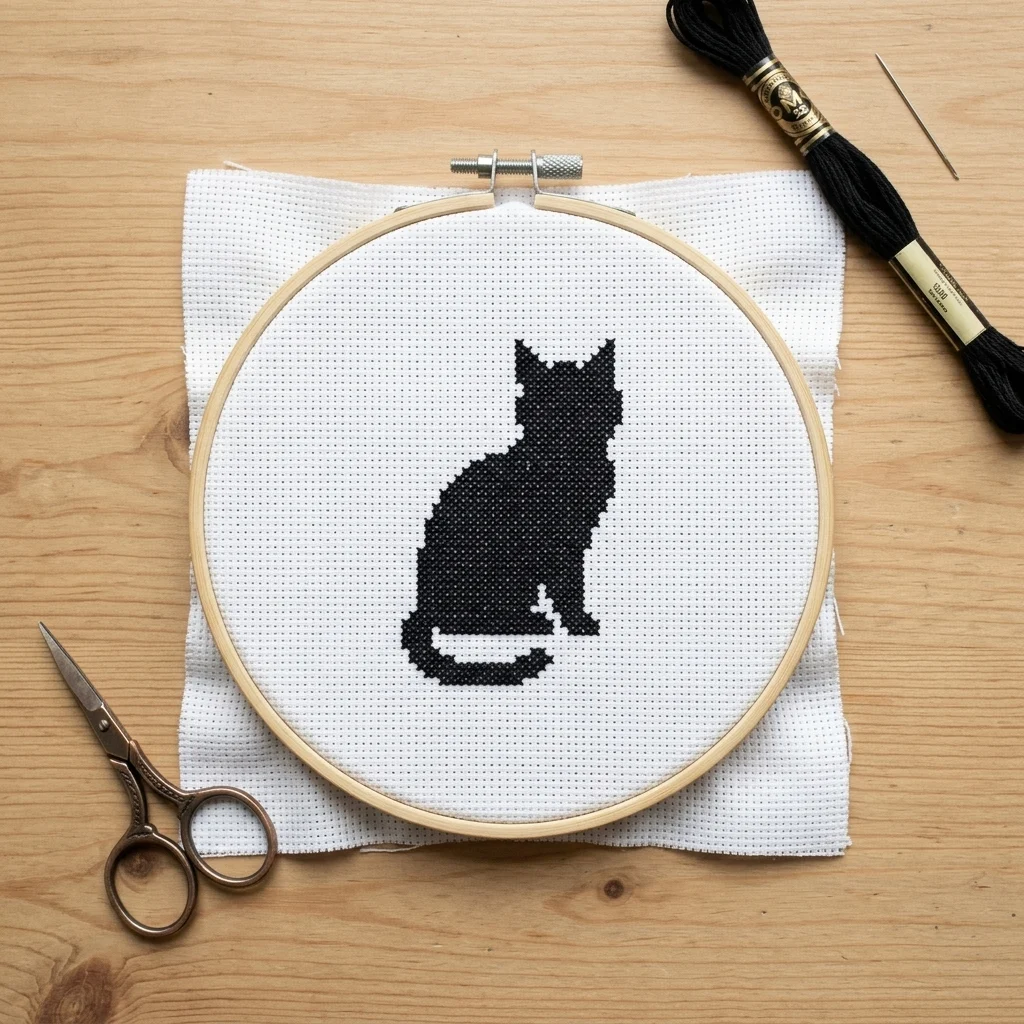
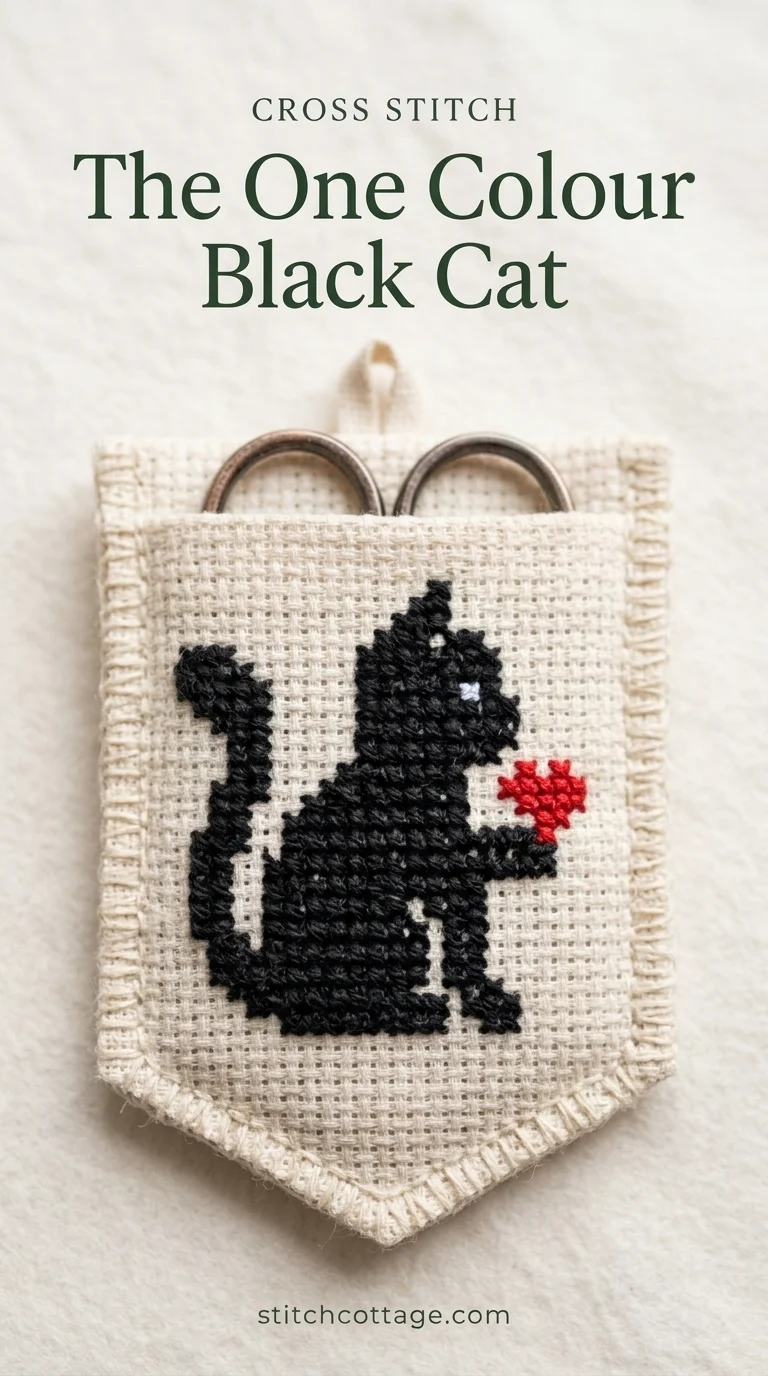
A one colour black cat fits a wide frame above a reading chair.
The design is one sitting silhouette with its ears up and its tail curled around its feet.
All you need is DMC 310 and white or cream aida.
The chart is 103 by 67 stitches, about 7.4 by 4.8 inches on 14 ct. The same page also lists 103 by 103.
If you buy a frame for the square version, the wide one sits inside bare bands. Decide which one you’re stitching before you buy the frame.
Long black runs are easy to miscount. I count them in tens and mark each ten in pencil.
- Best for: a calm, wide wall piece with one skein to buy
- Avoid for: a square frame you already own

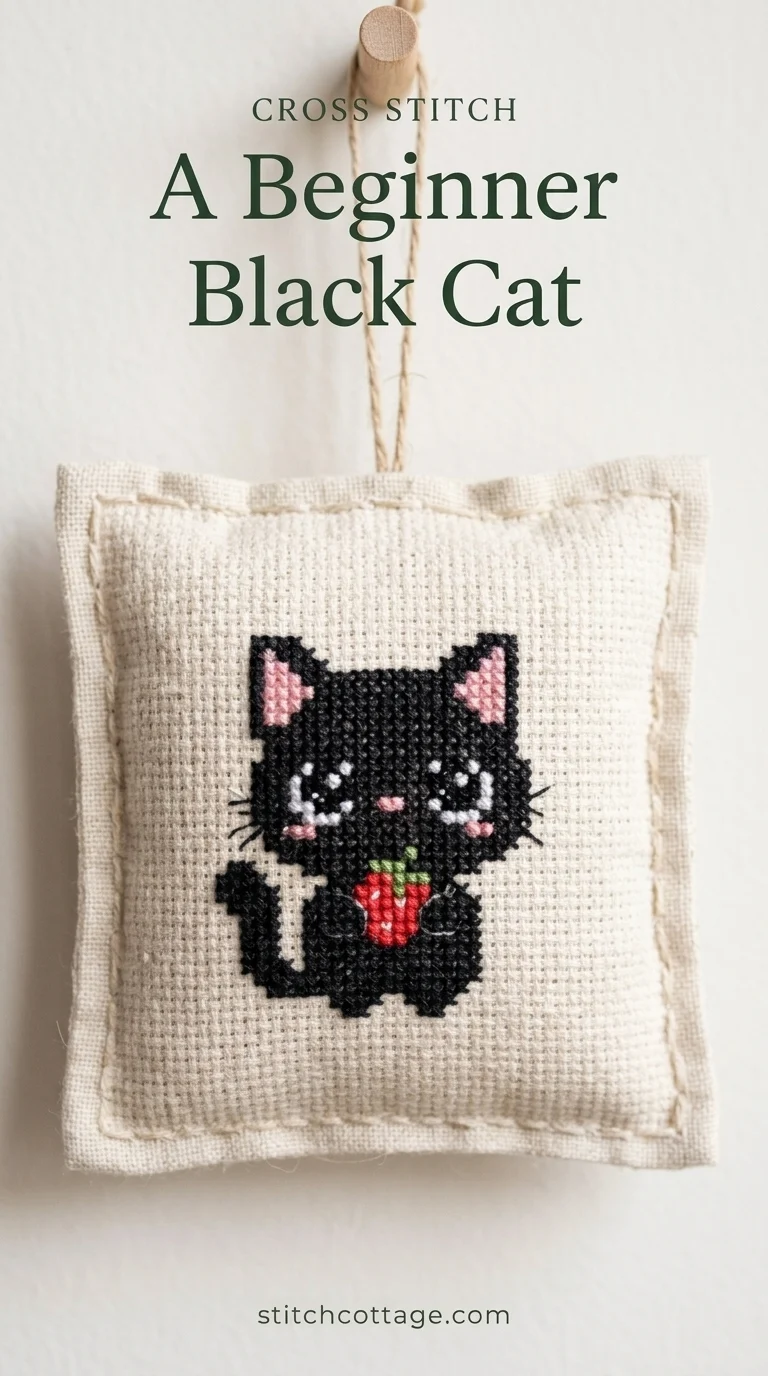
4. A beginner black cat in three colours
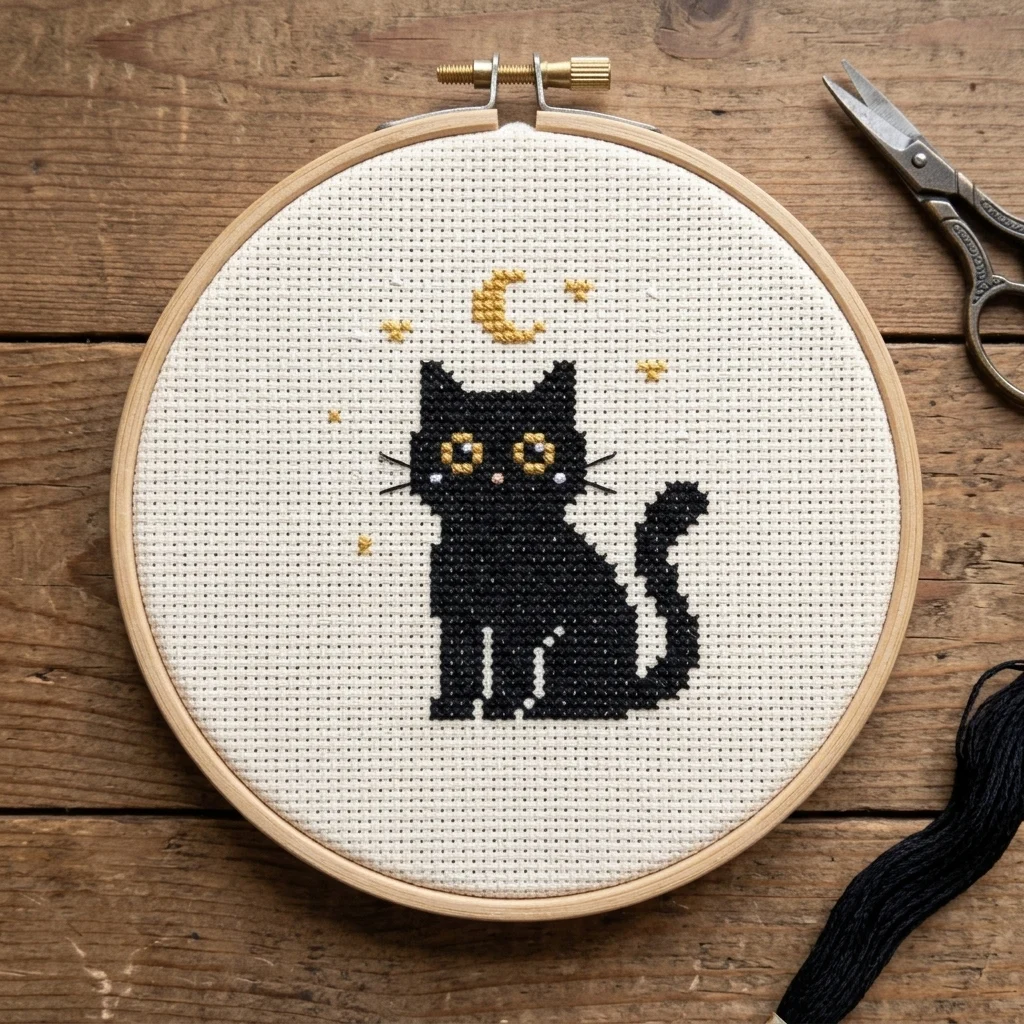
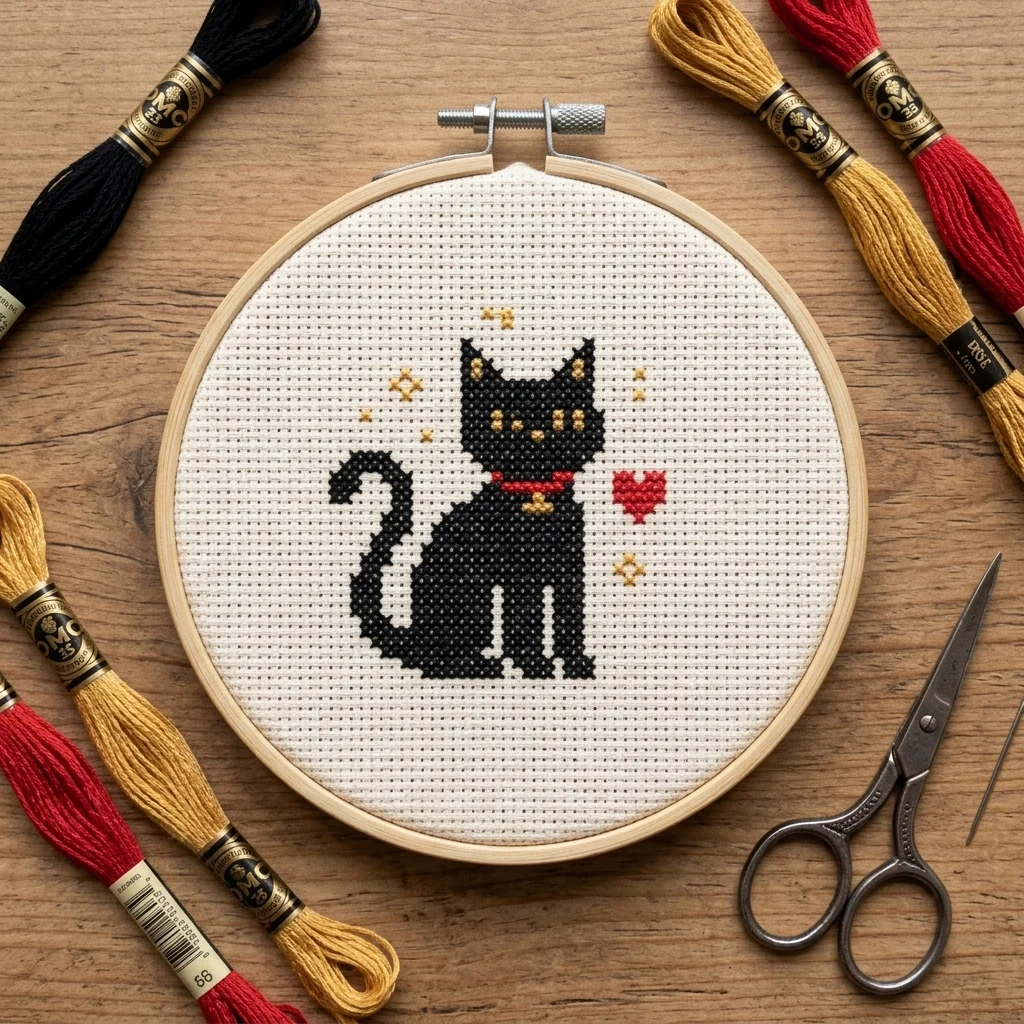
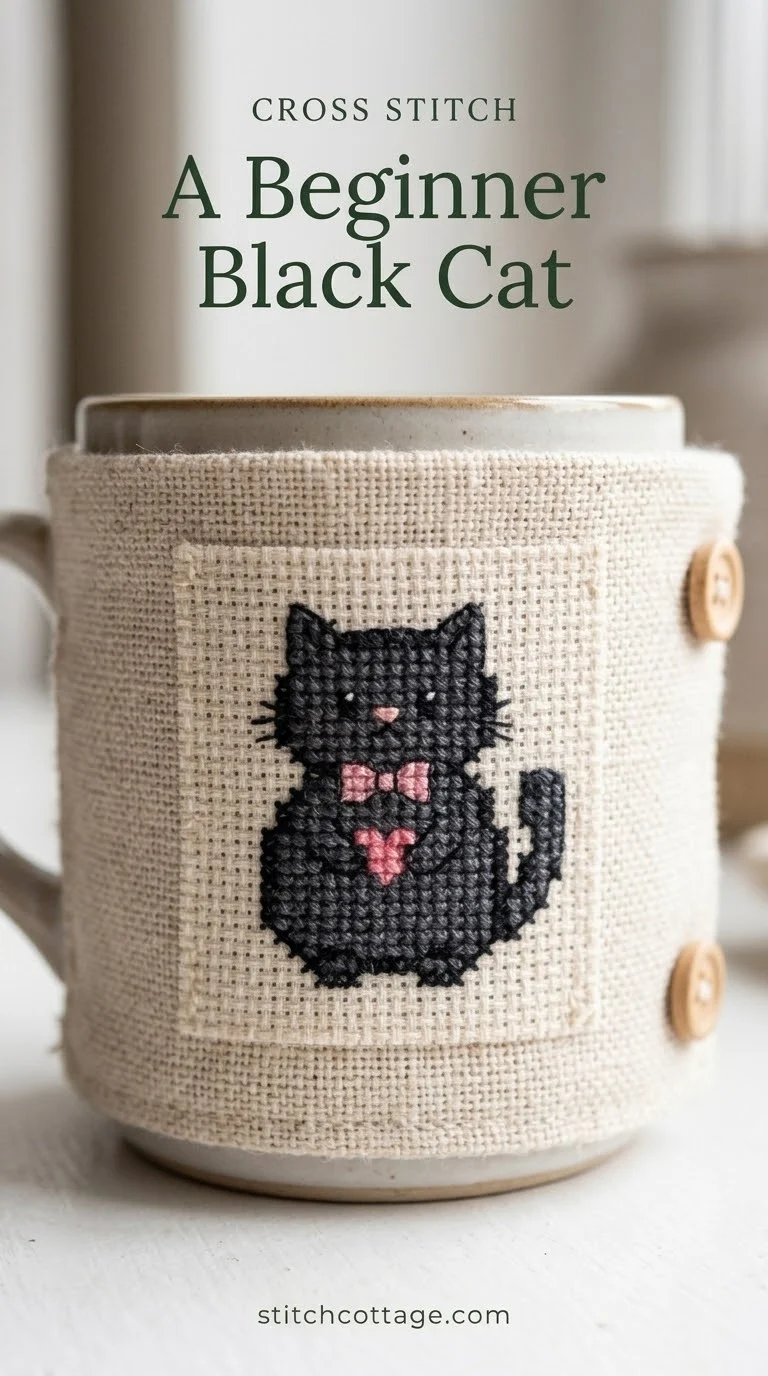
This is the black cat I hand to people who have never counted a row. It makes a small hoop for a child’s bedroom door.
The cat sits under a gold crescent moon. It has a round head and yellow eyes.
Three colours do the work: DMC 310 for the body, 3799 for shading and 726 for the eyes.
The chart is 50 by 57 stitches, about 3.6 by 4.1 inches on 14 ct aida. It takes a few evenings.
The tricky spot is telling 310 from 3799 once they’re on the needle. I keep each one on its own labelled card and stitch one shade at a time.
- Best for: a complete beginner’s first counted chart
- Avoid for: anyone who wants a detailed, shaded coat
5. The tuxedo cat
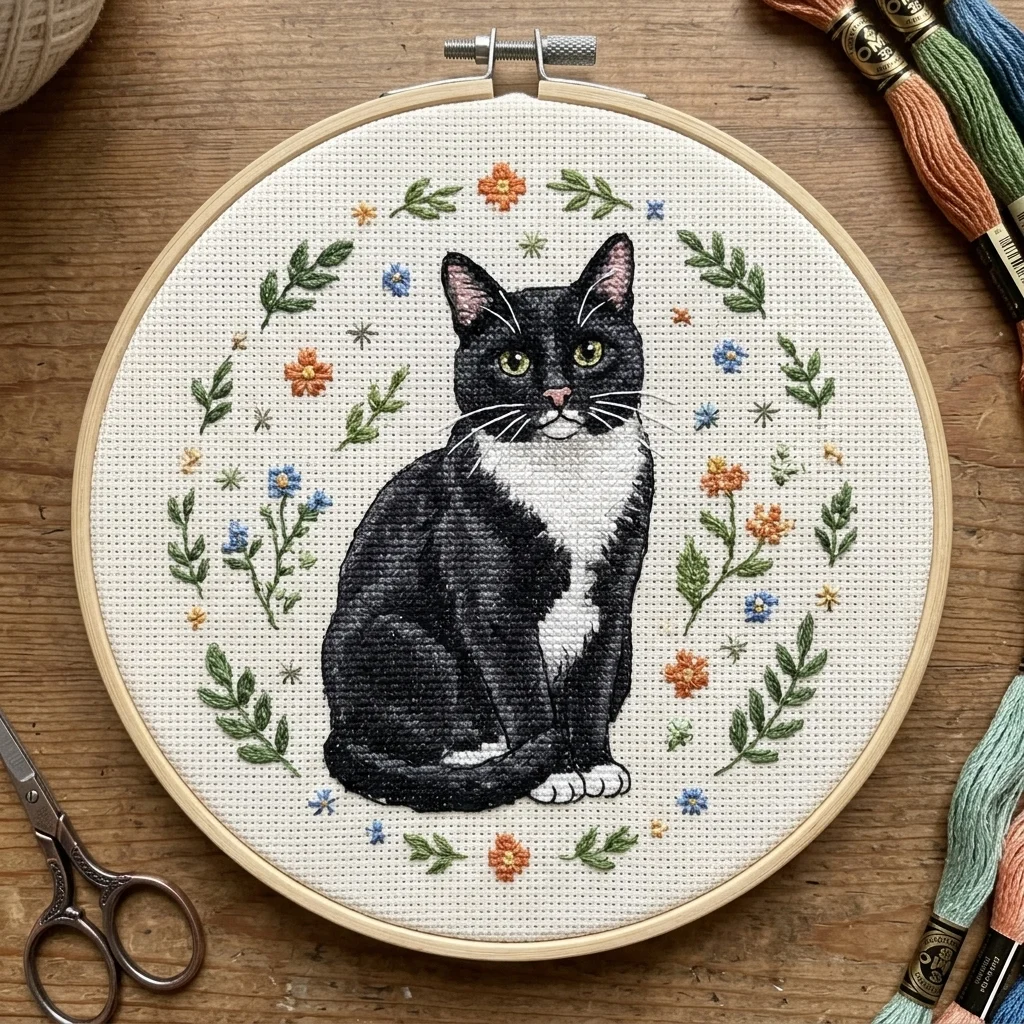
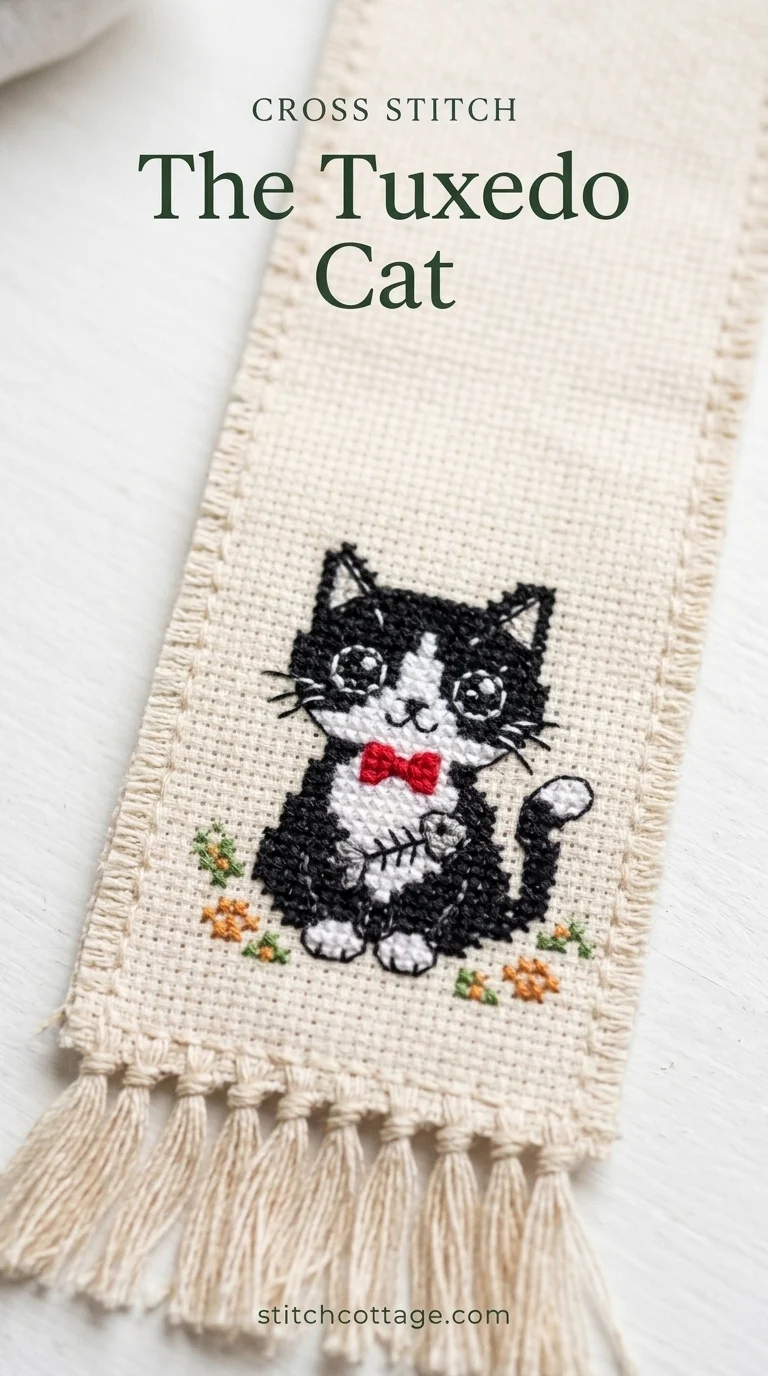
A tuxedo cat is the gift for someone who owns one. Frame it in a 6-inch hoop and stitch the cat’s name underneath.
The design shows a black cat with a white chest and paws and green eyes. It sits inside a ring of leaves.
You’ll want DMC 310 for the coat, blanc for the chest, 762 for chest shadow, 704 for the eyes and 3354 for the nose.
A chart around 60 by 70 stitches finishes about 4.3 by 5 inches on 14 ct aida.
The tricky spot is the white chest, which disappears on cream fabric. I backstitch its edge in 762 or stitch it on pale blue aida.
- Best for: a personal gift with a pet’s name added
- Avoid for: cream or white aida with no outline

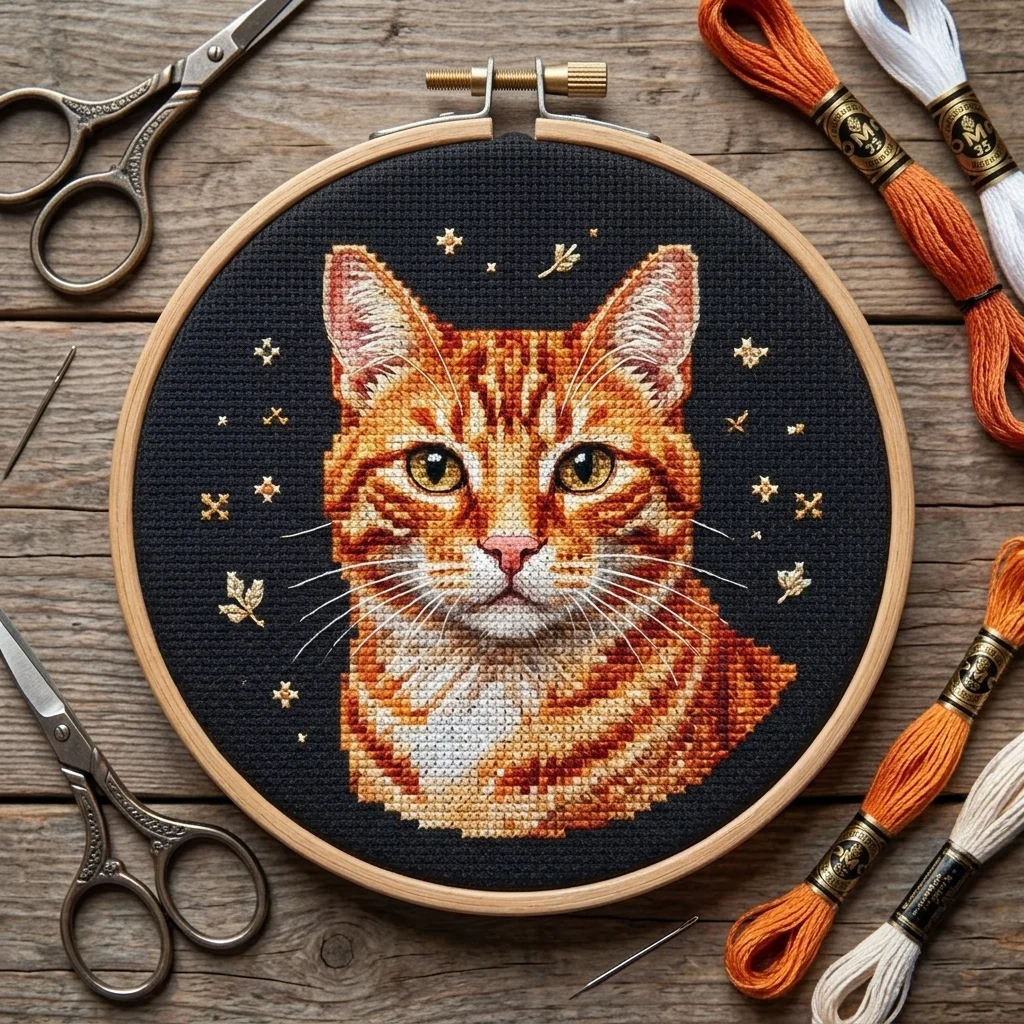
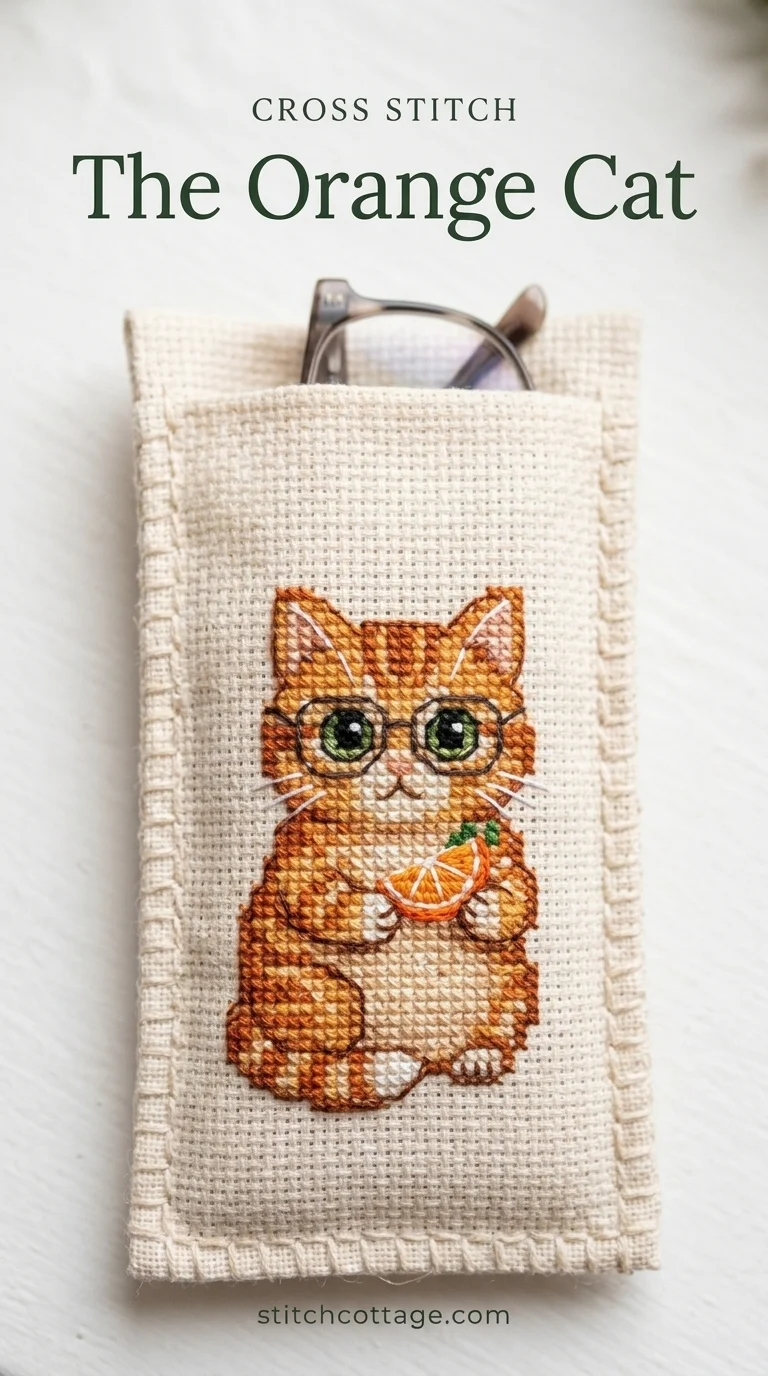
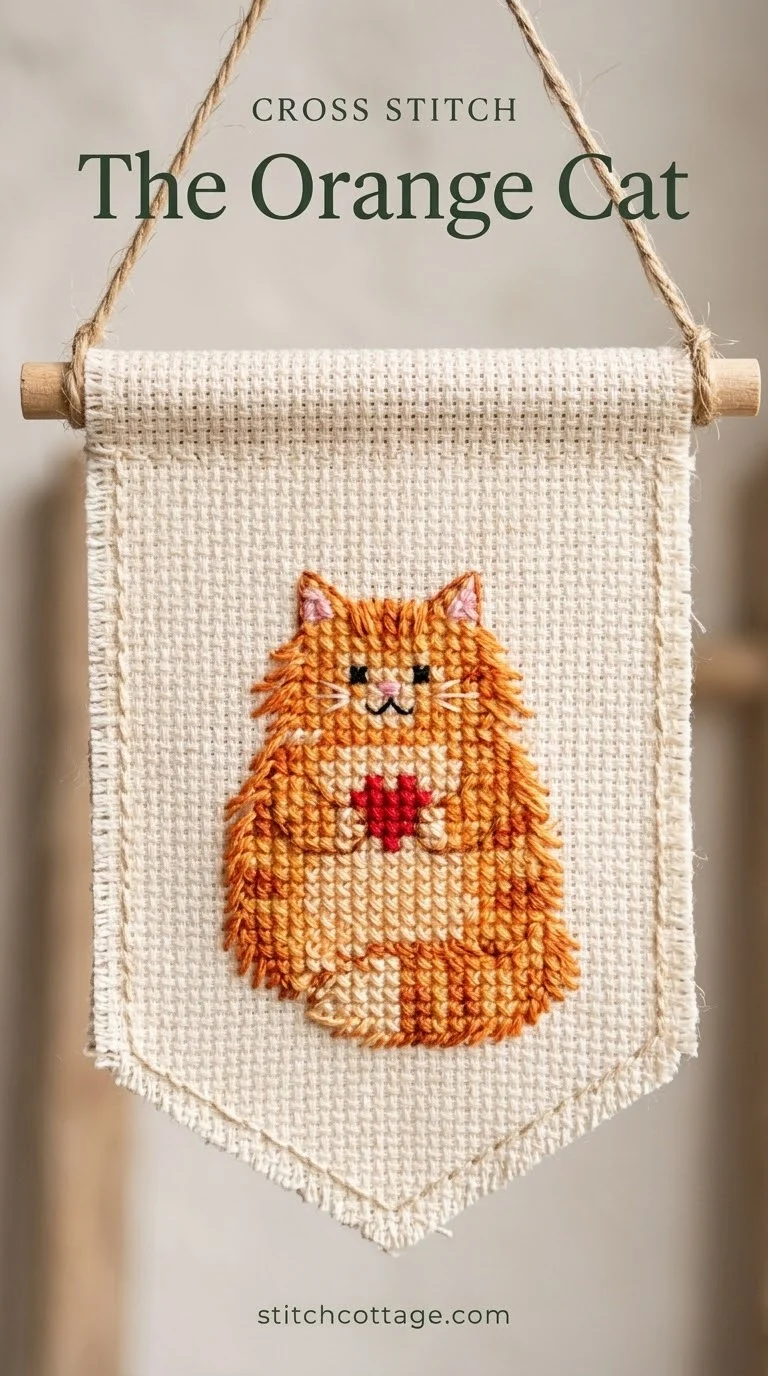
6. The orange cat
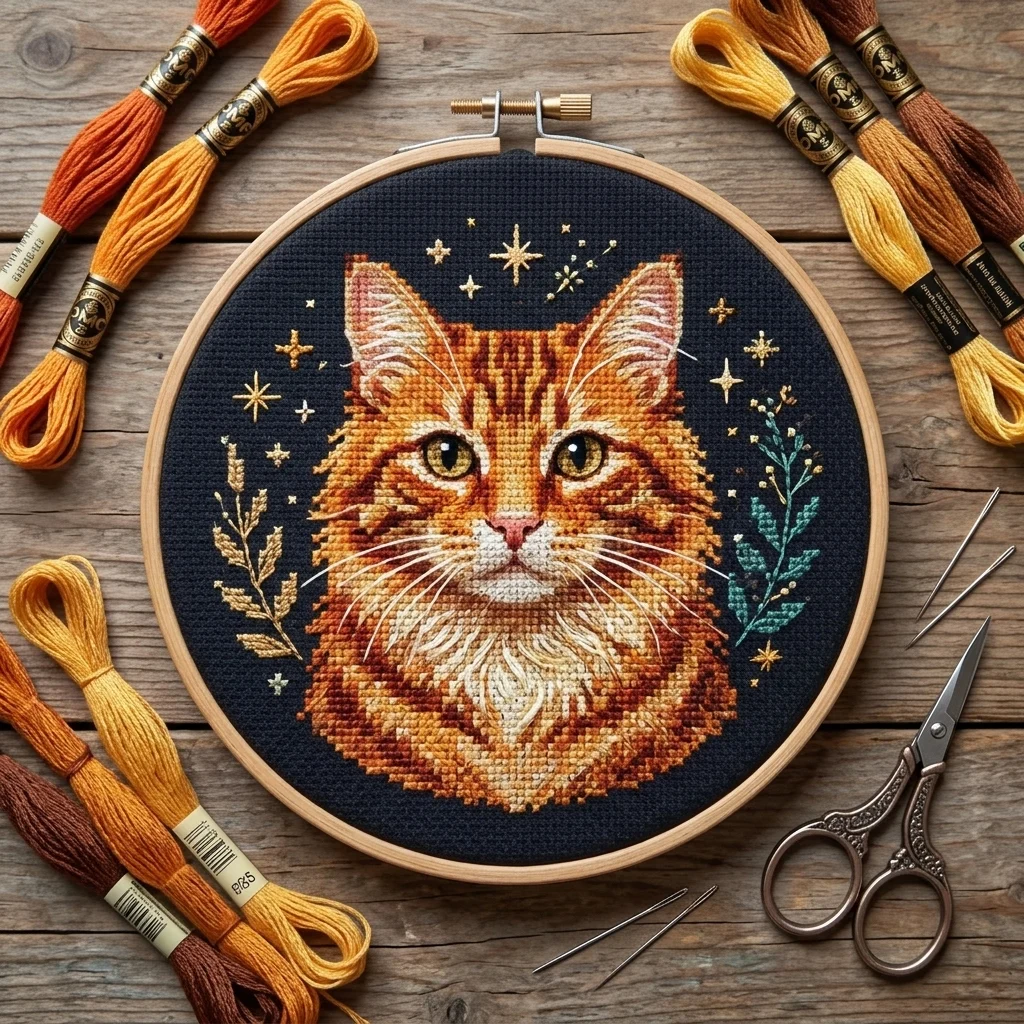
An orange cat warms up a sofa pillow from September to Thanksgiving. Stitched on navy, it’s also a framed gift for someone with a ginger cat.
The design is a tabby portrait from the chest up, with a white chest and fine whiskers.
The coat goes through DMC 742, 741, 740 and 720. Blanc covers the chest and 310 the pupils.
A portrait around 90 by 90 stitches comes to about 6.4 inches square on 14 ct.
The tricky spot is the oranges, which look alike on a screen. I print the chart in grey first. If two oranges turn into one symbol, I don’t stitch from it.
- Best for: an autumn pillow front
- Avoid for: a chart you can only print in black and white
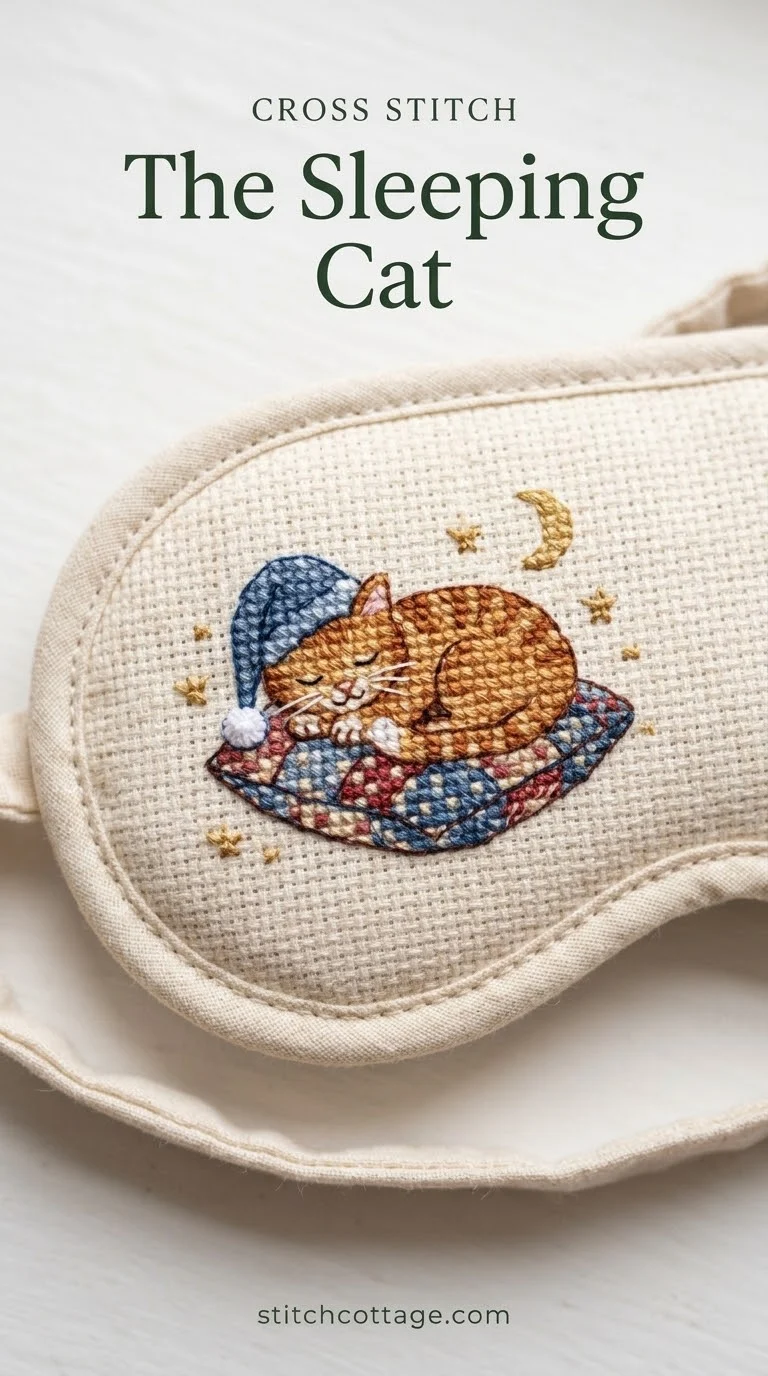
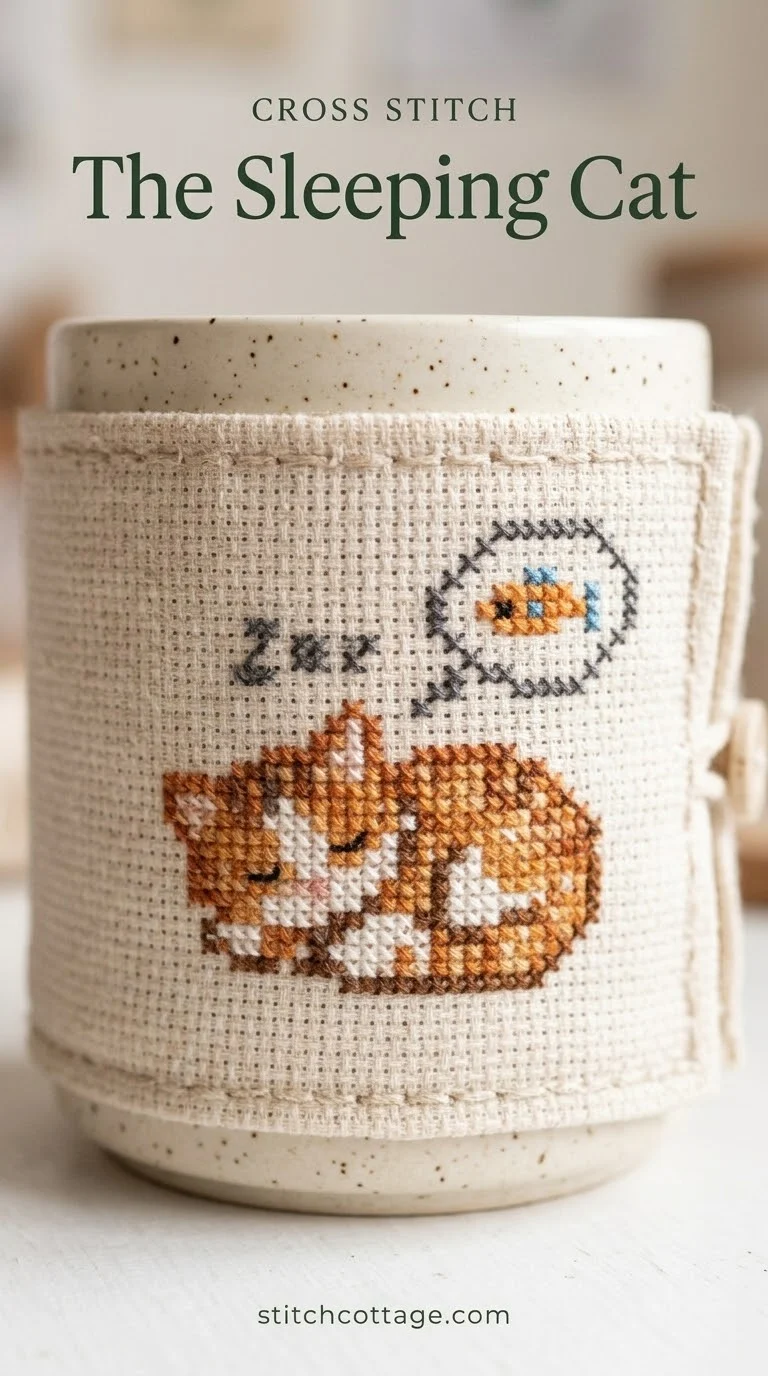
7. The sleeping cat
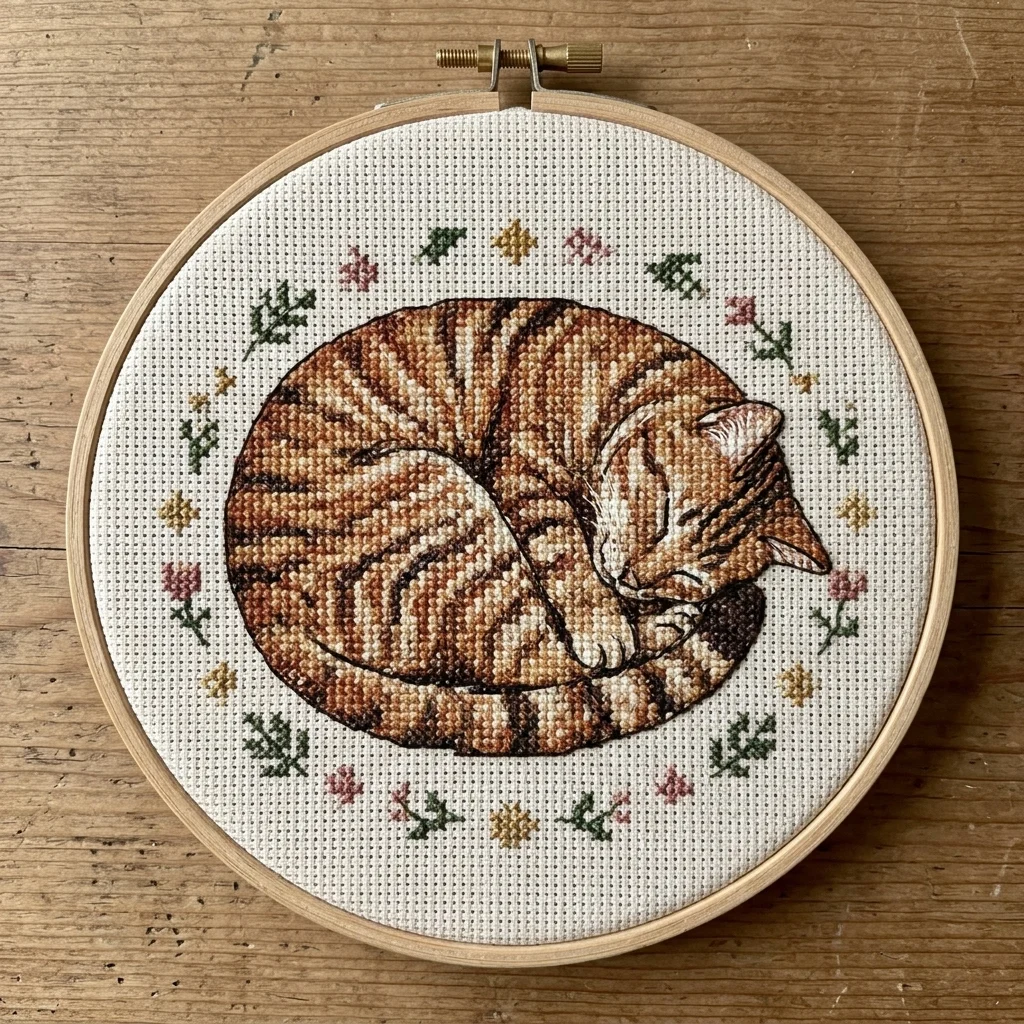
A sleeping cat belongs on a bedroom wall in winter, when the evenings are long and so is the project.
The cat is a curled oval with one ear showing and its tail across its nose.
Expect ten colours: DMC 3371, 433 and 437 for the tabby browns, 3865 for the pale fur and 3354 for the nose.
The free chart is 103 by 87 stitches, about 7.4 by 6.2 inches on 14 ct.
The tricky spot is where the tail crosses the face. I stitch the tail line first and fill the face around it.
A sleeping cat chart with a numbered colour list shows you all ten shades before you buy.
- Best for: a winter project for a stitcher who has finished a cat before
- Avoid for: your very first chart
Halfway through the list is a good moment to pick a kit for the next evening. These sets keep the colours already matched to the chart.
Check the fabric count on the listing before you buy, since 11, 14 and 16 count stitch up at different sizes.
Bradove Classic Embroidery Learning Kit for Adults and Kids

Bradove Classic Embroidery Learning Kit for Adults and Kids
Bradove Alphabet Embroidery Kit for Beginners with Patterns

Bradove Alphabet Embroidery Kit for Beginners with Patterns
Bonroy 4 Sets Embroidery Set for Beginners Art Crafts Easy Sewing Incl

udes Embroidery Clothes with Pattern, Hoop, Instruction Manual, Color Stitch Set (Assorted 1)
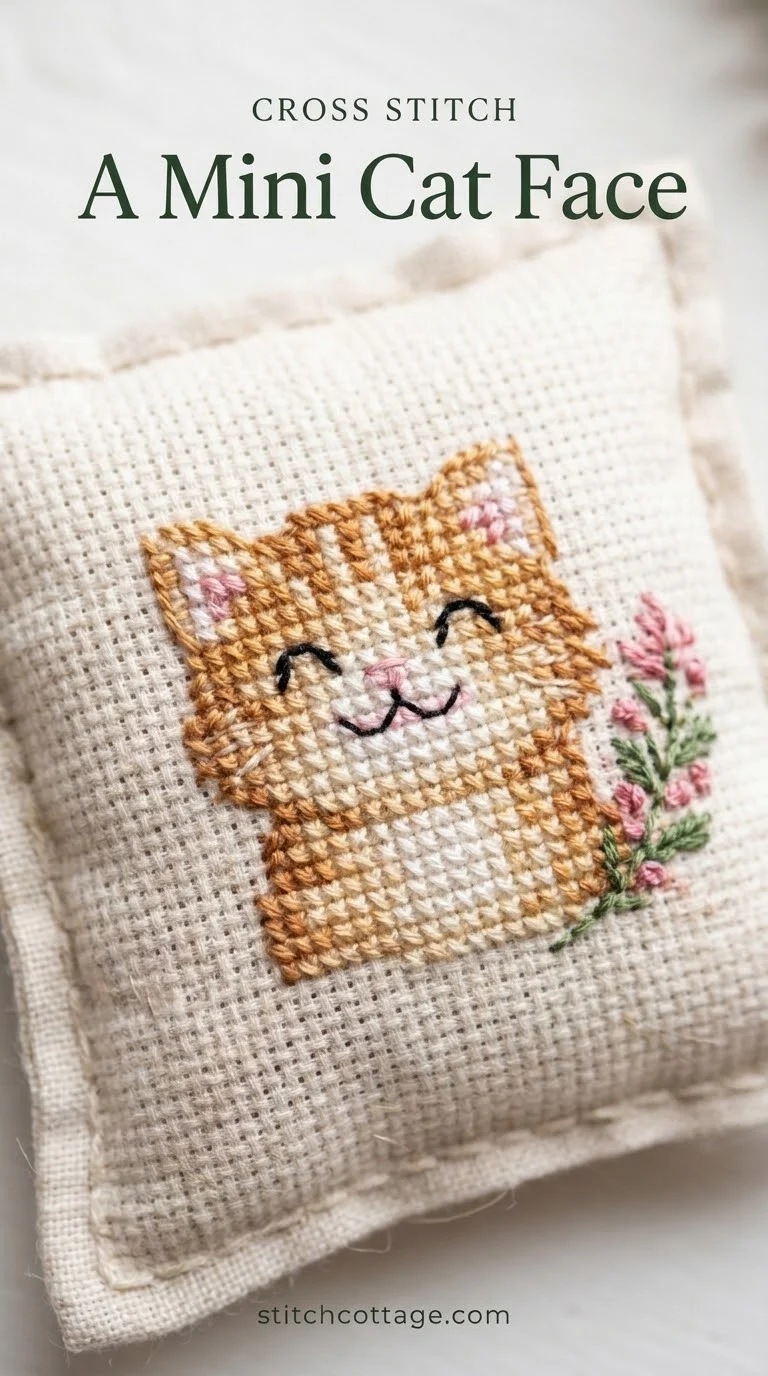
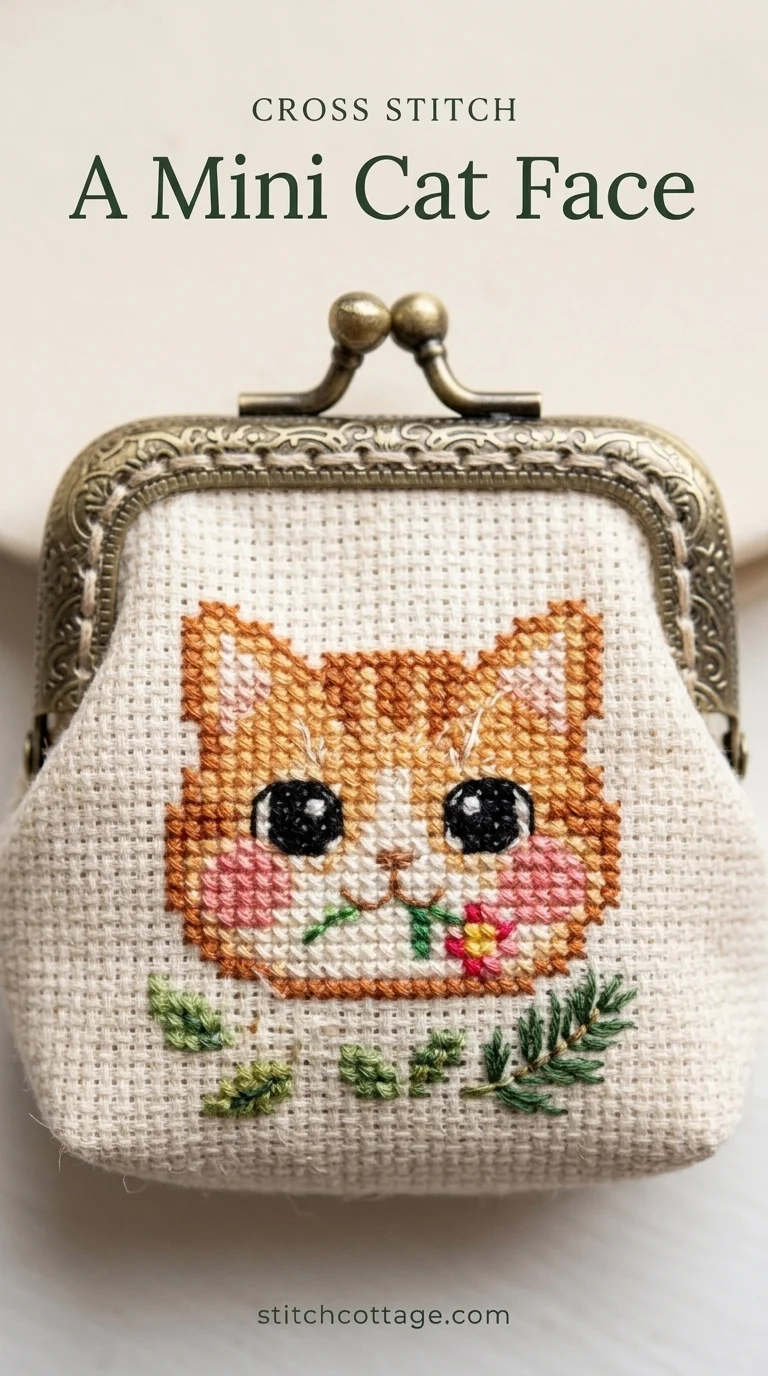
8. A mini cat face
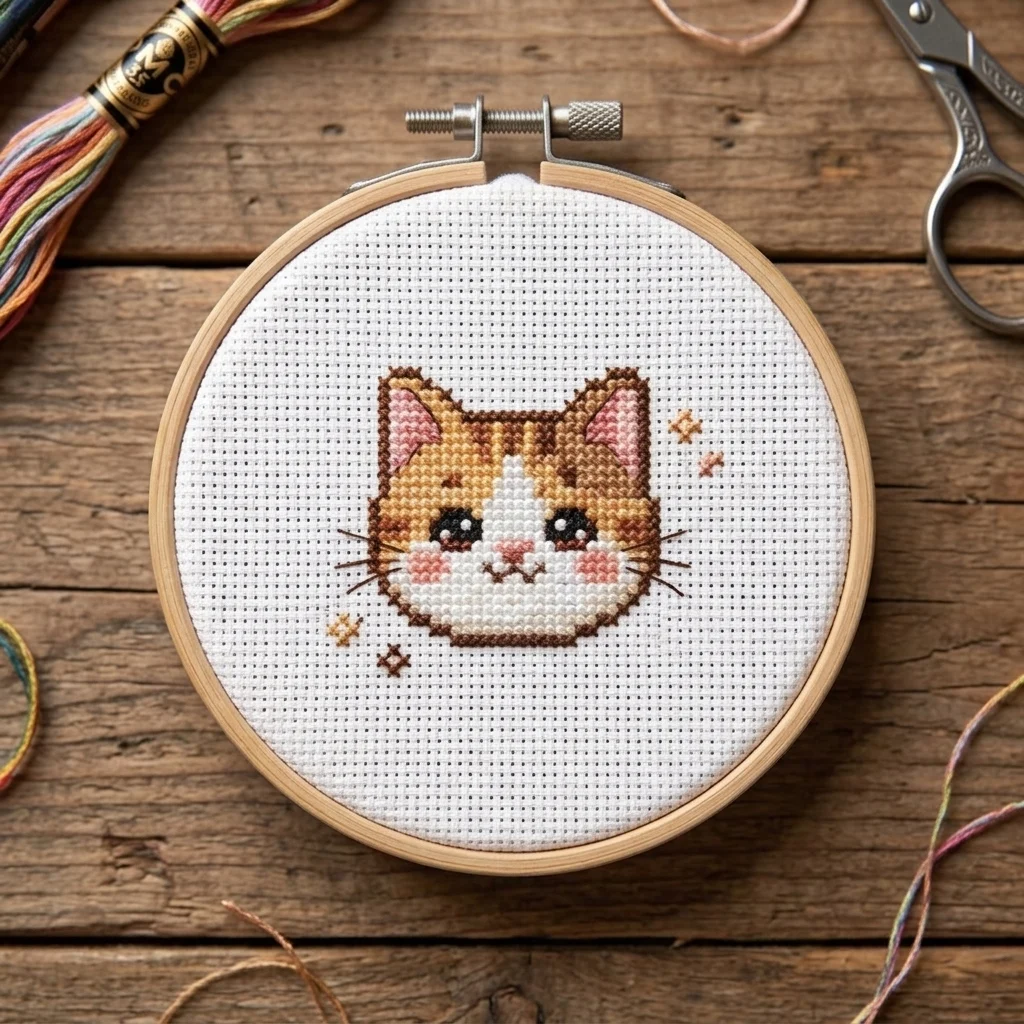
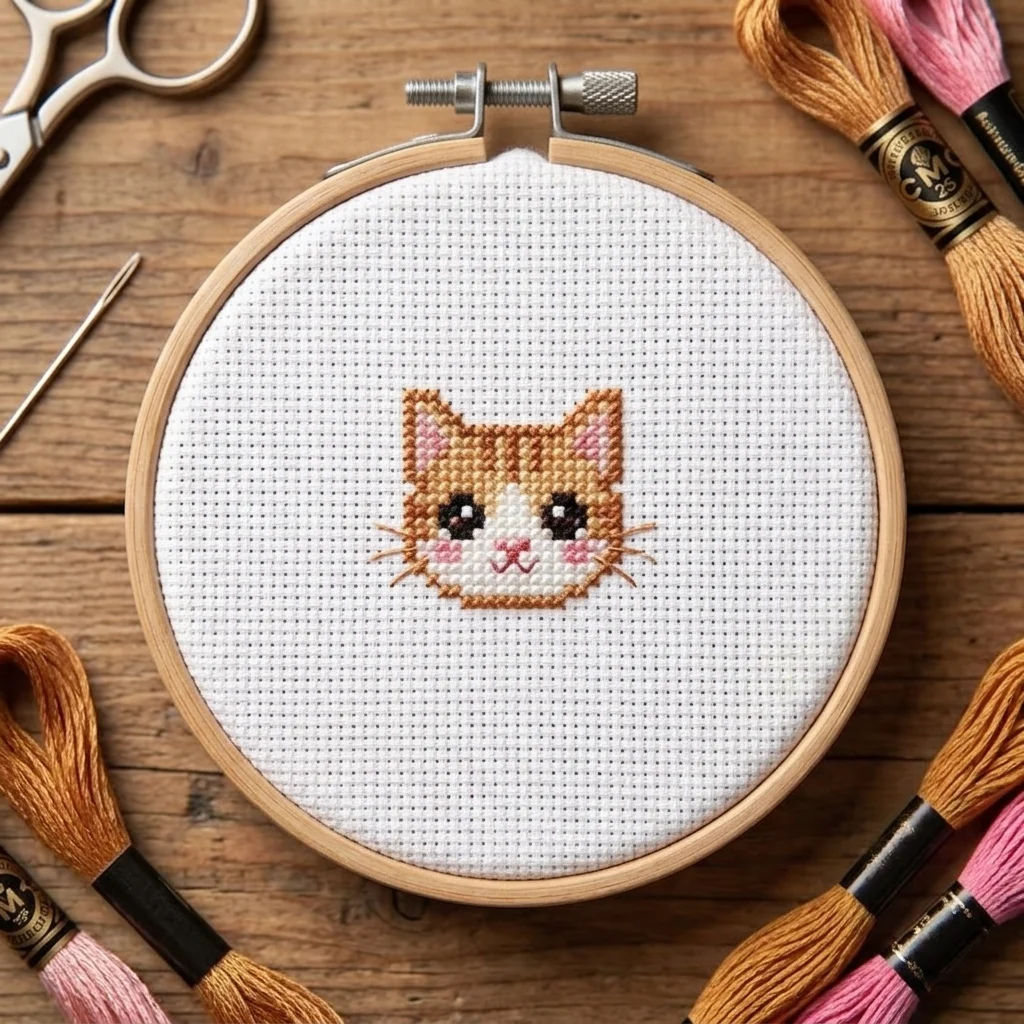
Mini cat faces make Christmas tree ornaments or gift tags for a whole office. You can stitch six in a weekend and back each one with felt.
The face is two ears, two eyes and a nose, plus pink cheeks. It’s the smallest cat that still reads as a cat.
You’ll want DMC 741 and blanc for the fur, 3354 for the cheeks and 310 for the eyes.
A face around 20 by 18 stitches finishes near 1.4 by 1.3 inches on 14 ct. Once backed, that’s a 2-inch ornament.
The tricky spot is the eyes, which are one stitch each. I put them in first and build the face around them.
- Best for: a batch of matching holiday ornaments
- Avoid for: a piece meant to fill a frame
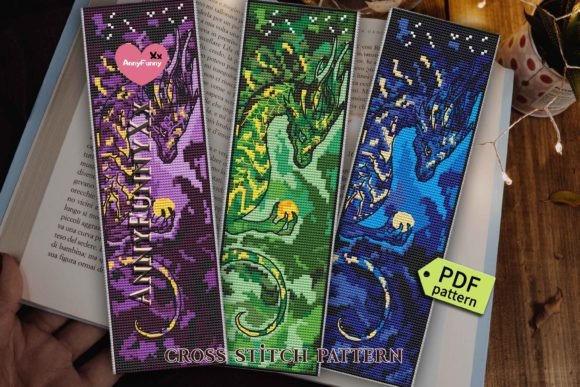
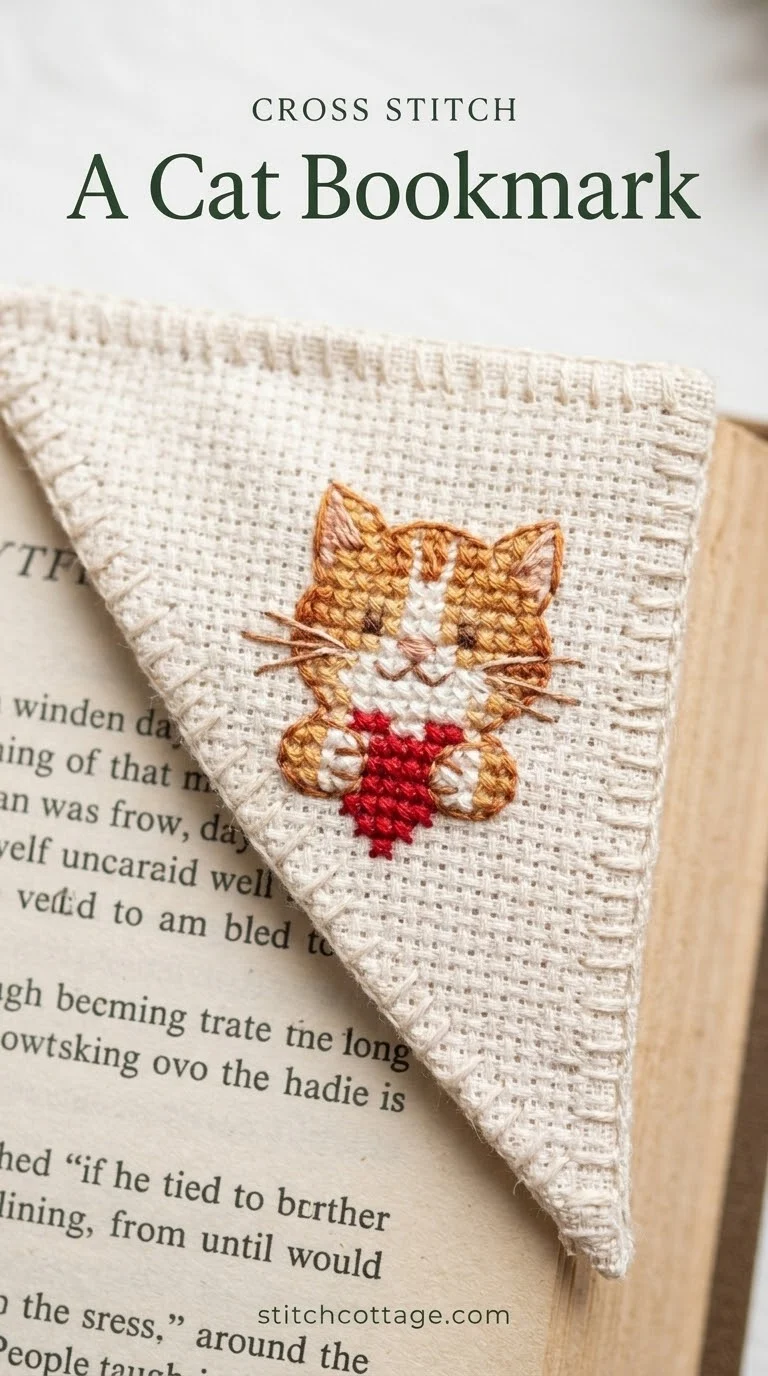
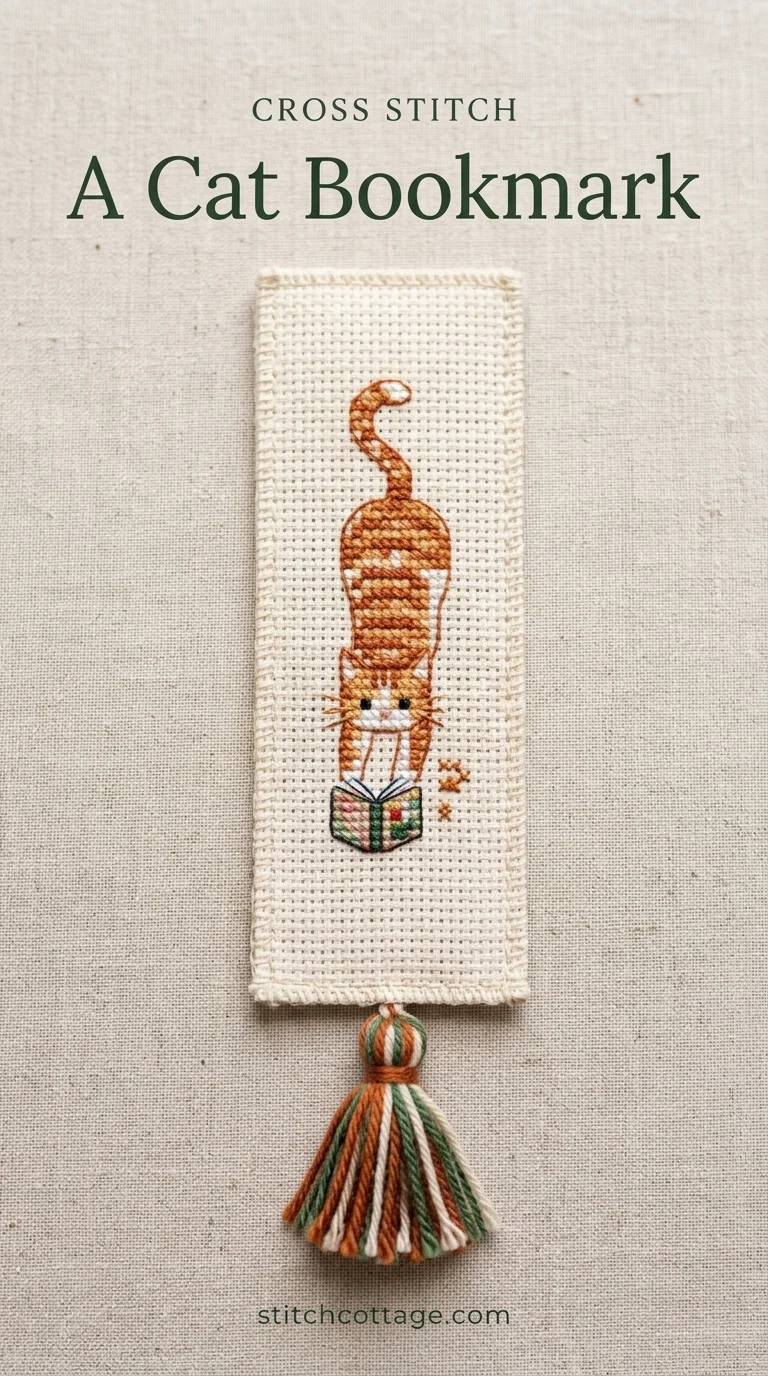
9. A cat bookmark
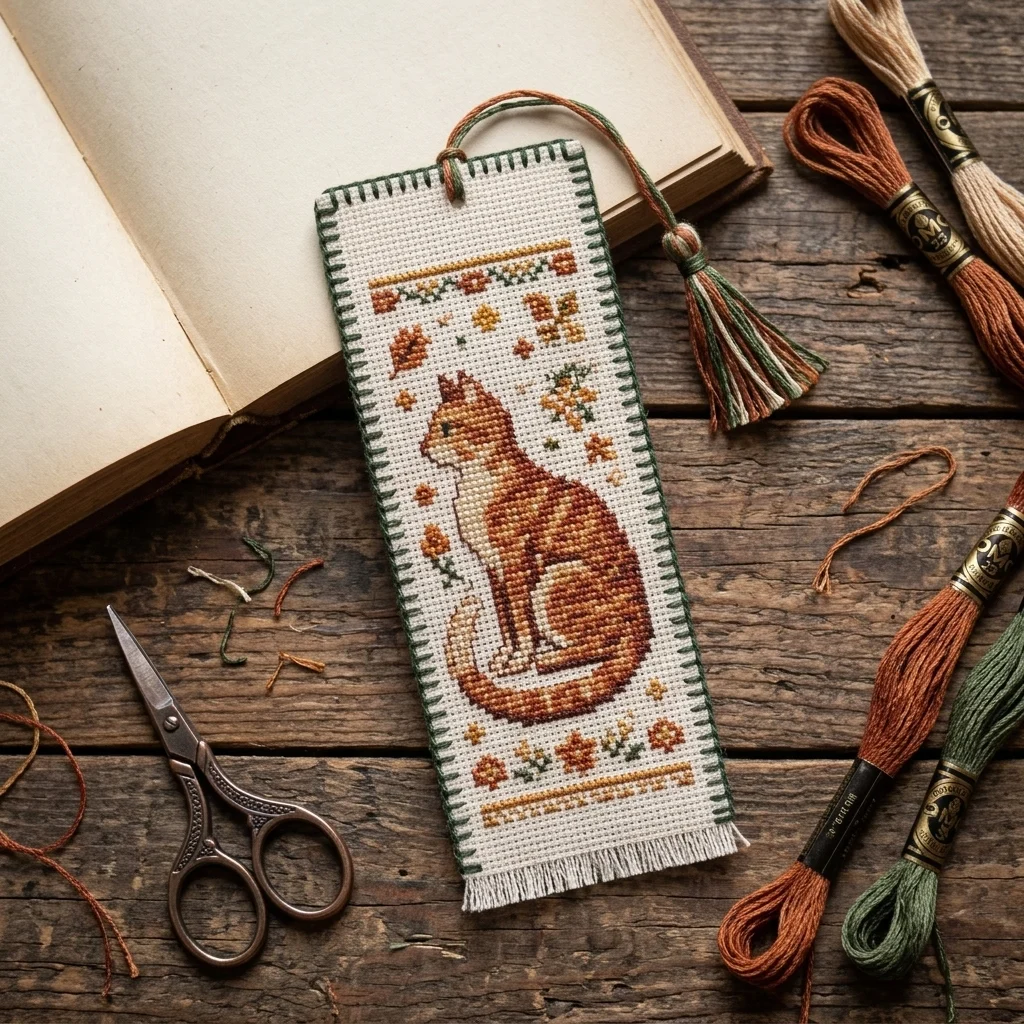
A cat bookmark makes a back-to-school gift for a teacher. It also slips nicely into a novel for a reader.
The design shows an orange tabby sitting in profile above a border of autumn leaves.
You’ll want DMC 741 and 720 for the coat, 3865 for the chest, 986 for the leaves and 310 for the eye.
A strip around 25 by 90 stitches comes to 1.8 by 6.4 inches on 14 ct aida.
The tricky spot is the back, because a bookmark shows both sides. I hem the edges first and line the back with felt.
A bookmark chart that states its width in stitches is better than a photo.
- Best for: a small, useful gift for a reader
- Avoid for: anyone who leaves a messy back
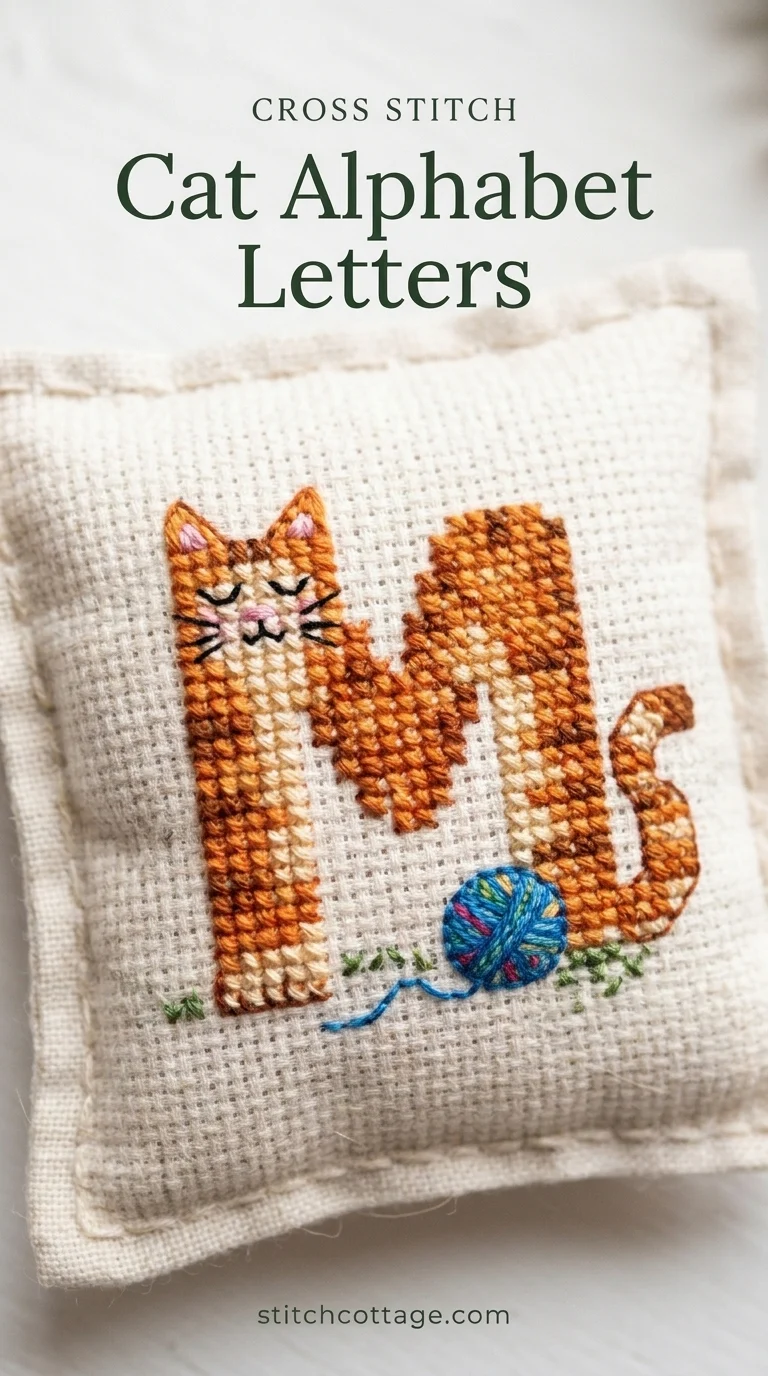
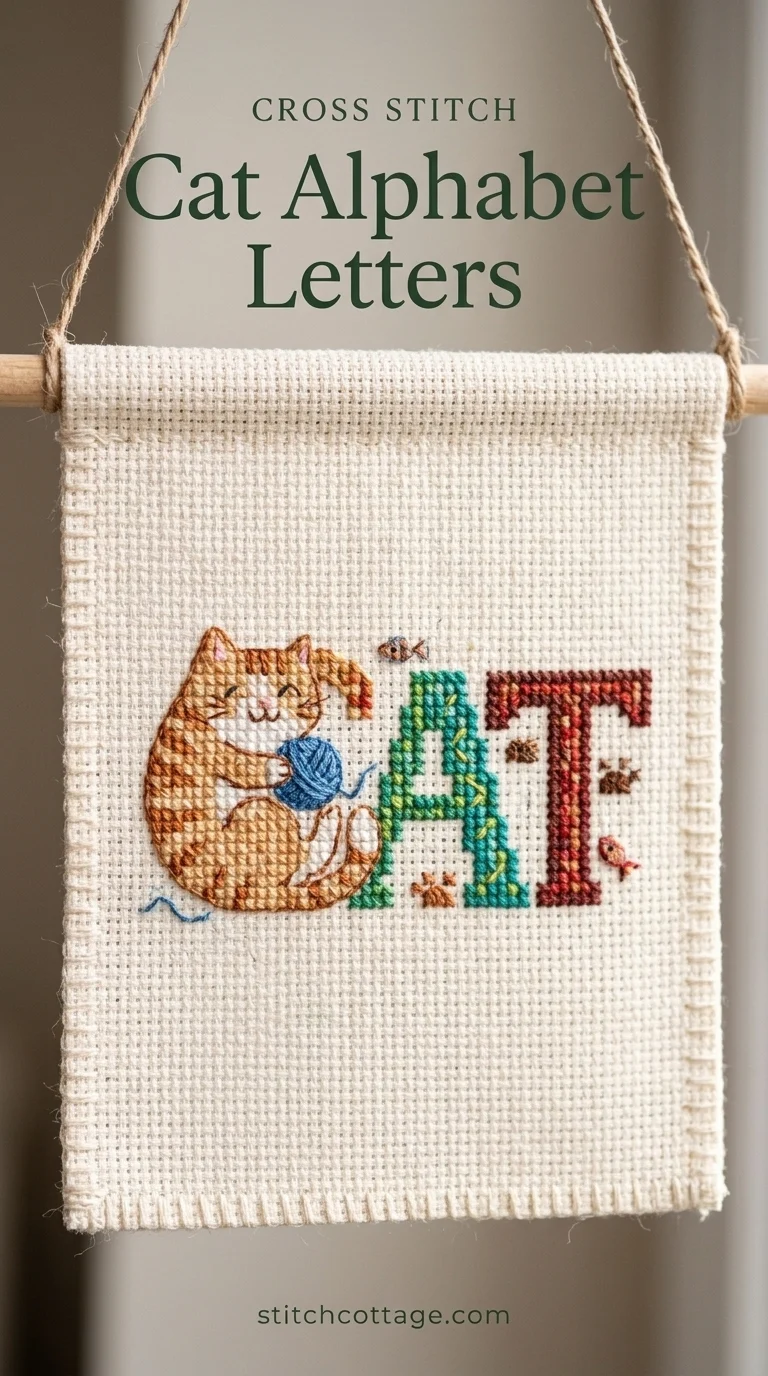
10. Cat alphabet letters
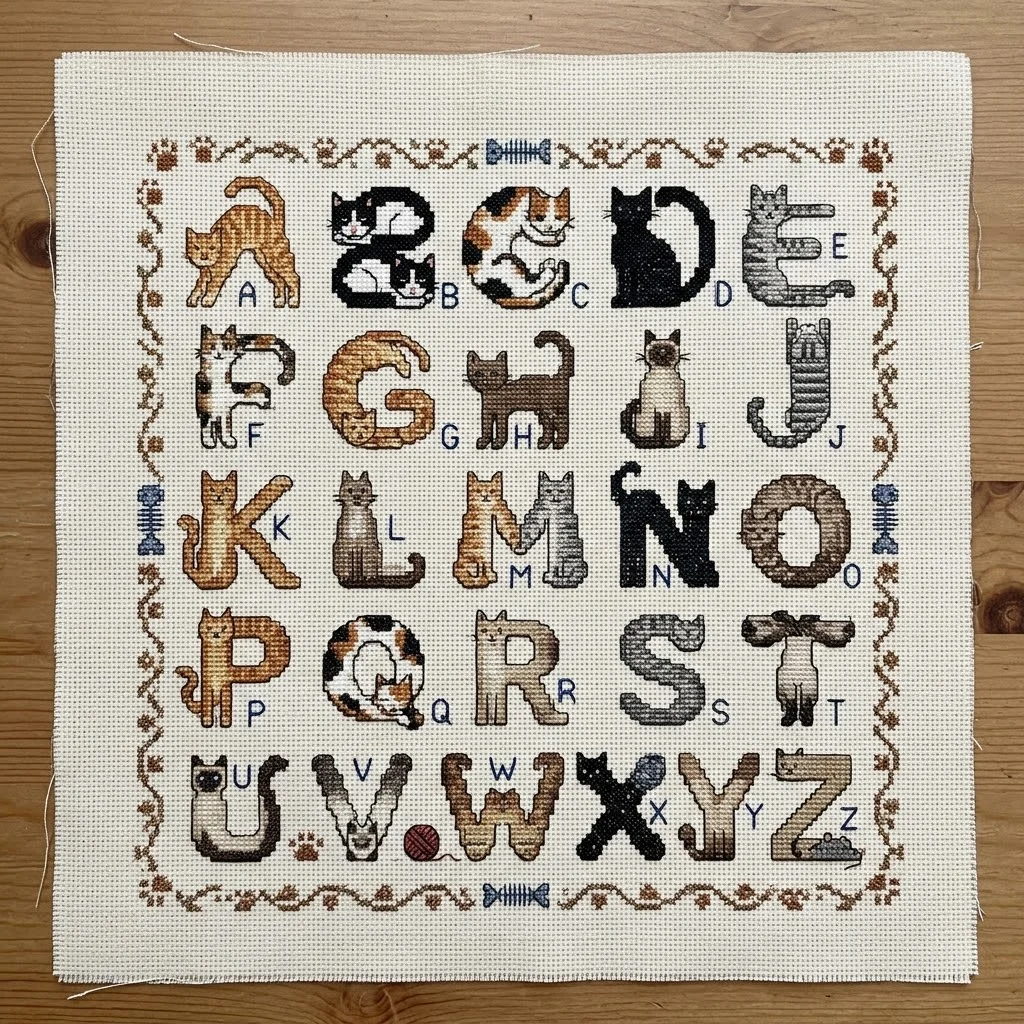
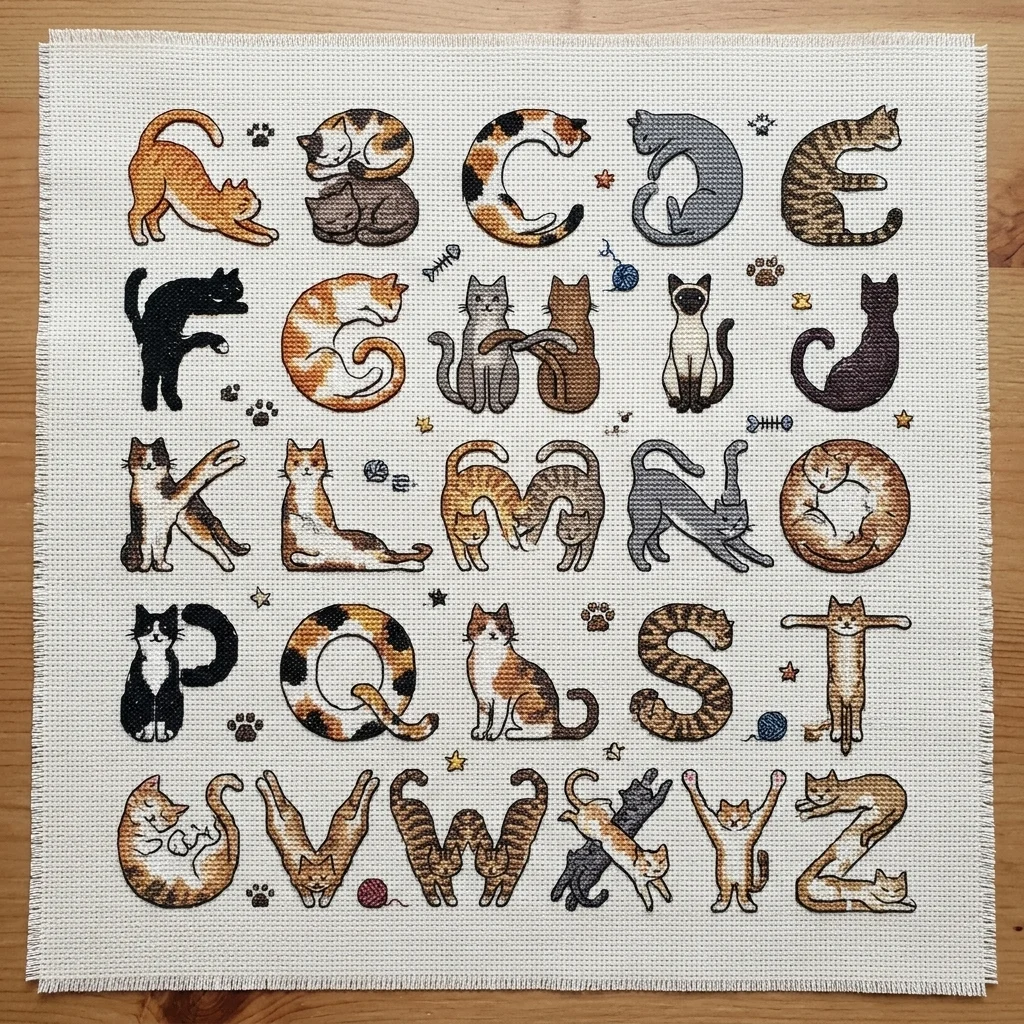
A cat alphabet can spell a child’s name above the nursery door, one letter a week.
Every letter is a cat shape. A sitting cat makes the A, a curled cat the C and a tail the J.
Two or three colours per letter are enough: DMC 310 with 741 or 762, and 3865 for highlights.
A letter around 22 by 28 stitches finishes near 1.6 by 2 inches on 14 ct. A full A-to-Z sampler is much larger.
The tricky spot is spacing. I mark a baseline in pencil so every cat sits on the same row. If you stitch names for other people, check the licence first.
- Best for: a name piece stitched as a series
- Avoid for: a gift with a deadline next week
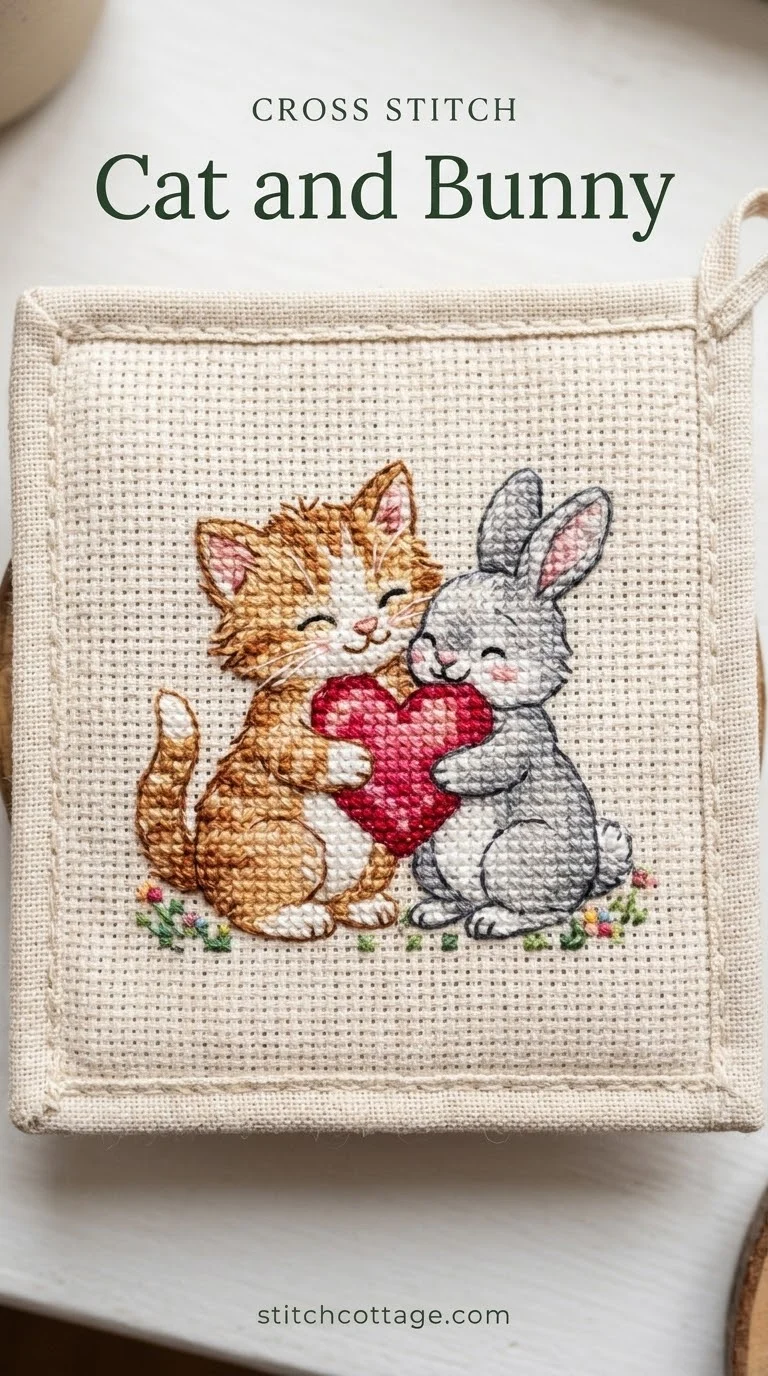
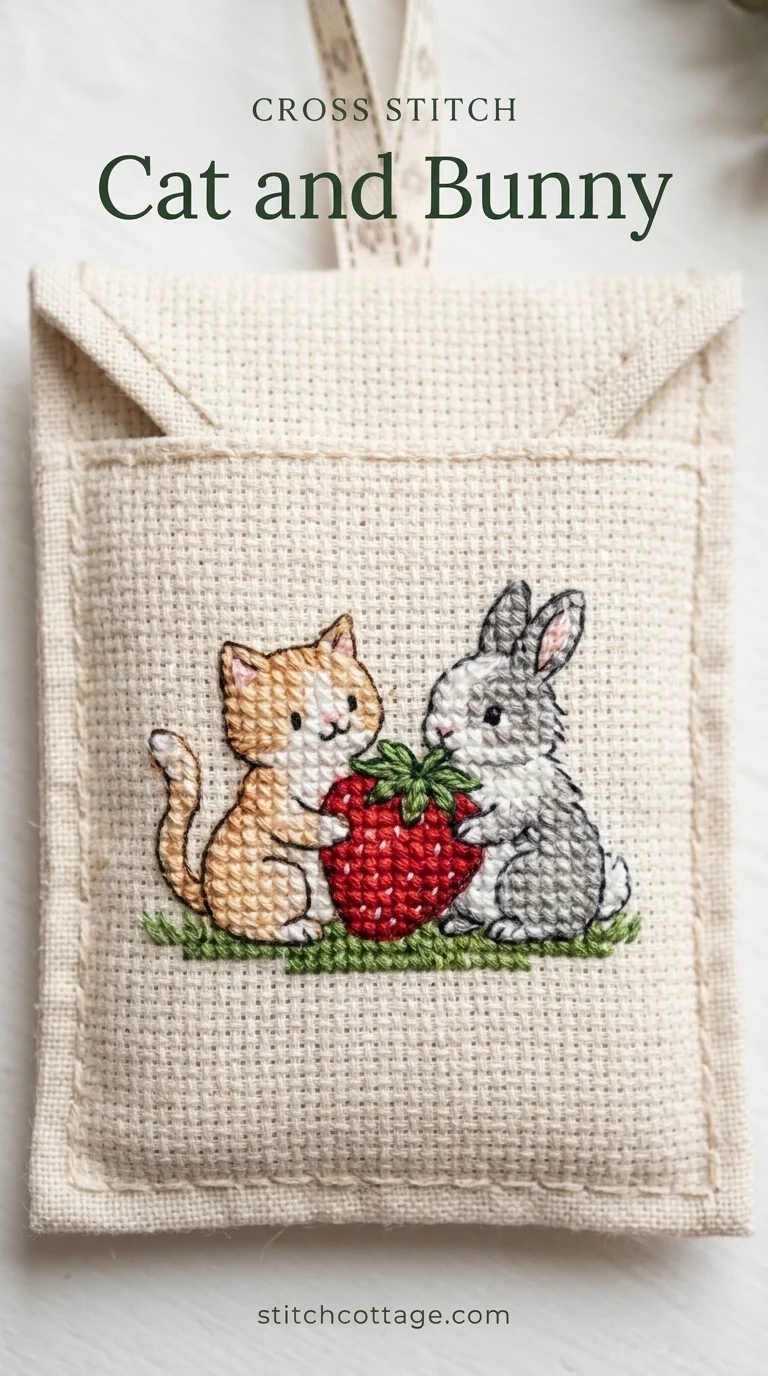
11. Cat and bunny
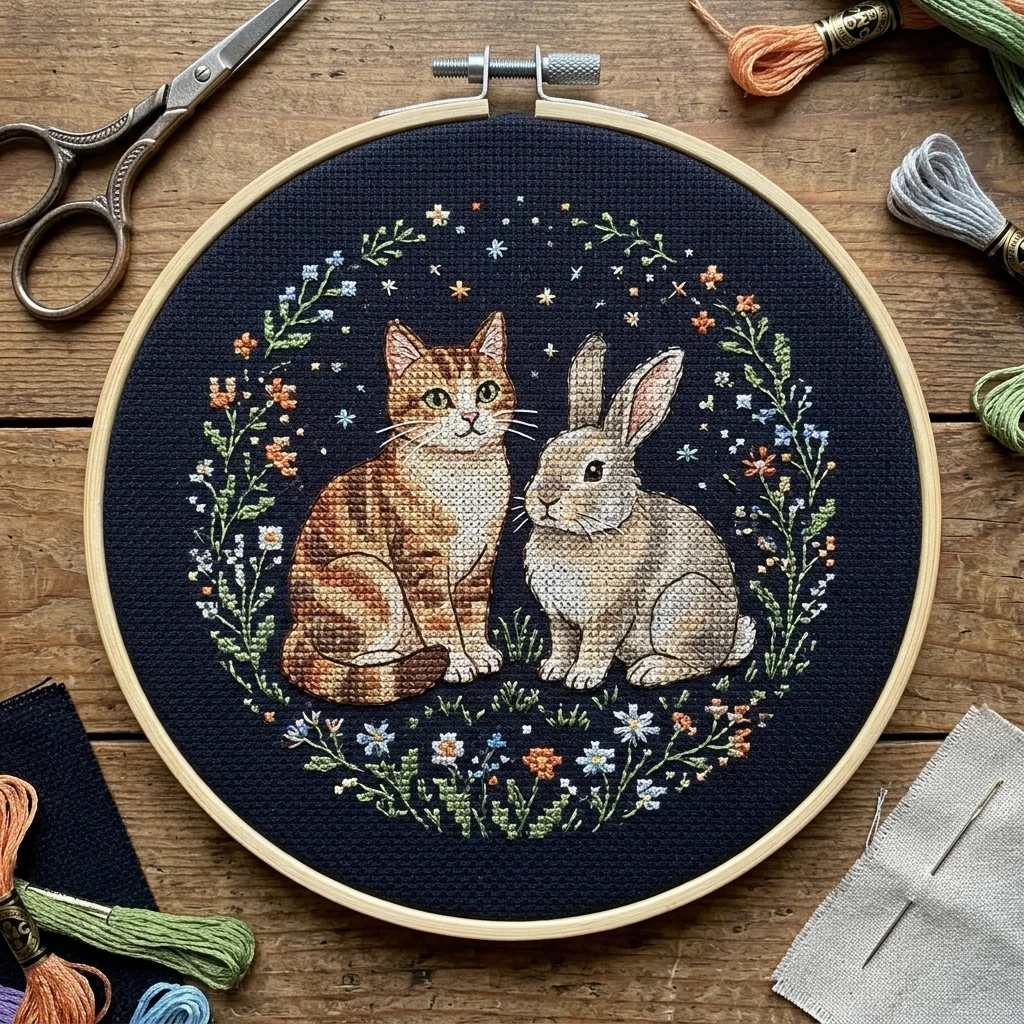
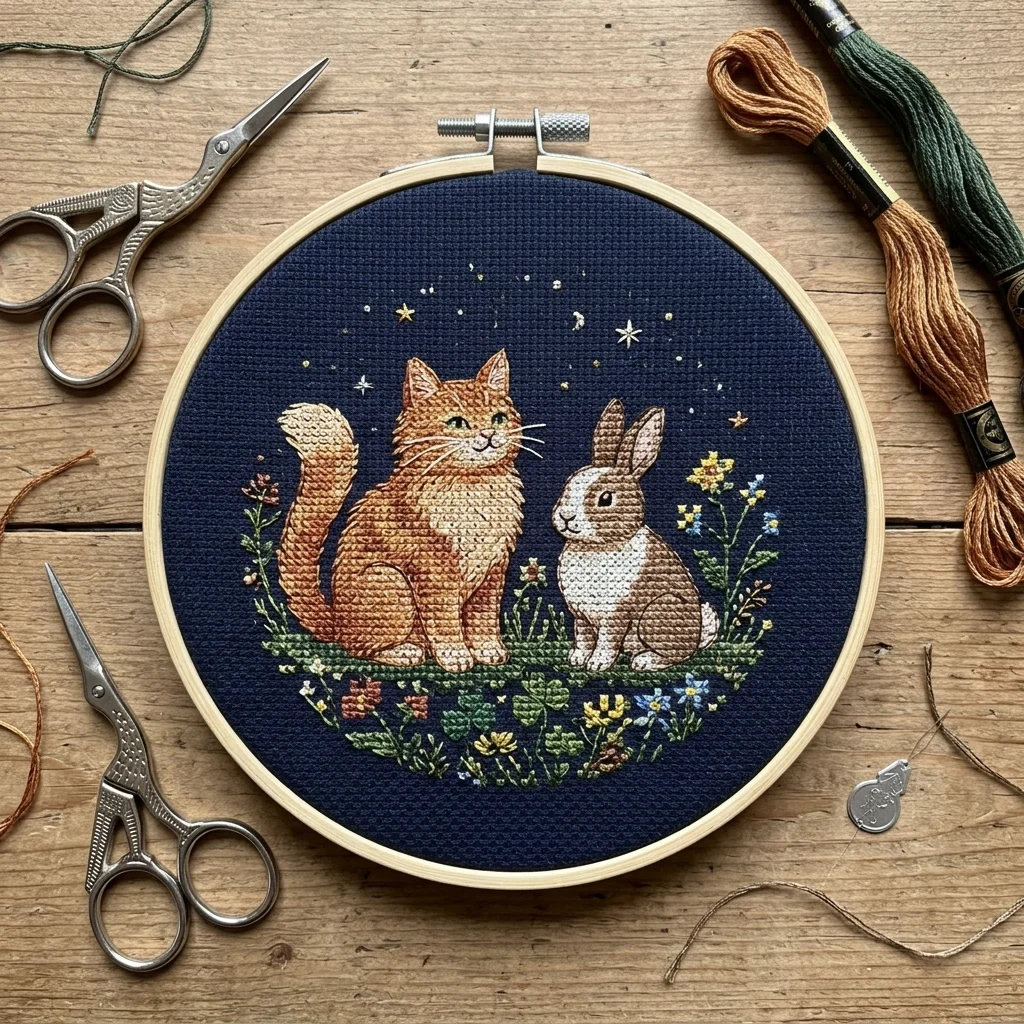
A cat beside a rabbit is a spring piece. Frame it for the hallway in March and leave it up through Easter.
The design shows an orange cat and a grey rabbit in the grass. Tiny wildflowers ring them, with small stars above.
You’ll want DMC 741 and 720 for the cat, 647 and 3072 for the rabbit, 704 for the grass and blanc for the stars.
The chart is 200 by 200 stitches, about 14.3 inches on each side on 14 ct. Plan on a month.
The tricky spot is keeping your place on navy aida. I baste the centre lines in white thread and stitch with a pale cloth on my lap.
- Best for: a large seasonal wall piece
- Avoid for: stitching in the evening under dim light
12. Four cats on a branch
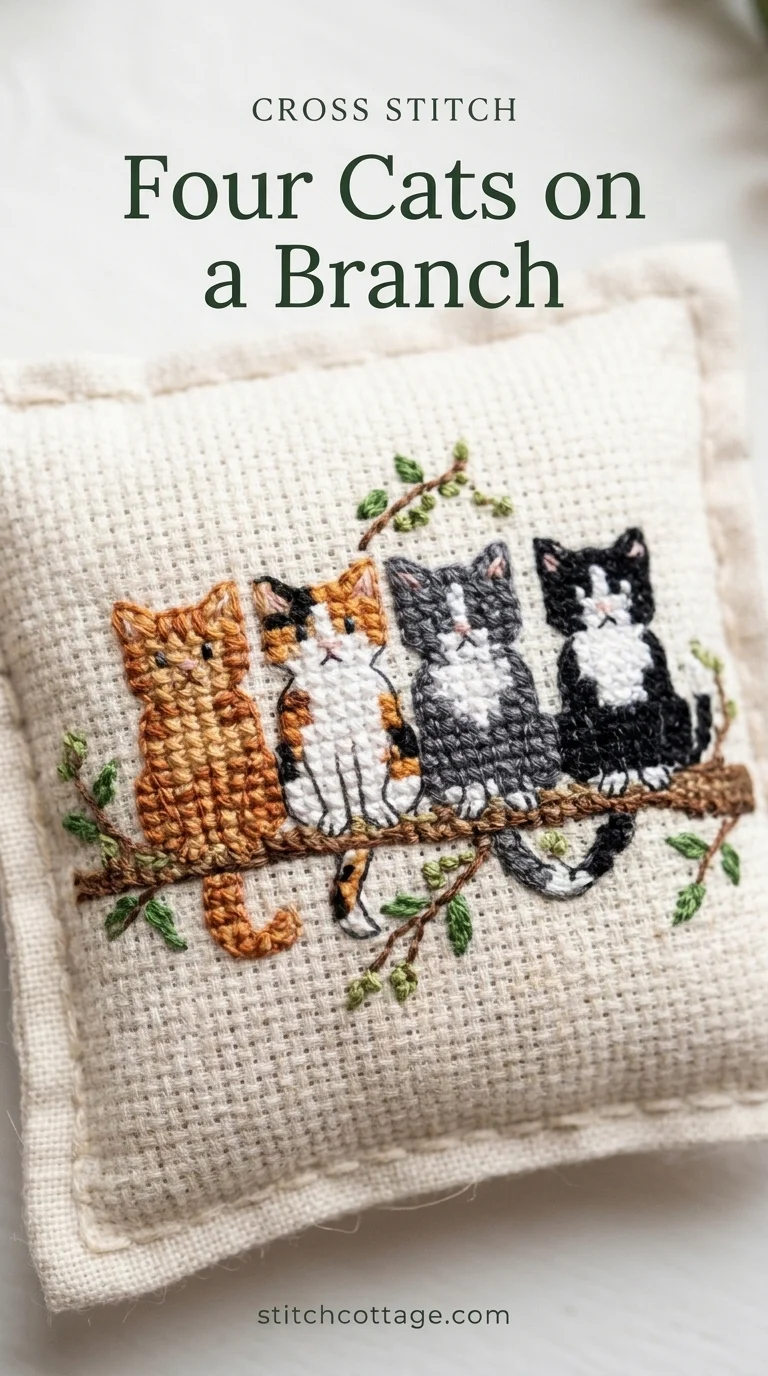
Four cats on a branch work as a border along a long shelf or the top of a guest-room wall.
The design is a row of cat silhouettes sitting on one long branch, each in a different pose.
Silhouettes need few colours: DMC 310 for the cats and 3371 for the branch, on light aida.
One listing is 300 by 170 stitches, about 21.4 by 12.1 inches on 14 ct. Buy fabric for that size before you print.
The tricky spot is drift along the branch. A one-stitch error at the first cat shifts the fourth. I count each cat’s feet from the branch line, never from the cat before it.
- Best for: a long, low border piece
- Avoid for: a standard square frame

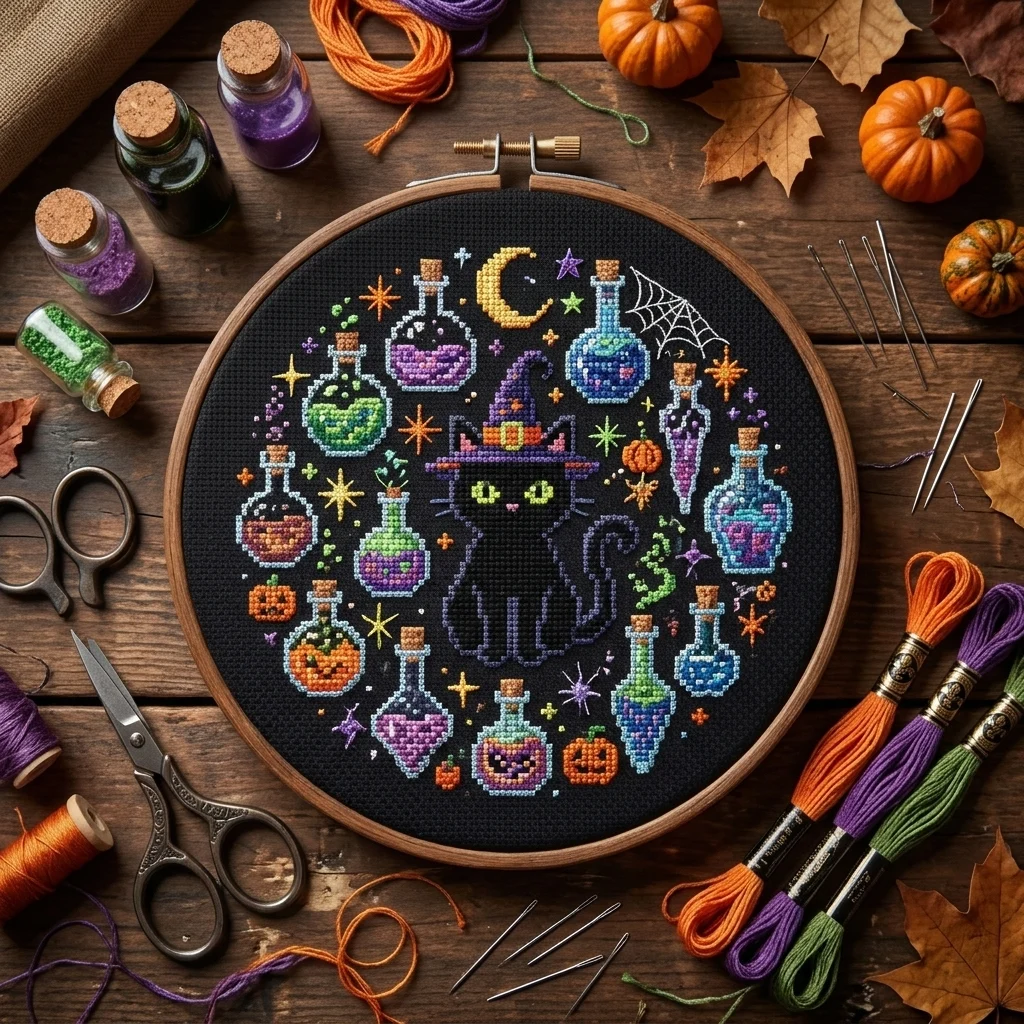
13. The Halloween black cat
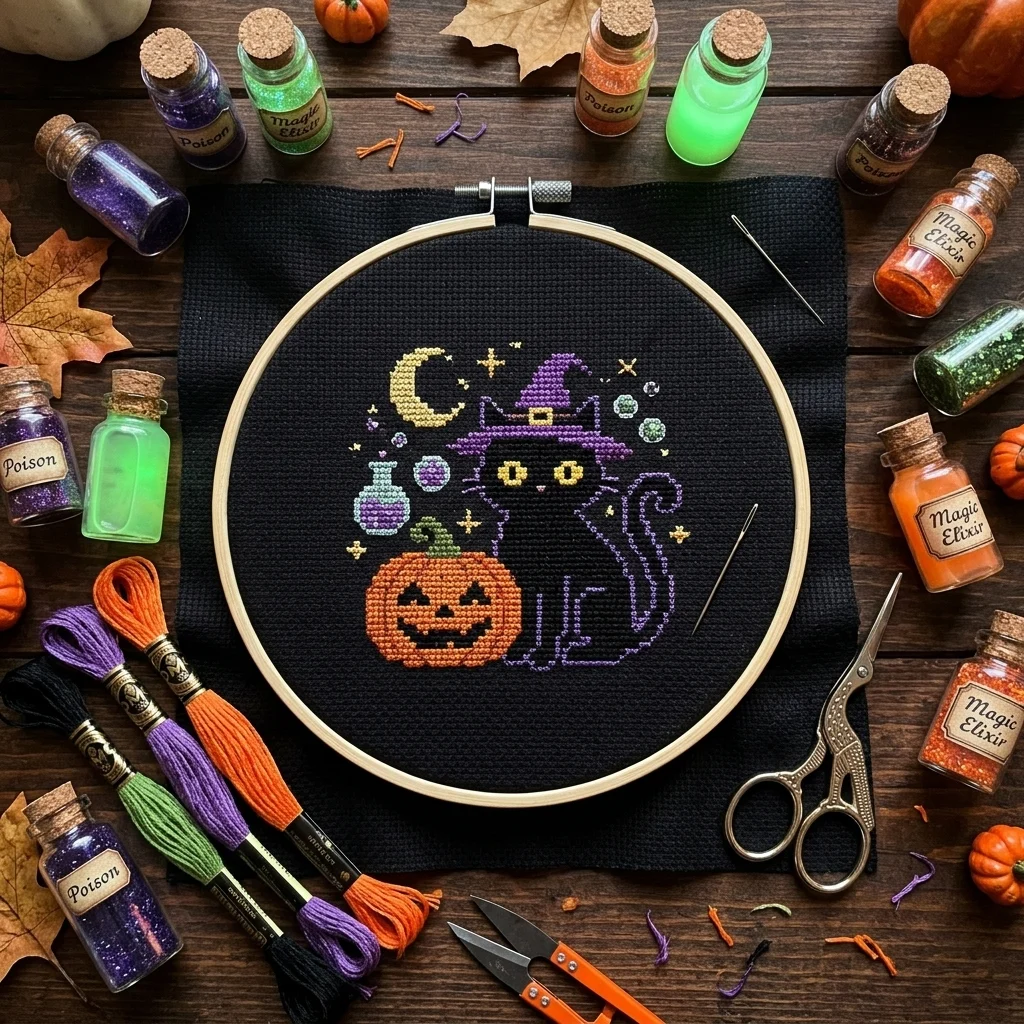
A Halloween black cat can hang on the front door or sit framed on the mantel all October. Start in August if you want it done in time.
The cat wears a witch hat and sits among potion bottles, a pumpkin and a spider web.
The cat itself is DMC 310 with 704 eyes. Most of the 25 colours go to the bottles, not the cat.
The chart is 151 by 155 stitches, about 10.8 by 11.1 inches on 14 ct aida.
The tricky spot is black thread on black aida. I stitch the cat in daylight only and keep a white towel on my lap so the holes show.
- Best for: a seasonal display you bring out every year
- Avoid for: a last-minute October project


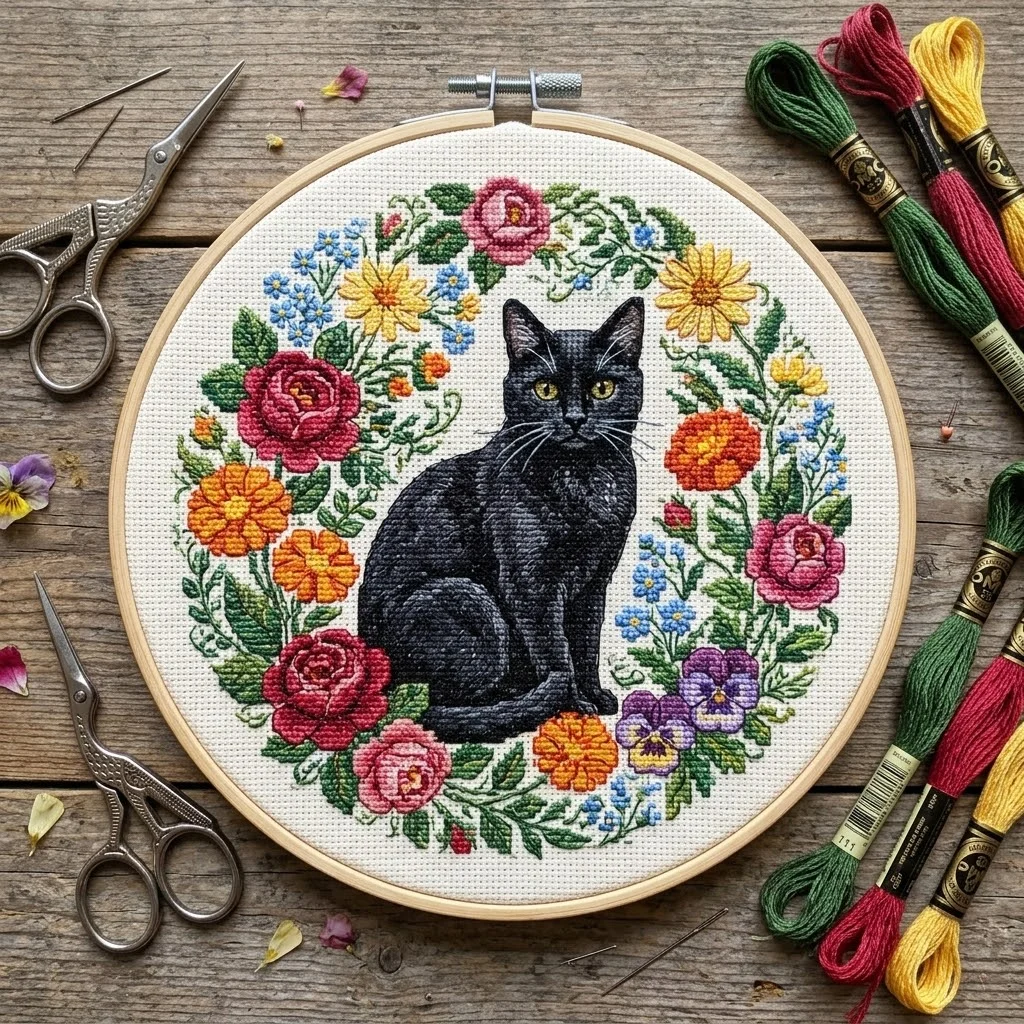
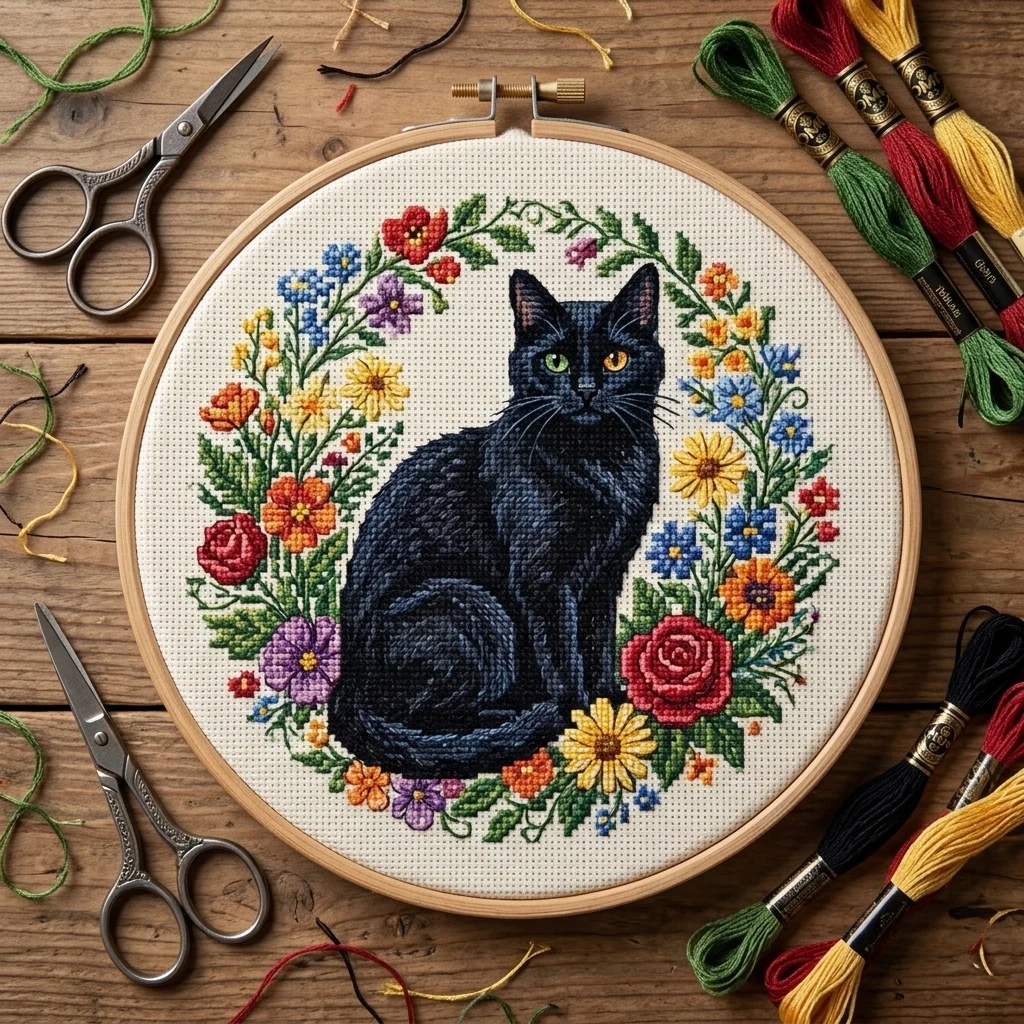
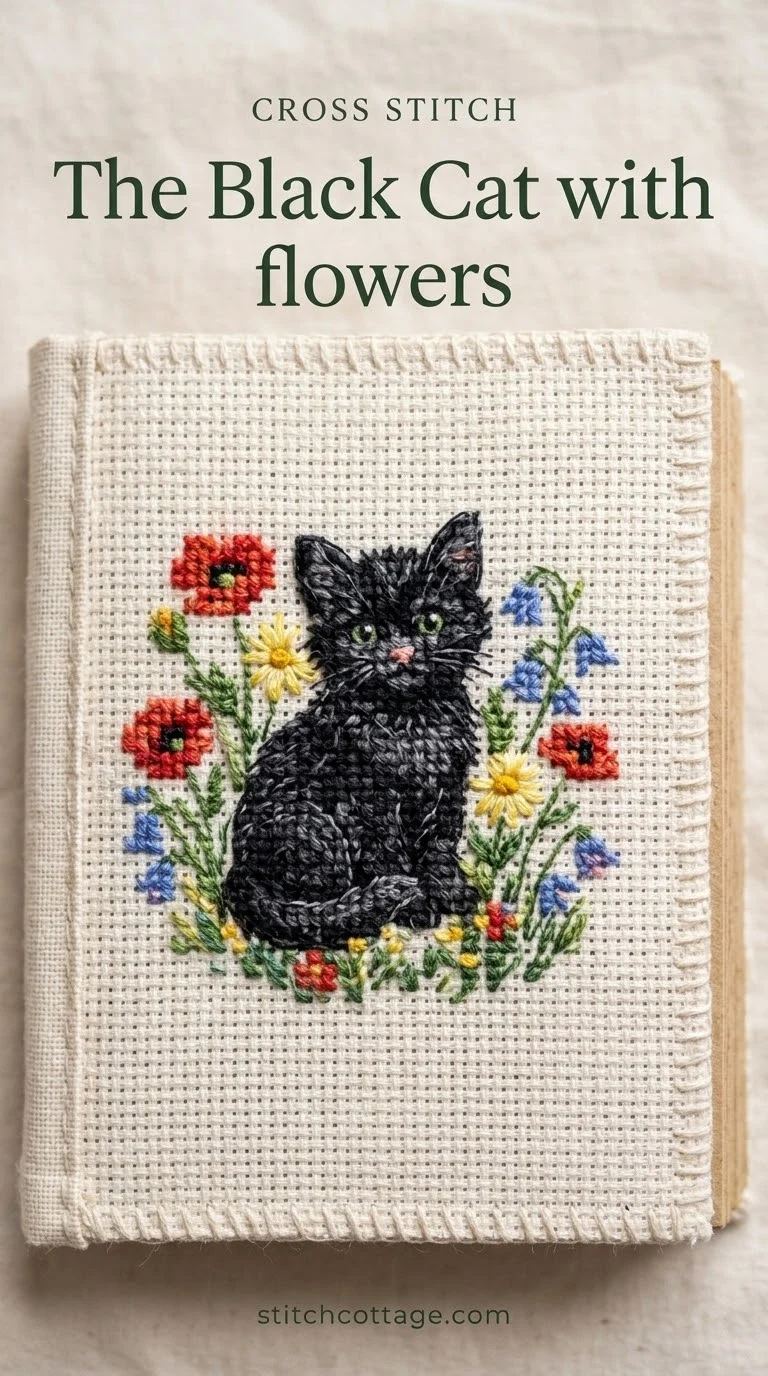
14. The black cat with flowers
A black cat in a flower wreath is an heirloom piece. Give it framed to a mother or grandmother.
The cat sits with green eyes among roses, marigolds, daisies and pansies.
The cat takes DMC 310 and 704. The flowers take the rest: 321 and 815 for the roses, 742 for the marigolds and 550 for the pansies.
The chart is 174 by 218 stitches in 29 colours, about 12.4 by 15.6 inches on 14 ct.
You’ll finish the cat in an afternoon and the garden in weeks. The tricky spot is the scattered single stitches in the petals. I park each thread rather than carry it across.
- Best for: an advanced stitcher’s long project
- Avoid for: anyone with fewer than five charts behind them

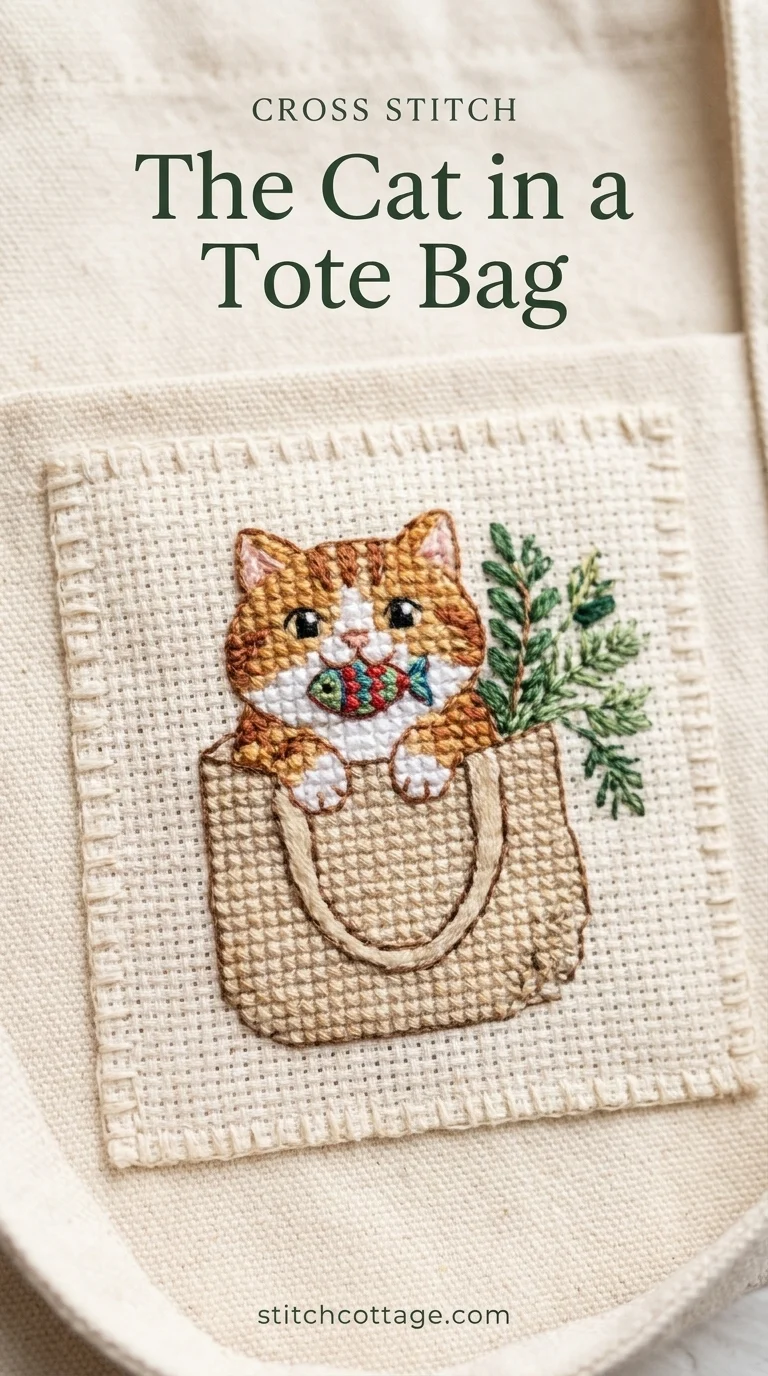
15. The cat in a tote bag
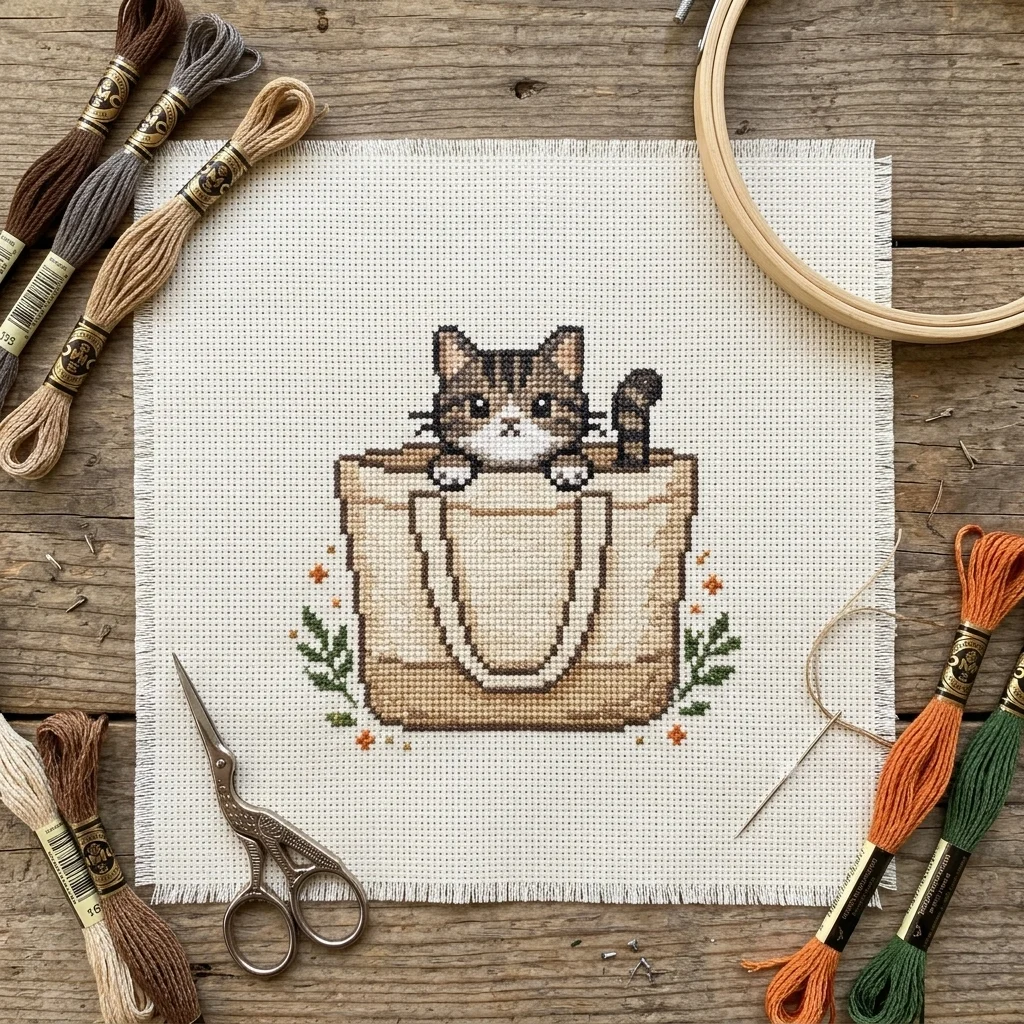
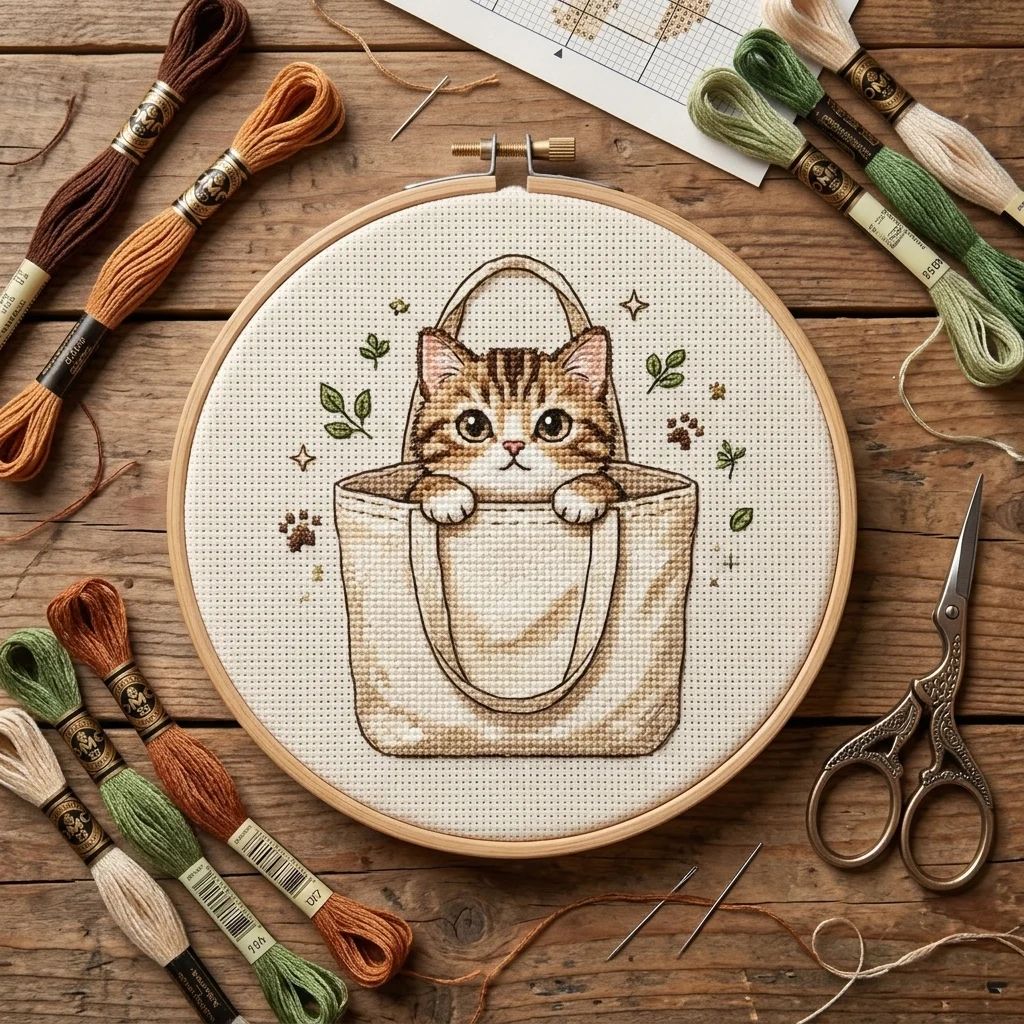
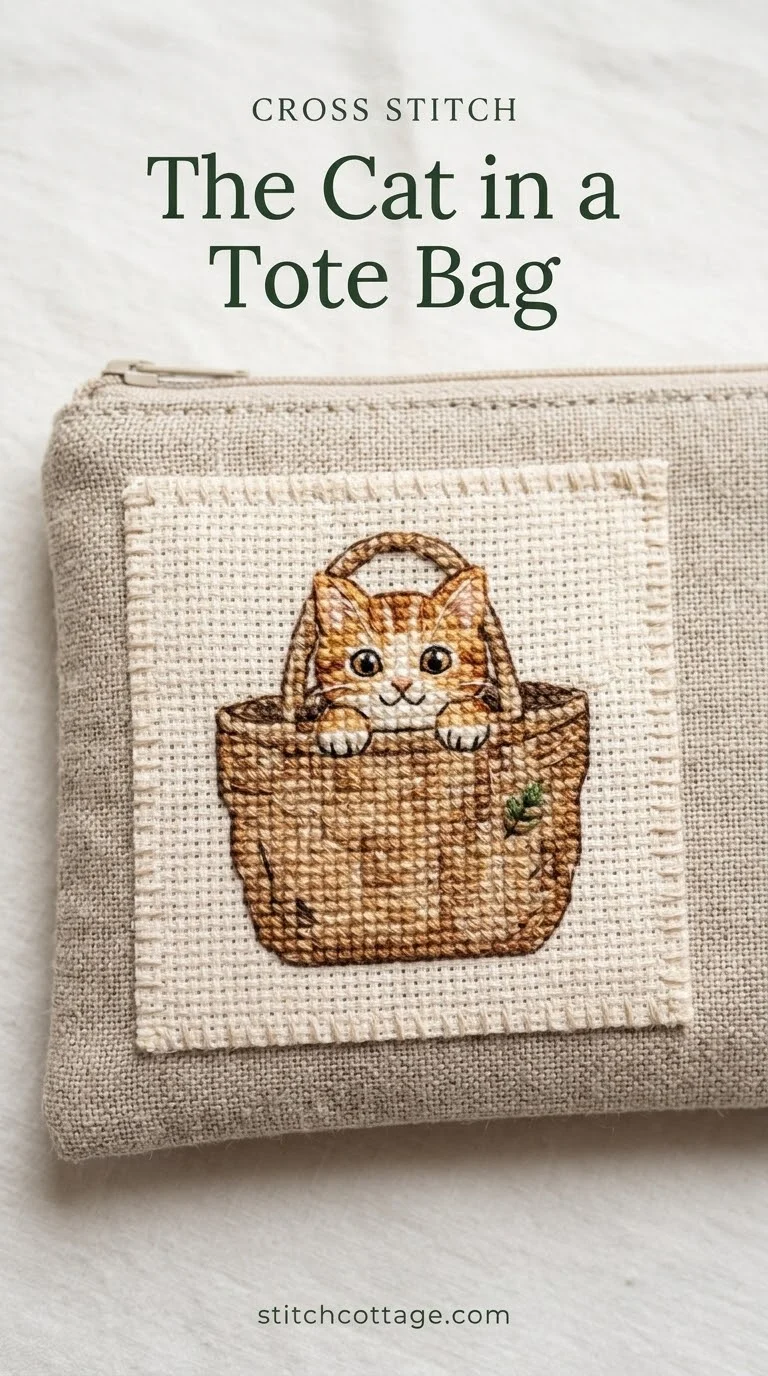
A cat in a tote bag works as a patch on a canvas library bag. It also makes a small hoop for a friend from your book club.
A tabby peeks out of the bag, so most of the cat is hidden. You stitch a face, two paws and a bag.
You’ll want DMC 434 and 3371 for the tabby, 3865 for the muzzle, 3354 for the nose and 3768 for the bag.
A chart around 55 by 65 stitches finishes about 3.9 by 4.6 inches on 14 ct.
The tricky spot is where the paws overlap the edge of the bag. I stitch the bag first and lay the paws over it.
- Best for: a second cat after your first three-colour one
- Avoid for: someone who wants the whole cat on show
Pick a kit and stitch one of these cat cross stitch ideas tonight. A complete kit saves the trip for floss and fabric.
Gift sets with two or three hoops work well for a stitching friend.
ITSTITCH Printed Cross Stitch Kits for Adults 11CT 17×22 in DIY Embroi

dery Starter Kits Easy Patterns Embroidery for Girls Crafts DMC Stamped Supplies Needlework Fairy Tales Cat Ra


If it goes wrong
Few free cat charts get checked before they reach you. Each fault takes a minute to catch.
- The size doesn’t match. Trust the grid and count it yourself. Divide by 14, then add two inches each way for the hoop.
- An ear or tail comes out blank. The PDF page was cropped. Every page should have its own grid border before you print.
- Two oranges look the same. Print one page in grey. If two symbols merge, don’t stitch from that chart.
- A floss number is no longer made. Check the key before you start, not halfway through the coat.
- An easy cat needs twenty-five shades. Count the colours in the key. Whatever the title says, that isn’t a beginner chart.
Many free charts don’t say whether you may sell what you stitch. Cat charts that print the licence in the listing answer that before you buy.
My sunshine chart guide and space cross stitch guide run the same checks on other motifs. For a house next, my cross stitch house guide gives sizes for 12 designs.
Key takeaways
- A cat is ears set wide apart, a low head and one curved tail line. The rest is colour.
- Divide your stitch count by 14 for inches on 14 ct aida.
- Free cat charts often list two different sizes; count the grid yourself.
- Choose by time: 36 x 33 for one evening, 200 x 200 for a month.
- To stitch rather than audit, start with charts that state count, colours and licence.
Common questions
What does ct mean in cross stitch?
Count: aida squares per inch. On 14 ct, a chart 42 stitches wide finishes at 3 inches. A higher count makes the same chart smaller.
What is a good first cat to stitch?
The three-colour black cat or the loaf cat. Each takes an evening or two. A beginner cat chart with a numbered colour list keeps your shopping short.
Can I sell what I stitch from a free cat chart?
Not unless the chart says so, and silence isn’t permission. A chart with a stated licence is the safe choice.
What is the difference between counted and stamped cross stitch?
Counted work follows a chart square by square. Stamped fabric has the design printed on it. Every size here is for counted work.
How much fabric should I cut?
Two inches more than the finished size on every side. Tape or fold the edges so they don’t fray.