The cross stitch supplies online that matter are the ones that stop a chart from failing you. Four do most of the work: 14 ct aida, DMC floss by number, a size 24 needle and a chart with a stated count.
Everything further down the list saves evenings. You can pick one in a minute, and I note where each one gets used.
Quick answer: for a first 5-inch hoop, order a fat quarter of 14 ct antique white aida, seven core DMC shades and size 24 needles.
Add a 6-inch wooden hoop. That set stitches a 70 by 70 design, about 5 inches square.
Most lost evenings come from the fabric and the chart, not from your counting, so buy those two with care first.
What are cross stitch supplies online?
Cross stitch supplies online are the fabric, floss, needles, frames and finishing materials you order for counted cross stitch instead of buying in a craft shop.
The difference is that you cannot touch them first. So you judge by numbers: fabric count, DMC shade number, needle size and hoop diameter. Those are the numbers I check on every listing.
Every kit in this row ships with fabric, sorted floss and a needle, so a cross stitch supplies online hoop can start the day it arrives. Picked by rating and number of reviews, not by price.
Printed kits suit a first project, counted kits suit a stitcher who reads charts.
ITSTITCH Printed Cross Stitch Kits 11CT 26X25 inch 100% Cotton Holiday

Gift DIY Embroidery Starter Kits Easy Patterns Embroidery for Girls Crafts DMC Stamped Supplies Needlework Art
ITSTITCH Printed Cross Stitch Kits for Adults 11CT 17×22 in DIY Embroi

dery Starter Kits Easy Patterns Embroidery for Girls Crafts DMC Stamped Supplies Needlework Fairy Tales Cat Ra
Armindou Embroidery Kit for Adults Beginners

Hand Embroidery Starter Kit with Solar System Patterns, Counted Stamped Cross Stitch Needlepoint Kit for Begin
1. 14 ct aida in antique white
A fat quarter of 14 ct aida in antique white sits under almost every first hoop you stitch, from a Christmas card to a birthday sampler.
It is a stiff cotton grid with 14 holes to the inch. Antique white reads warmer than bright white.
That matters for pale floss. DMC 3865 and ecru vanish on bright white, but they hold on antique white.
A fat quarter runs about 18 by 21 inches. That fits a 140 by 100 stitch chart with 3 inches of margin.
The tricky spot is the cut edge. You lose a row to fraying on day one, so I tape it before the hoop goes on.
- Best for: a first hoop or a Christmas card
- Avoid for: designs heavy in white floss
2. A core box of DMC floss
A box of core DMC floss carries every seasonal hoop you start, from a red Valentine heart to a green Christmas tree.
Each skein is six-strand cotton, 8 metres long, with its number on the paper band. Keep the band on.
Start with 310 black, blanc, 321 red, 699 green, 797 blue, 725 gold and 3865 winter white. Seven shades cover most small charts.
One skein stitches about 1,600 crosses with two strands on 14 ct. That is a 40 by 40 block, near 3 inches square.
Dye lots are the tricky spot. I buy two skeins of any background shade at once, because you can see the shift between orders.
- Best for: beginners stocking a first floss box
- Avoid for: kits that ship their own sorted floss
3. Size 24 blunt needles
Size 24 blunt needles go into every 14 ct project you own, from a bookmark stitched on a train to a framed sampler for a wedding.
The tip is rounded and the eye is long. You slide between aida threads instead of splitting them.
Gold-plated needles glide better through dark floss like 310 and 939, where a plain nickel one can drag a little.
Size 24 suits two strands on 14 ct. Move to size 26 for 18 ct and size 28 for 28 ct evenweave.
Losing them is the tricky spot. I keep six open in a needle book, because you will drop one into the sofa.
- Best for: every 14 ct project
- Avoid for: 28 ct linen, where size 28 fits
4. A 6-inch wooden hoop
A 6-inch wooden hoop holds most small gifts you stitch and can stay on as the frame. A baby name or a crescent moon above a crib is the classic use.
Two beech rings and a brass screw keep the aida drum-tight while you work.
I wrap the inner ring in white cotton tape. It grips the fabric and keeps pale shades like 3865 from greying at the rim.
A 6-inch hoop shows about 80 by 80 stitches on 14 ct. Give a 5.7-inch design a 7-inch hoop instead.
Hoop marks are the tricky spot. Take the hoop off at the end of each evening, or the ring leaves a crease.
- Best for: nursery and name hoops up to 5 inches
- Avoid for: designs wider than the ring
5. A Q-snap frame for big pieces
A Q-snap frame earns its place once you stitch past hoop size, like a Christmas stocking cuff or a 12-inch sampler for a hallway.
It is four plastic tubes with clips that snap over the fabric. You keep tension without turning a screw.
Tension shows most on dark floss. Stitches in 310 lie flat on taut aida and pucker on slack aida.
An 11 by 11 inch frame shows about 150 by 150 stitches on 14 ct. You slide it across bigger charts.
Clip lines are the tricky spot. I roll the clips off every night, the same as a hoop, and you should too.
- Best for: samplers over 10 inches
- Avoid for: tiny ornaments under 3 inches
6. Floss bobbins and a storage box
Floss bobbins live in the box you open before every project. They save hours of tangles on a big seasonal piece you stitch over winter.
Each skein is wound onto a card or plastic bobbin and labelled. The box keeps numbers in order.
Sort reds like 321, 815 and 498 side by side. Close shades mix up fast once the band is gone.
A standard box has 17 compartments and holds about 100 bobbins. Each bobbin is near 1.5 by 1.75 inches.
The number is the tricky spot. I write it in pencil before I wind, because you cannot tell 498 from 815 by lamplight.
- Best for: stitchers with more than 30 shades
- Avoid for: a single kit you finish in a week
7. Small stork scissors
Small stork scissors sit in every project bag and on many gift lists for a stitcher. You use them a hundred times on one ornament.
The blades are about 1 inch long with sharp points. A fine point snips one strand, not three.
Short tails matter most with dark floss. A long tail of 310 shows through pale aida from the front.
The usual pair is 3.5 inches long. It fits a needle book and a small hoop bag.
The aida is the tricky spot. I lift the thread with the needle before I cut, so the blades never touch the fabric you spent weeks on.
- Best for: a gift for a new stitcher
- Avoid for: cutting paper charts
8. A magnetic needle minder
A needle minder rides on every hoop you carry, and it makes a small birthday gift for a stitching friend.
It is two magnets: a decorated one on top, a plain one behind the aida. Your needle parks on top between colours, so you never lose it.
Pick one that contrasts with your floss. A red minder gets lost on a hoop full of DMC 321.
Most are 1 to 1.5 inches across. That holds two needles and a threader.
Placement is the tricky spot. Keep it outside the stitched area, because a strong magnet flattens crosses. I park mine 1 inch inside the hoop rim.
- Best for: stitching on the sofa or on trains
- Avoid for: beaded pieces, which the magnet pulls
9. A water-soluble marking pen
A water-soluble pen helps when you place a name or a date on a wedding sampler or a baby gift, where centring is the whole point.
It draws a blue line that vanishes in cold water. You mark the centre and the outline before the first cross.
Blue lines show well on white and cream aida. On black aida, use a white chalk pencil.
For a 100 by 60 stitch name, I mark a box about 7.1 by 4.3 inches on 14 ct.
Heat is the tricky spot. Never iron a marked piece before you rinse it, because heat can set the blue for good.
- Best for: names and dates on samplers
- Avoid for: dark aida
10. Pre-gridded aida or gridding line
Pre-gridded aida pays off on large framed pieces, like a full-coverage house portrait for a new home or a family anniversary.
A printed or stitched line marks every 10 stitches, the same bold lines your chart prints.
Choose a pale grey or nylon gridding line. It pulls out cleanly after the stitching is done, unlike a strand of DMC floss.
A 200 by 150 stitch chart, about 14 by 11 inches, holds 300 squares of 10 by 10. You count inside one square at a time.
Pull the grid as you finish each block. I once lost an evening unpicking a nylon line trapped under a dozen crosses.
- Best for: charts over 150 stitches wide
- Avoid for: small cards and ornaments
11. A printed chart with a stated count
A printed chart starts every gift you stitch, from a small gold star on a tree to a framed hoop for the hall.
A good one prints a bold grid every 10 stitches and a key with DMC numbers. It states the stitch count on page one.
Check that close shades like 3865 and blanc get symbols that differ by shape, not only by colour.
A 100 by 100 chart, about 7 inches square on 14 ct, needs four pages with one overlap row on each.
Page edges are the tricky spot. I tape the pages together and check each join before I cut any fabric. You should see no blank column.
- Best for: any gift with a deadline
- Avoid for: charts with no stated stitch count
12. A magnetic chart board
A magnetic chart board stands beside your chair for long projects, like a winter sampler you stitch from November to March.
It is a steel board with a fold-out stand and long magnetic strips. The strip sits under the row you are stitching.
Busy rows of 310 and 3799 blur together on a flat page. A strip cuts the chart down to one line.
An A4 or letter board holds one full chart page, about 70 by 100 stitches at normal print size.
The tricky spot is moving the strip. I shift it only after I finish a row, never mid-row, so you always know where you stopped.
- Best for: big charts with dense colour changes
- Avoid for: travel stitching
13. A pale highlighter for the chart
A highlighter marks off the chart for any piece you put down and pick up, like a gift you stitch in lunch breaks.
You colour each block of symbols once it is stitched. The chart then shows your progress at a glance, even weeks later.
Pick a pale yellow or green. A dark marker hides symbols for 310 and 3371, and you cannot check them later.
A 10 by 10 block takes about 15 minutes to stitch, so the marks also tell you your pace.
Mixed-up blocks are the tricky spot. I highlight a block only after I count it against the chart a second time.
- Best for: projects stitched in short sessions
- Avoid for: charts you want to reuse clean
Halfway through the list is a good moment to pick a kit for the next evening. These sets keep the colours already matched to the chart.
Check the fabric count on the listing before you buy, since 11, 14 and 16 count stitch up at different sizes.
Dimensions Stamped Cross Stitch Baby Quilt 34" X 43"

Dimensions Stamped Cross Stitch Baby Quilt 34" X 43"

Bradove Alphabet Embroidery Kit for Beginners with Patterns

Bradove Alphabet Embroidery Kit for Beginners with Patterns
14. Thread conditioner
Thread conditioner helps on any piece with long backstitch, like a lettered birthday quote framed for a desk or a shelf.
It is a small tub of wax or a silicone pad. You draw the cut floss across it once before threading.
It matters most on metallics and dark shades. DMC 310 and 939 fuzz fast, and fuzz shows on pale aida.
One tub lasts a year of evenings. A single pass covers an 18-inch length, the longest length I ever cut.
Too much wax is the tricky spot. You want a light pass; a heavy one leaves a dull film the wash will not lift.
- Best for: backstitch lettering and metallics
- Avoid for: short cotton lengths on simple blocks
15. A wire needle threader
A needle threader earns its place in a card you stitch at night, under a lamp, when tired eyes miss the eye of a size 26.
It is a fine wire loop on a flat handle. You push the loop through the eye and pull the floss back.
It saves the most time on metallic floss like E3821, which frays as soon as you lick or squeeze it.
Most fit needles from size 22 to 28. Two strands of 14 ct floss pass easily.
The tricky spot is the wire. It snaps if you force three strands through, so I keep two spares in the needle book.
- Best for: night stitching and metallic floss
- Avoid for: three-strand work
16. Metallic floss for ornaments
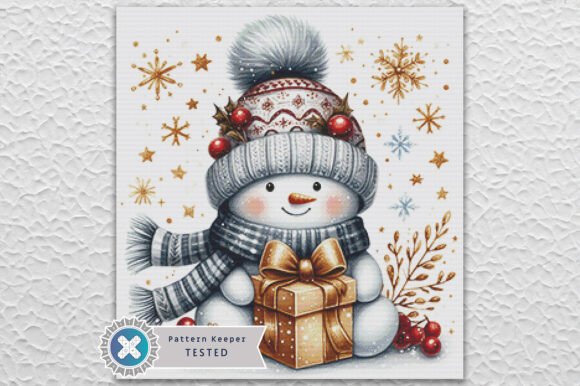
Metallic floss lights up a Christmas ornament or a star on top of a holiday card. You only need a few rows of it.
DMC Light Effects is polyester film twisted with fibre. It catches the light where plain cotton stays matt.
E3821 is the gold, E168 the silver and E321 the red. Pair E3821 with 725 cotton for a shaded star.
A 30 by 30 stitch star, about 2.1 inches on 14 ct, uses about half a skein of metallic.
Fraying is the tricky spot. I cut lengths of 12 inches, not 18, and you can blend one metallic strand with one cotton strand for a softer shine.
- Best for: ornament highlights and star tips
- Avoid for: large filled areas
17. Variegated floss for shading
Variegated floss turns an autumn leaf wreath or a sunshine hoop for the kitchen into a piece you stitch with one needle.
The colour shifts along the strand, so each cross lands a slightly different shade. You get shading without changing colour.
DMC Color Variations carry four-digit numbers in the 4000s, so you never confuse them with plain floss.
A 40 by 40 leaf, about 2.9 inches, takes one skein. The shift repeats every few inches of strand.
Stripes are the tricky spot. I finish each cross before starting the next, because rows of half stitches turn the shading into bands.
- Best for: leaves, skies and sunsets
- Avoid for: charts that need exact shade blocks
18. Size 11 seed beads
Seed beads add frost to a snowflake ornament or dew to a spring flower hoop. You see them from across the room.
A bead replaces a cross with one half stitch through its hole, sewn with one strand of matching floss.
Size 11 beads fit 14 ct squares. Sew white beads with blanc and gold ones with 725.
A 40 by 40 snowflake, near 3 inches across, takes about 60 beads on its tips. Buy double, because beads vary in size.
The tricky spot is the bead tray. You lose half of them to the floor, so I pour a few at a time onto felt.
- Best for: winter ornaments and bridal pieces
- Avoid for: pillows and anything washed often
19. 28 ct evenweave for heirlooms
28 ct evenweave is the fabric for an heirloom sampler or a christening record you plan to frame for decades.
It is a smooth, even cloth. You stitch over two threads, so it works like 14 ct but looks finer. It drapes softly in a frame.
Antique white suits muted sampler shades like 221, 3768 and 3021.
A 140 by 100 stitch sampler finishes at 10 by 7.1 inches, the same as on 14 ct aida.
The tricky spot is the first stitch. Start next to a vertical thread, and I mark that thread with a pin, or every cross shifts half a unit.
- Best for: heirloom samplers for framing
- Avoid for: a first project
20. 18 ct aida for small pieces
18 ct aida shrinks a design for a tree ornament or a 4-inch card. You get detail in a small space.
It has 18 holes per inch, so each cross is smaller than on 14 ct. That is 324 crosses per square inch, against 196 on 14 ct.
Use two strands for blocks and one strand of 310 for backstitch. Three strands crowd the holes.
A 56 by 50 stitch design finishes at 3.1 by 2.8 inches on 18 ct, against 4 by 3.6 on 14 ct.
Eyestrain is the tricky spot. I stitch it in daylight only, and you will want a size 26 needle.
- Best for: ornaments and 4-inch cards
- Avoid for: stitchers who find 14 ct hard to see
21. Perforated paper
Perforated paper makes bookmarks, gift tags for parcels and flat ornaments you hang the same day you finish them.
It is stiff card punched with 14 holes to the inch. You stitch it like aida, then cut the shape out.
Bold shades work best: 321 red, 699 green and 310 outlines. Pale floss vanishes against the cream card.
A sheet of 9 by 12 inches fits six bookmarks of 25 by 85 stitches, each about 1.8 by 6 inches.
The tricky spot is a torn hole. Paper cannot be unpicked twice, so I count each row twice before I stitch it. Pull gently.
- Best for: bookmarks and gift tags
- Avoid for: pieces you plan to wash
22. A wash kit for finished pieces
A small wash kit finishes every piece before it becomes a gift or goes into a frame.
You need a mild wool soap, a white towel and a press cloth. Hand oils and hoop marks come out in one soak.
Red is the risk. DMC 321 and 498 are colourfast, but rinse in cold water and never leave a piece soaking.
Five minutes in a basin is enough for a 6-inch hoop. Then roll it in the towel and press it face down, still damp.
The tricky spot is ironing. I iron face down on a folded towel, so you keep the crosses raised.
- Best for: every finished gift
- Avoid for: hot water on red floss
23. A daylight lamp with a magnifier
A daylight lamp lets you stitch a dark-fabric Halloween piece or a navy star sky on autumn evenings.
It gives a white light close to midday sun, often with a clip-on magnifier. You see the holes of the aida, not a grey blur.
Under yellow bulbs, 310 and 939 look the same, and so do 3865 and blanc. Daylight separates them.
A lamp with a 5-inch lens at 2x shows every hole on 18 ct and on 28 ct evenweave.
The tricky spot is glare. I angle the lamp from the side I do not stitch from, so you avoid your own hand’s shadow.
- Best for: dark fabric and evening stitching
- Avoid for: small flats with no desk space
24. A clear project bag
A project bag keeps one kit together when you stitch in a car, in a waiting room or at a friend’s house.
It is a zipped clear or fabric pouch big enough for a hoop, a chart and a floss card.
Clear vinyl lets you see the colour card and spot a missing shade like 3865 before you leave.
A 12 by 12 inch bag holds a 10-inch hoop or a folded fat quarter of 14 ct.
The tricky spot is the hoop. Remove it before packing, because a hoop left on in a bag leaves a permanent crease. I learned that on a gift.
- Best for: travel and waiting-room stitching
- Avoid for: storing a hoop on fabric
25. Felt and ribbon for ornament finishing
Felt and ribbon turn a stitched motif into a tree ornament you can hang on Christmas Eve or tie onto a present.
You back the piece with craft felt, glue or whipstitch the edge, and add a ribbon loop.
Match the felt to the design: red felt with 321 borders, green with 699 trees.
A 30 by 30 stitch motif is 2.1 inches on 14 ct. Cut the aida with two rows spare and the felt 0.25 inches larger.
The tricky spot is the cut edge. I seal it with a thin line of fabric glue first, so you keep the outer stitches safe.
- Best for: Christmas ornaments and gift tags
- Avoid for: pieces over 4 inches
26. Aperture card blanks
Aperture cards turn a small stitched piece into a birthday or Christmas card you post the same week.
Each is a tri-fold blank with a window cut in the middle panel. The stitching sits behind the window, and the fold covers the back.
Choose the card colour from the chart: cream for pastel 3865 designs, red for a 310 and blanc snowman.
A 3.5-inch round window frames about 45 by 45 stitches on 14 ct. Leave half an inch of fabric spare all round.
The tricky spot is centring. I tape the fabric behind the window face up first, so you see it straight before the glue goes on.
- Best for: birthday and Christmas cards
- Avoid for: designs over 60 stitches wide
27. A frame and acid-free mount board
A frame and mount board finish the big piece you give for a wedding, a new home or a retirement.
You lace the stitching over acid-free board, then fit it into a deep frame without glass pressing the crosses.
A cream mount suits warm shades like 321 and 725. A grey one suits navy and 310.
A 140 by 100 stitch piece is 10 by 7.1 inches on 14 ct. Order board and frame at about 12 by 9 inches.
The tricky spot is lacing tension. I lace the long sides first, then the short, and you check the grid stays straight. Pull firm, not tight.
- Best for: wedding and new-home gifts
- Avoid for: small hoops that frame themselves
Pick a kit and stitch one of these cross stitch supplies online ideas tonight. A complete kit saves the trip for floss and fabric.
Gift sets with two or three hoops work well for a stitching friend.

Bonroy 4 Sets Embroidery Set for Beginners Art Crafts Easy Sewing Incl

udes Embroidery Clothes with Pattern, Hoop, Instruction Manual, Color Stitch Set (Assorted 1)

How do you choose cross stitch supplies online?
You cannot touch fabric or floss before it ships. So check three numbers on every listing.
- Size in stitches and on fabric → divide the stitch count by 14 for inches. A free chart often prints no count, so you guess the cut.
- Number of DMC colours → count the key before you order floss. Free files can hide 27 shades behind a two-colour preview.
- A chart you can read → bold lines every 10 stitches and symbols that differ by shape. Free PDFs often crop the last column.
If it goes wrong
- The design runs off the fabric. Add 3 inches on each side to the stitch size before you cut.
- A shade looks wrong mid-project. It is a new dye lot. Buy background floss in one order.
- A miscount shows forty rows later. Grid the fabric and count inside 10 by 10 blocks.
- A crease won’t leave the aida. The hoop stayed on overnight. Soak, roll in a towel and press face down.
- The chart has a blank column. A page was cropped. Check every join before the first stitch.
Key takeaways
- Buy 14 ct aida, DMC floss by number and size 24 needles first.
- Divide the stitch count by 14 and add 3 inches each side before you cut.
- Order background floss in one go to avoid a dye-lot shift.
- Check chart page joins and symbol shapes before the first cross.
- Take hoops and clips off every night.
When the free version isn’t enough
A free chart and loose floss leave you to check the count, the colours and the page edges yourself. That is where most lost evenings start.
A full kit fixes it: aida cut to size, floss sorted by DMC number and a chart checked against a stitched model. You open it and start.
For gift ideas, see Valentine patterns and gift kits or house patterns worth stitching.
Common questions
What cross stitch supplies do you need to start?
You need four things to start: 14 ct aida, DMC floss in the chart’s shades, size 24 needles and a hoop one size larger than the design. Scissors come fifth.
Everything else on this list makes stitching faster, not possible.
Is it safe to buy cross stitch supplies online?
Yes, if the listing states numbers. Look for the fabric count, the DMC shade numbers and the hoop diameter in inches.
A photo alone cannot tell you if 14 ct or 16 ct arrived, so you check the count when the parcel opens.
How much aida do you need for a cross stitch pattern?
Divide the stitch width and height by 14 for inches on 14 ct, then add 3 inches on every side.
A 100 by 70 stitch chart needs a piece about 13 by 11 inches. That margin leaves room for a hoop and for framing.
Which DMC colours should you buy first?
These seven carry most seasonal charts: 310 black, blanc, 321 red, 699 green, 797 blue, 725 gold and 3865 winter white.
Add a skin tone like 948 and a brown like 433 once you stitch people or houses. Then buy by chart key.
Can you use the same needle for 14 ct and 18 ct aida?
You can, but it is not ideal. A size 24 suits 14 ct; on 18 ct it stretches the holes, so switch to size 26.
On 28 ct evenweave, a size 28 keeps the threads from shifting. I keep all three in one needle book.