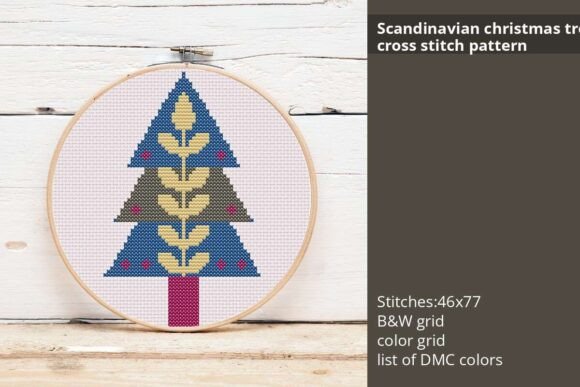
A Christmas tree cross stitch is decided by its outline, not its ornaments: get the triangle and trunk right and three greens do the rest. You want a chart that names its size, its DMC list and its count before you thread a needle. Below are 19 trees, so you can pick one in a minute.
You have probably opened a free tree chart that looked fine and stitched wrong. The trunk sat off-centre, or two greens shared one symbol. That is a lost evening.
Quick answer: for a first tree, pick a chart under 50 stitches wide in three greens, a red and a gold. On 14 ct aida that finishes near 3.5 inches.
For a gift, pick a tree with an odd width so the star sits on one middle column. The same rule shapes our favourite star cross stitch designs.
A Christmas tree chart is only as good as its stated stitch count, because the count tells you the finished size before you cut the aida.
What is a Christmas tree cross stitch pattern?
A Christmas tree cross stitch pattern is a counted chart of a fir tree on a grid. Each square is one cross in a named DMC colour.
Every kit in this row ships with fabric, sorted floss and a needle, so a christmas tree cross stitch hoop can start the day it arrives. Picked by rating and number of reviews, not by price.
Printed kits suit a first project, counted kits suit a stitcher who reads charts.
Dimensions 70-08998 Winter Farm Christmas Counted Cross Stitch Kit

18" x 6", 14 Cnt. Blue Aida, 5pcs
Dimensions

8778, Santa Claus, Gold Collection Personalizable Counted Cross Stitch Christmas Stocking Kit, 16" Long, 16 Cn
Santune Christian Embroidery kit

Nativity Scene Needlepoint Cross Stitch Kits for Beginners Adult,Needle Point Sets,4 Embroidery,2 Hoops,Christ
It differs from a printed kit picture because you count every stitch yourself. A good chart states its size, its colours and its centre. That suits anyone with a needle and a free evening.
How do you choose cross stitch Christmas tree patterns?
- Stitch count and size. A free chart often skips it, so you find out the tree is 9 inches wide after cutting the aida.
- Number of DMC colours. A free file lists “green”, not 699, 700 and 702, and you buy the wrong skein.
- Readability. Symbols that differ only by colour merge when you print in black and white, and two greens become one.
1. Tiny triangle tree for a Christmas card
A tiny triangle Christmas tree fits the front of a 5 by 7 inch Christmas card. You can stitch three in one evening and post them by mid-December.
The design is a stepped green triangle on a two-stitch trunk, with one gold cross on top. Nothing else.
You need DMC 699 for the tree, 433 for the trunk and 725 for the star.
The chart runs 21 by 28 stitches, so you get about 1.5 by 2 inches on 14 ct aida. Leave a 1 cm margin for the card window.
The tricky spot is the width. It must be odd, or the star has no centre column. I count the bottom row first and build up.
- Best for: a last-minute batch of Christmas cards
- Avoid for: a framed wall piece
2. Round ornament tree with a felt back
A round tree ornament hangs on your own tree or ties onto a gift for a teacher. You finish it with felt on the back and a ribbon loop.
The design is a full fir inside a 3-inch circle, with red baubles and a cream border.
You need DMC 890 and 702 for the branches, 321 for baubles, 3865 for the border and 801 for the trunk.
The chart is 42 by 52 stitches, so you get about 3 by 3.7 inches on 14 ct aida.
The tricky spot is the circle edge. Its stepped curve looks lumpy if one row is off. I backstitch the border in 3865 after the crosses, which hides small steps.
- Best for: a handmade ornament for a teacher
- Avoid for: stitchers who dislike finishing work
3. Buffalo plaid tree in a 5-inch hoop
A buffalo plaid tree in a 5-inch hoop hangs on a cabin-style kitchen door from Thanksgiving to New Year. You can also give it to a friend who loves lumberjack check.
The design is a triangle filled with red and black check, on a cream background. No ornaments, no star.
You need DMC 321 for red, 310 for black and 815 where the two cross.
The chart runs 56 by 70 stitches, so you get about 4 by 5 inches on 14 ct aida.
The tricky spot is the repeat. Each check block is 4 by 4 stitches, and one miscount shifts every row above. I stitch all the black blocks first, then fill red.
- Best for: a cabin-style kitchen door
- Avoid for: anyone who loses count on repeats
4. Red truck carrying a tree home
A red truck carrying a tree home suits a framed piece for a farmhouse entryway. You can also stitch it as a gift for someone who drives a pickup.
The design shows a vintage truck in side view with a small fir tied in the bed.
You need DMC 321 and 815 for the truck, 699 for the tree, 310 for the tyres and 762 for the chrome.
The chart is 84 by 56 stitches, so you get about 6 by 4 inches on 14 ct aida. It fits a 6 by 4 photo frame.
The tricky spot is the wheels. Round tyres on a square grid need quarter stitches at the edge. I swap them for full crosses if my count drifts.
- Best for: a farmhouse entryway frame
- Avoid for: a first-ever project
5. Three snowy pines for a mantel strip
Three snowy pines in a long strip sit on a mantel shelf or a windowsill all winter. You can leave them up through February, since nothing on them says Christmas.
The design is three firs of different heights on a white snow line, with no ornaments.
You need DMC 890, 699 and 702 for the trees, blanc for snow and 3799 for the trunks.
The chart runs 140 by 42 stitches, so you get about 10 by 3 inches on 14 ct aida.
The tricky spot is spacing. A long strip drifts if you count each tree from the last one. I mark the centre of each tree on the aida with a pin first.
- Best for: a mantel shelf or a winter windowsill
- Avoid for: a round hoop
6. One-colour blackwork tree
A one-colour blackwork tree frames well in a white mat for a modern living room. It also suits you if you stitch on the train and hate swapping thread.
The design is a fir outline filled with small geometric backstitch bands. One colour carries the whole tree.
You need only DMC 310, or 890 if you want a softer green.
The chart covers 50 by 70 stitches, so you get about 3.6 by 5 inches on 14 ct aida.
The tricky spot is the fill. Each band uses a different motif, and you work it in backstitch, not crosses. I use one strand only. Two strands blur the lines.
- Best for: a modern living room in black and white
- Avoid for: stitchers who want colour
7. Gold star tree in metallic floss
A gold-topped tree in metallic floss suits a framed gift for a grandmother who keeps her decorations up all December. It catches the lights of the real tree beside it.
The design is a deep green fir with gold garland swags and a large star on top.
You need DMC 890 and 699 for the tree, 783 for garland and Light Effects E3821 for the star.
The chart is 60 by 80 stitches, so you get about 4.3 by 5.7 inches on 14 ct aida. Use a 7-inch frame.
The tricky spot is the metallic thread. It frays and twists. I cut 30 cm lengths, not 50, and let the needle hang free every few stitches.
Stitch the star last so the gold stays clean.
- Best for: a framed gift for a grandmother
- Avoid for: beginners new to metallic floss
8. Big-block tree for a first-time stitcher
A big-block tree is the one you hand to a child or a friend learning to stitch on a December weekend. The finished piece goes on the fridge or into a card.
The design is a plain triangle in three bands of green, with a brown trunk and a yellow star.
You need DMC 702, 699 and 890 for the bands, 433 for the trunk and 307 for the star.
The chart is 35 by 49 stitches, so you get about 2.5 by 3.5 inches on 14 ct aida.
The tricky spot is starting. Beginners often start at a corner and run off the fabric. I fold the aida in four and start at the crease.
- Best for: kids and first-time stitchers
- Avoid for: a detailed heirloom piece
9. Advent tree with 24 ornaments
An advent tree with 24 ornaments hangs on the wall from December 1. Your family adds one button or charm a day, so it becomes the countdown.
The design is a tall fir with 24 small numbered circles across the branches.
You need DMC 890, 699 and 700 for the tree, 321 for the numbers, 725 for the star and 433 for the pot.
The chart runs 112 by 154 stitches, so you get about 8 by 11 inches on 14 ct aida. Start it in October.
The tricky spot is the numbers. They are 3 stitches wide, and an 8 can turn into a 0. I backstitch each number in 310 after the green is done.
- Best for: families with children counting down to Christmas
- Avoid for: a project started in December
Halfway through the list is a good moment to pick a kit for the next evening. These sets keep the colours already matched to the chart.
Check the fabric count on the listing before you buy, since 11, 14 and 16 count stitch up at different sizes.


10. Scandinavian red folk tree
A Scandinavian folk tree works as a table runner end or a small square for a white kitchen. You can stitch it for a friend who keeps decorations minimal.
The design is a symmetrical tree of red hearts, birds and stars on a stem. One red only.
You need DMC 321 on white aida, with blanc if you want snow dots.
The chart is 63 by 77 stitches, so you get about 4.5 by 5.5 inches on 14 ct aida.
The tricky spot is the mirror. Both halves must match, and a miss on the left shows at once. I stitch the centre stem first, then work out each side.
- Best for: a minimal white kitchen
- Avoid for: stitchers who dislike symmetry
11. Tree pillow front for the sofa

A tree pillow front turns into a 14-inch cushion for the sofa every December. You can also stitch it as a gift for a couple’s first Christmas.
The design is a large fir with ornaments, wrapped presents at the base and a cream background left unstitched.
You need DMC 890, 699, 702 and 704 for the tree, 321, 996 and 725 for ornaments, and 801 for the trunk.
The chart runs 168 by 168 stitches, so you get about 12 by 12 inches on 14 ct aida.
The tricky spot is size. You need 16-inch aida for seams. I grid the fabric every 10 stitches with a wash-out pen first. Plan six to eight weeks.
- Best for: a gift for a couple’s first Christmas
- Avoid for: a project started after December 1
12. Tree gift tag with an initial
A tree gift tag goes on a parcel for a neighbour or a teacher, then on their own tree next year. You can make six from one strip of aida.
The design is a small fir with a tag hole at the top and space for one initial.
You need DMC 700 for the tree, 815 for the initial and 3865 for the edge.
The chart is 25 by 35 stitches, so you get about 1.8 by 2.5 inches on 14 ct aida.
The tricky spot is the initial. Letters 5 stitches tall barely read. I chart the letter on graph paper before I stitch it.
Back each tag with card stock so it keeps its shape.
- Best for: gift wrap and teacher presents
- Avoid for: initials with fine serifs
13. Lit tree with French knot lights
A lit tree with French knot lights belongs in a dark frame above the fireplace. It also makes a gift for someone who loves the tree after dark.
The design is a dark fir on navy aida, dotted with tiny knots in warm yellow and white.
You need DMC 890 and 3818 for the tree, 3820 and 3865 for lights, and E3821 for the star.
The chart runs 70 by 98 stitches, so you get about 5 by 7 inches on 14 ct aida.
The tricky spot is the knots. They loosen if you wrap more than twice. I wrap once with two strands and stitch the knots last.
- Best for: a dark frame above the fireplace
- Avoid for: stitchers who struggle on dark fabric
14. Retro ceramic tree with coloured bulbs
A retro ceramic tree suits a mid-century shelf or a gift for a parent who had the real one in the 1970s. You can frame it in a 5-inch hoop.
The design copies the glazed tree with tiny coloured bulbs on every branch tip, plus a white base.
You need DMC 909 and 911 for the glaze, 666, 307, 996 and 3607 for bulbs, and blanc for the base.
The chart is 49 by 63 stitches, so you get about 3.5 by 4.5 inches on 14 ct aida.
The tricky spot is the bulbs. Four colours on single stitches means constant changes. I park each colour in its own needle and stitch one colour at a time.
- Best for: a mid-century shelf display
- Avoid for: travel stitching with one needle
15. Tree in a cottage window
A tree in a cottage window hangs in a hallway as the first thing guests see. You can pair it with a house cross stitch for a new homeowner.
The design shows a lit fir through a four-pane window, with a wreath and snow on the sill.
You need DMC 699 and 890 for the tree, 3371 for the frame, 321 for the wreath bow and blanc for snow.
The chart runs 98 by 84 stitches, so you get about 7 by 6 inches on 14 ct aida.
The tricky spot is the window bars. They are one stitch wide and split the tree into four. I stitch the bars first, then count the tree inside each pane.
- Best for: a new homeowner’s hallway
- Avoid for: a small card
16. Baby’s first Christmas tree with a name
A baby’s first Christmas tree hangs on the nursery wall and moves to the family tree later. You stitch the name and 2026 under it.
The design is a soft fir in pastel greens with a star, a teddy and room for a name up to 8 letters.
You need DMC 368, 320 and 3348 for the tree, 3326 for the teddy and 3820 for the star.
The chart runs 70 by 84 stitches, so you get about 5 by 6 inches on 14 ct aida.
The tricky spot is centring the name. Count the letters, add one space between each, and halve. I write the centre column on the chart in pencil.
- Best for: a newborn’s nursery wall
- Avoid for: names longer than 8 letters
17. Woodland tree with a fox and a rabbit

A woodland tree with a fox and a rabbit suits a child’s bedroom from Christmas to spring. You can give it to a nature lover who dislikes tinsel.
The design is a snowy pine with a fox sitting left of the trunk and a rabbit on the right.
You need DMC 890 and 3363 for the pine, 920 and 921 for the fox, 3864 for the rabbit and blanc for snow.
The chart runs 112 by 98 stitches, so you get about 8 by 7 inches on 14 ct aida.
The tricky spot is the fox’s tail. It wraps round the trunk in three shades. I stitch the darkest shade first to fix the shape.
- Best for: a child’s bedroom through spring
- Avoid for: a quick weekend project
18. Patchwork quilt-block tree
A patchwork quilt-block tree suits a quilter friend, framed square for the sewing room. You can also stitch it as a pillow centre panel.
The design builds a tree from triangles in six greens, like a pieced block. Each patch is 7 stitches wide.
You need DMC 3346, 3347, 988, 986, 3363 and 699, plus 321 for the trunk square.
The chart is 77 by 91 stitches, so you get about 5.5 by 6.5 inches on 14 ct aida.
The tricky spot is telling six greens apart. Free charts often give two greens one symbol. I print the key in colour and tick off each triangle.
- Best for: a quilter’s sewing room
- Avoid for: a chart printed in black and white
19. Heirloom sampler tree with a holly border
A sampler tree with a border and alphabet becomes a family heirloom for the dining room. You stitch it over winter and date it 2026.
The design centres a large fir with an alphabet above, a motto below and a holly border round the edge. It is the advanced pick here.
You need about 14 colours, led by DMC 890, 699, 321, 815, 783 and 3865.
The chart runs 140 by 182 stitches, so you get about 10 by 13 inches on 14 ct aida.
The tricky spot is the border corners. Holly turns 90 degrees, and charts often crop the turn. I stitch one corner first to test the count.
- Best for: advanced stitchers making an heirloom
- Avoid for: a first winter project
Pick a kit and stitch one of these christmas tree cross stitch ideas tonight. A complete kit saves the trip for floss and fabric.
Gift sets with two or three hoops work well for a stitching friend.

Dimensions Stamped Cross Stitch Baby Quilt 34" X 43"

Dimensions Stamped Cross Stitch Baby Quilt 34" X 43"
Bradove Alphabet Embroidery Kit for Beginners with Patterns

Bradove Alphabet Embroidery Kit for Beginners with Patterns
If it goes wrong
- The tree leans. Your centre was off by one column. Unpick to the trunk and recount from the fabric centre.
- Two greens look the same. The chart reused one symbol. Check the DMC key against the colour preview before you start.
- The star splits in two. The width is even. Add one centre column, or pick a chart with an odd width.
- The right edge is blank. The PDF page is cropped. I check page edges first, a habit I learned on a crescent moon chart.
Key takeaways
- Divide the stitch count by 14 to get your finished size in inches.
- Pick an odd width so the star sits on one centre column.
- Three greens from dark to light, such as 890, 699 and 702, give enough depth.
- Start at the fabric centre, never at a corner.
- Stitch French knots, metallics and backstitch last.
When the free version isn’t enough
A free tree chart gives you the picture but rarely the floss list or a checked key. A full kit with aida and sorted DMC floss closes both gaps.
If you stitch gifts all year, our Valentine patterns and gift kits and house cross stitch patterns follow the same checks.
Common questions
How big is a cross stitch Christmas tree pattern on 14 ct aida?
Divide the stitch count by 14. A tree 56 stitches wide finishes at 4 inches. Add 3 inches of aida on every side for the hoop and framing.
Are Christmas tree cross stitch patterns good for beginners?
Yes, if the tree is under 50 stitches wide and uses five colours or fewer. A plain triangle with a trunk and star teaches counting without quarter stitches.
How many strands of floss do you use for a Christmas tree on 14 ct aida?
Use two strands for full crosses and one for backstitch. Metallic gold goes on better at one strand in 30 cm lengths, so it frays less.
Which DMC greens work best for a Christmas tree?
DMC 699, 700 and 702 give a classic bright tree. For a darker pine, use 890 with 3363. Three greens from dark to light are enough.
How long does a Christmas tree cross stitch take?
A card-size tree of 21 by 28 stitches takes one evening. A 4-inch hoop takes a weekend or two. A 12-inch pillow front takes six to eight weeks.