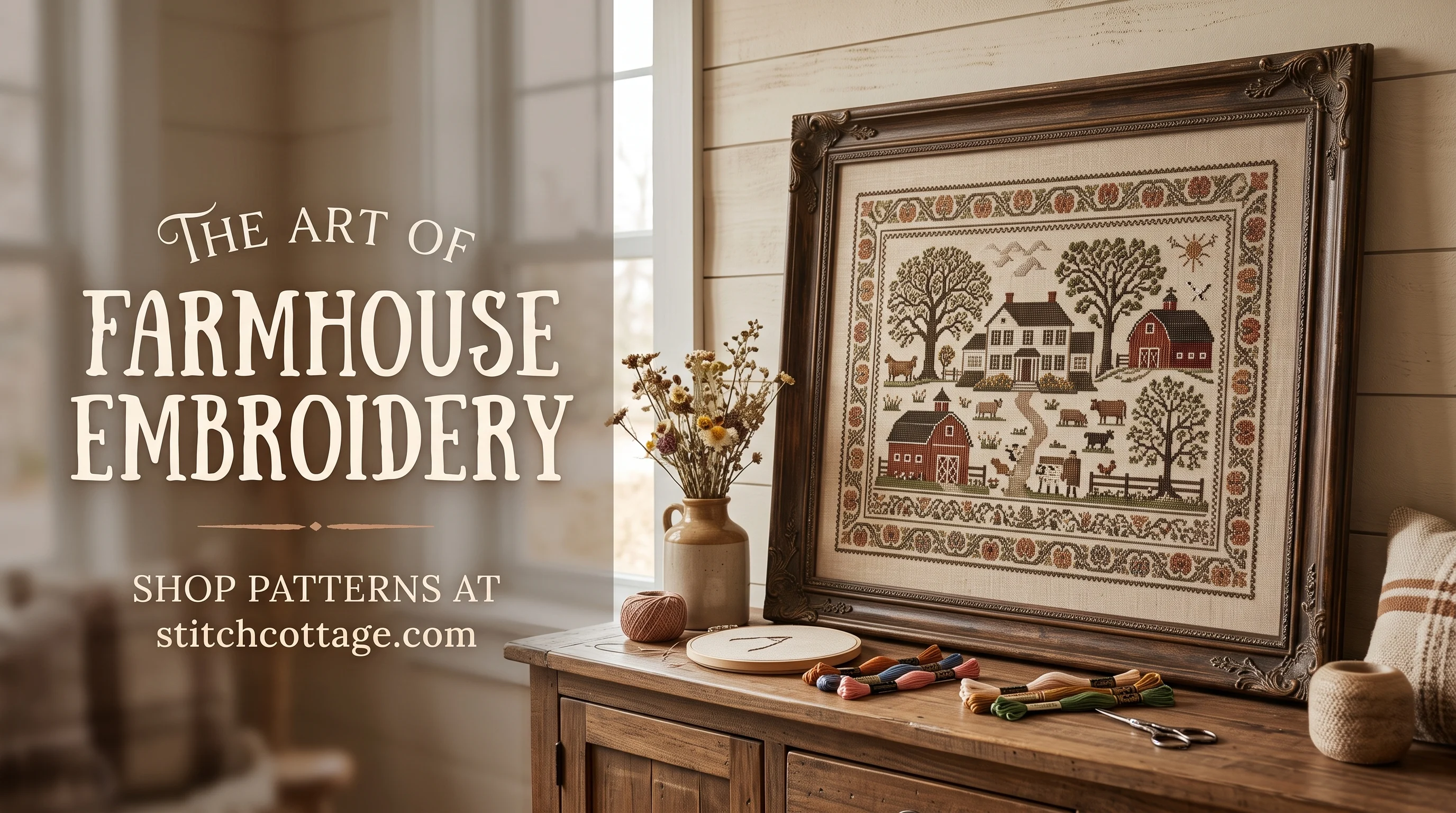
Cross Stitch House: 12 Ideas With Sizes and Colour Counts
Last updated: October 7, 2026
A cross stitch house is sized by one division. Take the chart’s width in stitches and divide by 14: that is the finished width in inches on 14 ct aida. A house 84 stitches wide comes out at exactly 6 inches.
Most house charts show you a photo of the finished piece and a PDF. The arithmetic is left to you. The twelve ideas below come with the numbers worked out: stitches, inches and colour count.
Quick answer: start with a tiny house, 28 to 40 stitches square, three colours, full crosses only. Move to a cottage 70 to 98 stitches wide once your windows come out straight. Keep streets and wall pieces for later, because they need 120 stitches or more. Before you buy any chart, check the stitch count, the colour list and the page edges of the PDF.
I always stitch houses from charts that state their count on the file, so I can cut fabric before I print. If you would rather skip the hunting, house charts with a stated stitch count and licence are one search away.
How big is a cross stitch house: stitches to inches on 14 ct
Every number in this article assumes 14 ct aida, the fabric most house charts are drawn for. Divide the stitch count by 14 and you have inches.
| Stitches wide | Finished width on 14 ct | What it suits |
|---|---|---|
| 28 | 2 inches | Ornament, bookmark top, keychain |
| 56 | 4 inches | Greeting card, small hoop |
| 84 | 6 inches | A cottage in a 7 inch hoop |
| 112 | 8 inches | A framed house with a border |
| 168 | 12 inches | A wall piece, a whole village |

I add two inches on every side for the hoop, and I know how big a piece of fabric to cut. The same chart on 18 ct shrinks to about three quarters of that width. On 11 ct it grows by a quarter.
Height matters as much as width. A chart 84 stitches wide and 70 tall finishes at 6 by 5 inches, so check both numbers against your hoop. A chart that states both numbers saves you the ruler.
Stitch count is the only size a chart can state without lying. Photos get cropped and inches depend on your fabric, but stitches never change.
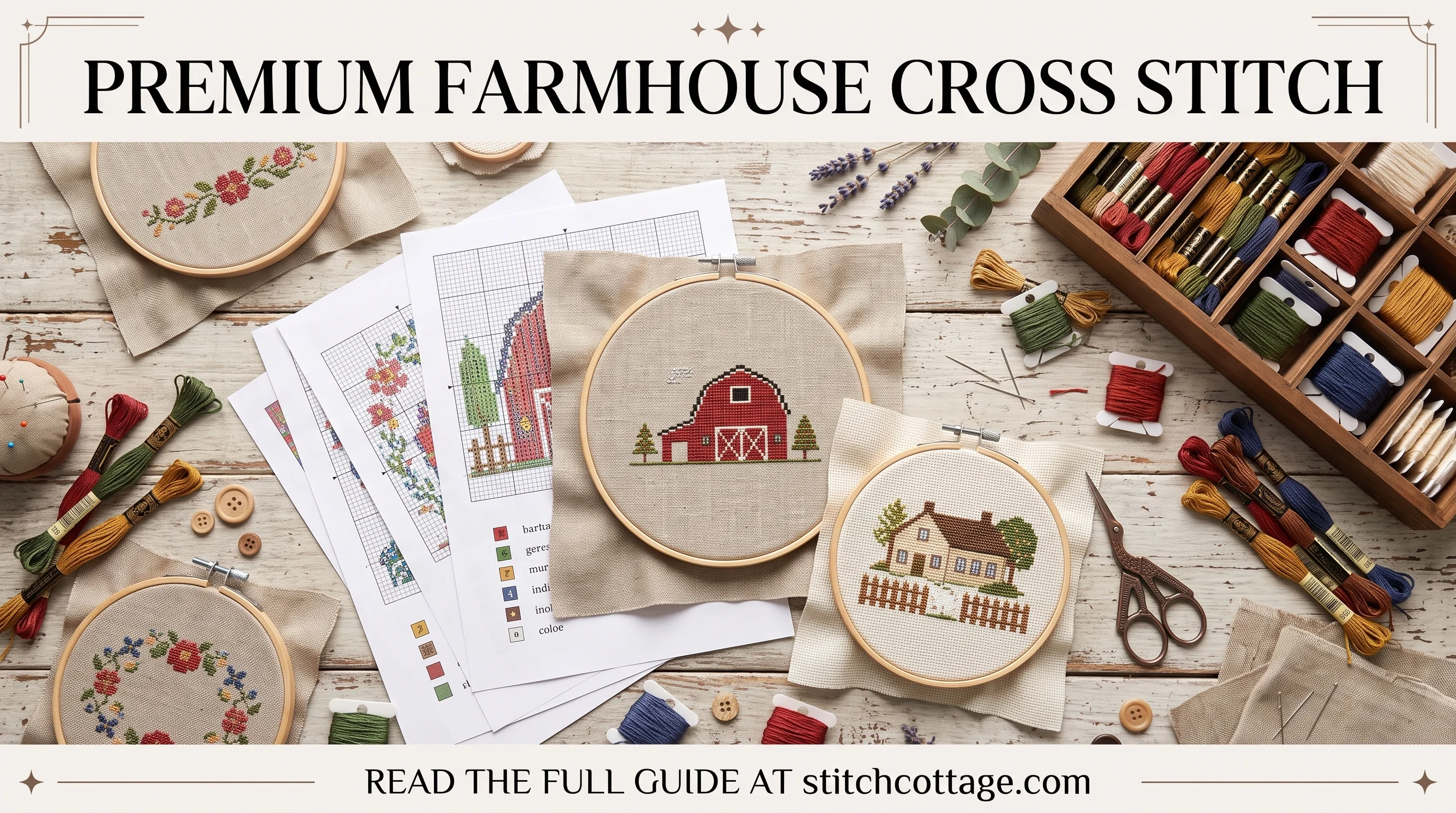
Tiny houses for beginners: 3 ideas
Houses cross stitch charts run from 28 stitches wide to well over 100. A tiny house is the right first one, because every part of it is a single decision: roof, wall, door, perhaps one window.
You have nowhere to hide a wrong count, and nothing is small enough to need a magnifier. Keep to full crosses and three colours. Half stitches and single-square dots are what make a small chart feel hard.
My hearts cross stitch ideas follow the same rule for a second tiny motif in the same hoop.
| Idea | Stitches | Finished size | Colours |
|---|---|---|---|
| Ornament house | 28 × 28 | 2 × 2 inches | 3 |
| Bookmark house | 28 × 112 | 2 × 8 inches | 3 |
| Matchbox house | 40 × 40 | 2.9 × 2.9 inches | 4 |
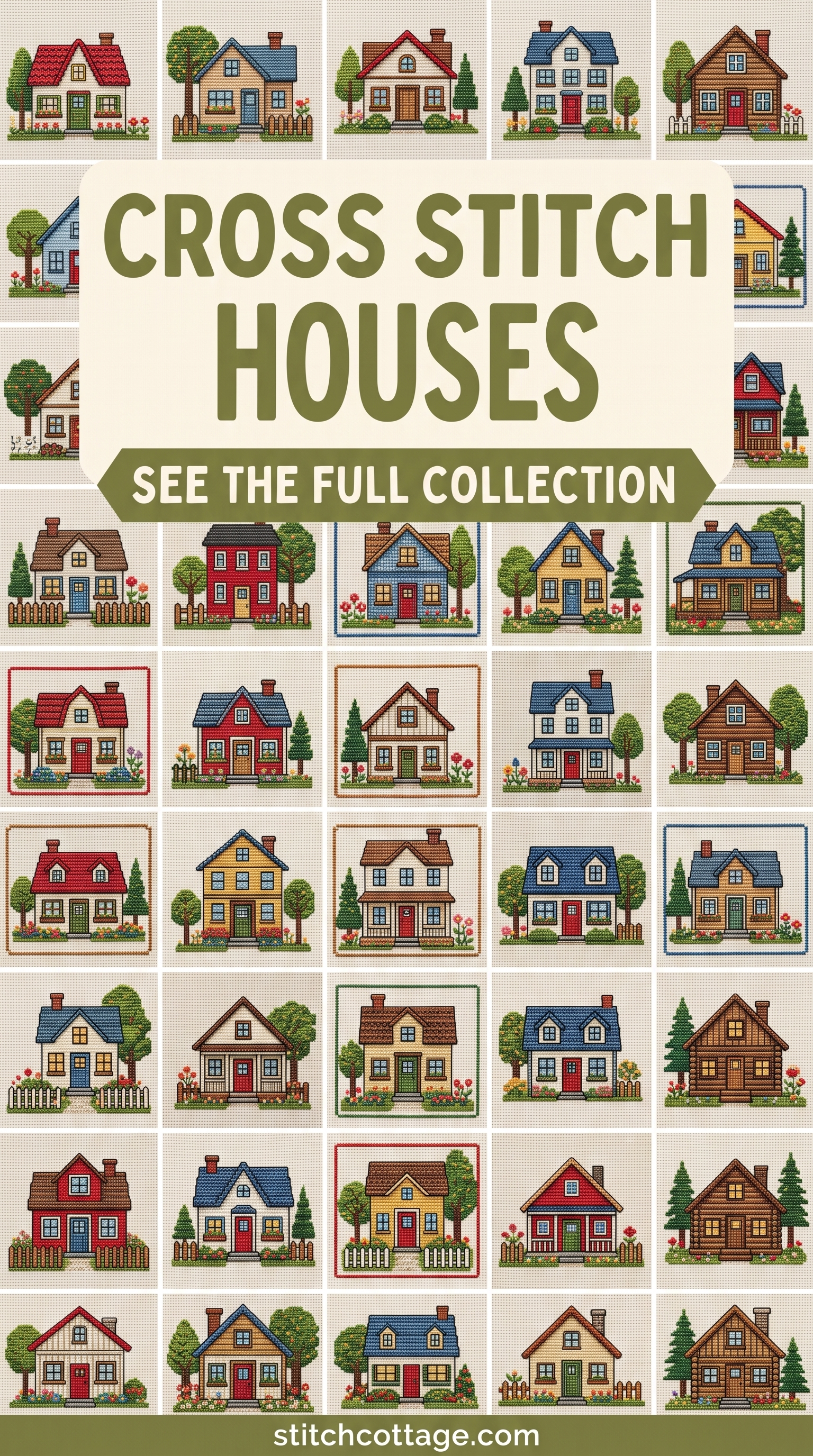
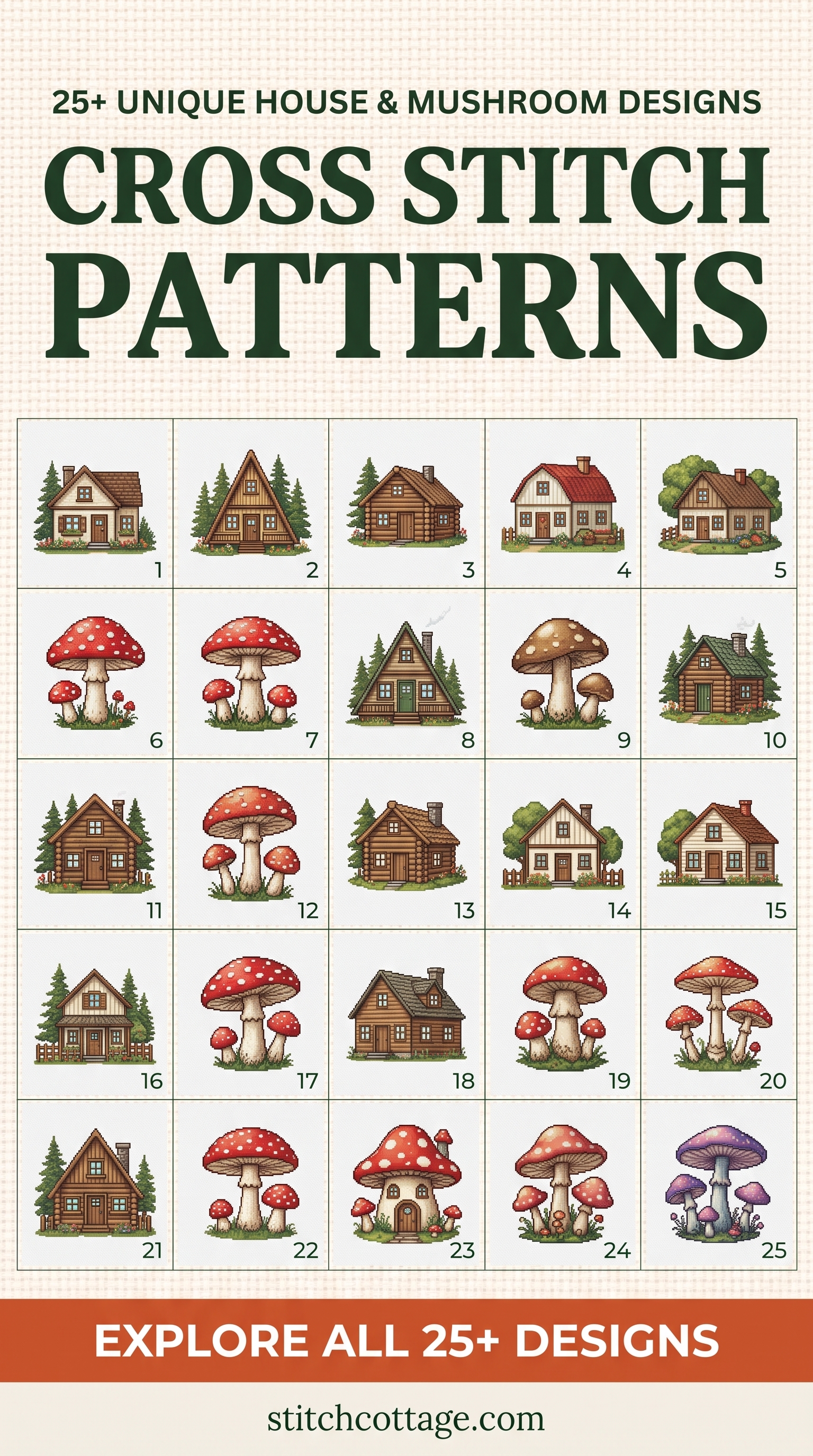
1. The ornament house
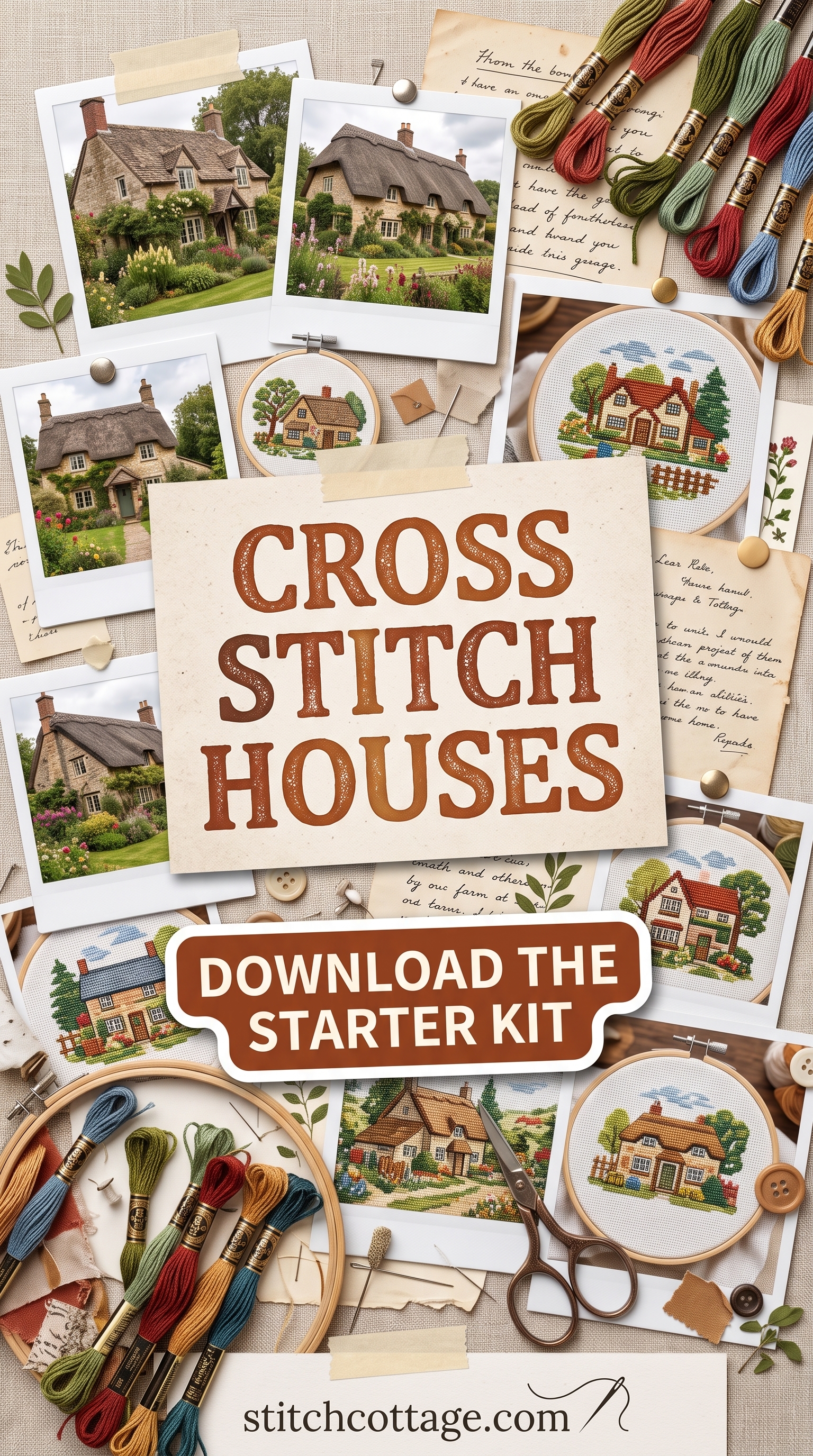
About 28 stitches square, finishing at 2 inches on 14 ct. Red roof, cream wall, one dark door. You can stitch it in an evening and hang it on a tree or a drawer pull.
2. The bookmark house
A narrow chart, 28 stitches wide and 112 tall, finishing at 2 by 8 inches. The house sits at the top and a plain strip of path runs down the length.
The strip keeps the bookmark flat in the book. It also keeps you honest: if your count drifts, the strip shows it first.
3. The matchbox house
Around 40 stitches square, which is 2.9 inches on 14 ct and fits the lid of a small box. It gets one window with a one-row frame.
I stitch this one when I want to learn how a window frame behaves before you commit to a cottage. I did, and I was glad of it: my first cottage windows came out straight because of it. I now stitch one matchbox house before every cottage.
Whichever you pick, look for a tiny house chart that prints its count and colour list on the first page. A chart this small should never make you hunt for either.
Cottage and cabin patterns: 3 ideas
House cross stitch patterns for cottages bring in the details that make a house look lived in: a chimney, a thatched edge, shutters, a path. Each detail costs you a colour or a backstitch line, so colour counts start to climb here.
| Idea | Stitches | Finished size | Colours |
|---|---|---|---|
| Thatched cottage | 84 × 70 | 6 × 5 inches | 6 |
| Log cabin in snow | 98 × 84 | 7 × 6 inches | 5 |
| Lakeside cabin | 91 × 77 | 6.5 × 5.5 inches | 7 |

4. The thatched cottage
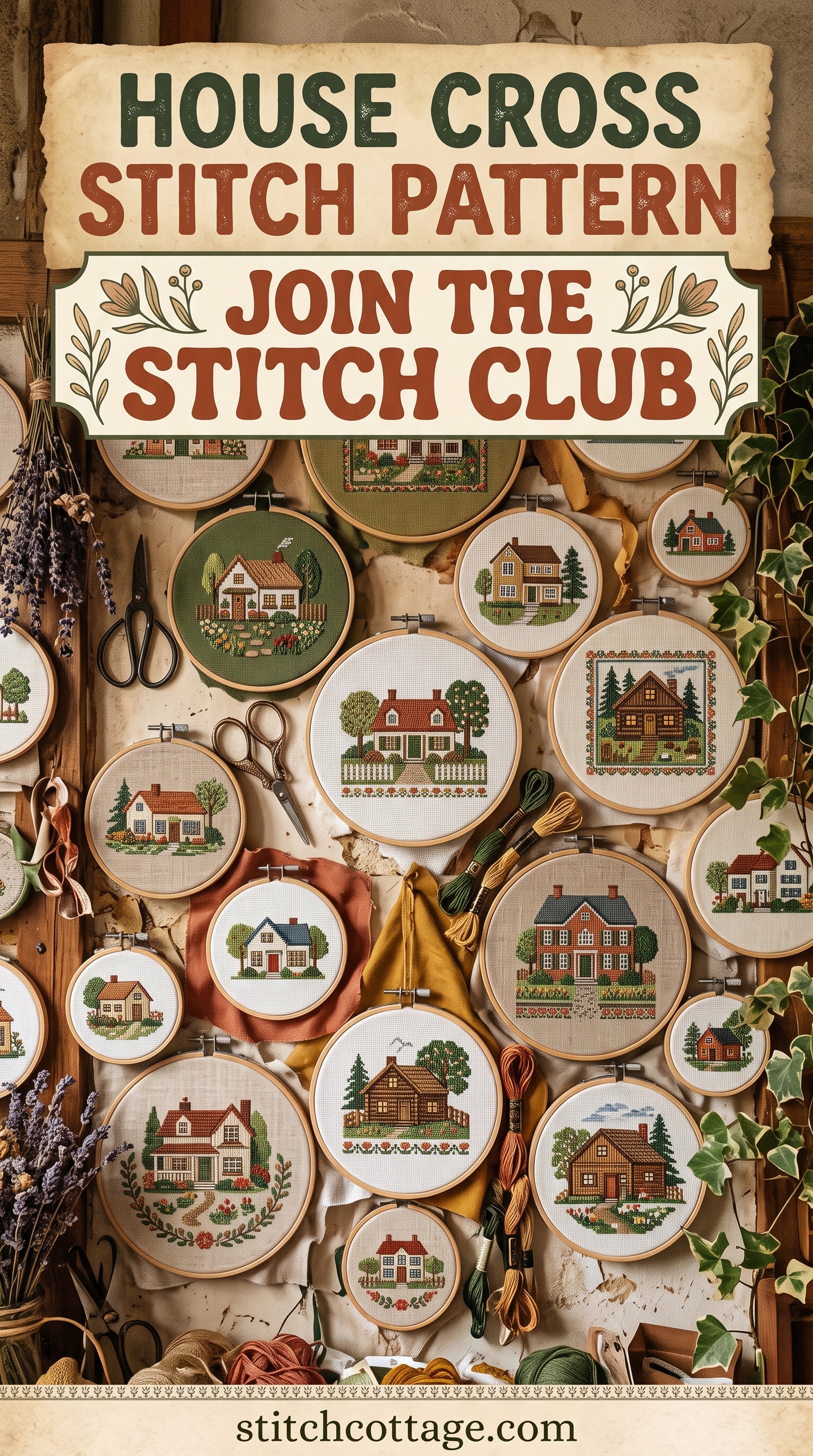
84 stitches wide and 70 tall, so 6 by 5 inches. Allow six colours: thatch, wall, window, door, chimney and one green for the garden.
The thatch overhangs the wall by two stitches on each side. That overhang does the work of a roof. A chart without it gives you a box in a hat.
5. The log cabin in snow
98 stitches wide and 84 tall, 7 by 6 inches. The logs are rows of two alternating browns, and that is the clever part: two colours make the whole wall.
If you stitch on white aida, leave the snow on the roof as bare fabric. You save a colour and a skein of thread.
6. The lakeside cabin
91 stitches wide and 77 tall, 6.5 by 5.5 inches. It takes seven colours, because the water needs two blues.
This is the first house where the windows want a backstitch outline. A thin line can vanish if the chart prints it in the same symbol as the stitch beside it, so you want a cottage chart with a separate backstitch key.
Cross stitch houses: 3 village and street ideas
Several houses on one piece change the job. Every house has to agree with its neighbours, and one miscount at the first house slides the whole street out of place.
I stitch streets from the centre of the piece, not from the left. For a gentler warm-up first, my mushroom cross stitch ideas are small enough to finish in a weekend. I count the gap between two houses twice before I place the third.
More ideas for the same grid live in our cross stitch patterns shelf, and the Stitch Cottage home page has the rest, and About Stitch Cottage says who is stitching them.
| Idea | Stitches | Finished size |
|---|---|---|
| Terrace of three | 126 × 56 | 9 × 4 inches |
| Village on a hill | 140 × 112 | 10 × 8 inches |
| Four-seasons set | 4 × (56 × 56) | 4 × 4 inches each |


7. The terrace of three
126 stitches wide and 56 tall, finishing at 9 by 4 inches. Three houses touch, each with its own roof colour, and they share a wall.
I love how it reads as a street from across a room. It also fits a long, thin frame above a door.
8. The village on a hill
140 stitches wide and 112 tall, 10 by 8 inches. The houses stack up a slope, so each row sits a few stitches higher than the last. Allow ten or more colours.
The slope is a single backstitch line. If that line goes missing from your printed page, the hill disappears.
9. The four-seasons set
Four little charts, each 56 stitches square and 4 inches on 14 ct, with one house per season. In a row they cover 16 inches. In a square of four they cover 8 by 8.
I think it is the easiest way to stitch a whole village, because you only commit to one house at a time. For a single-season motif instead of the full set, my sunshine cross stitch ideas finish in one sitting.
Sets are also where free charts run out. A single house is easy to find for nothing, but a set of houses drawn in one style with a shared colour list is something a catalogue sells, because it is work to draw.
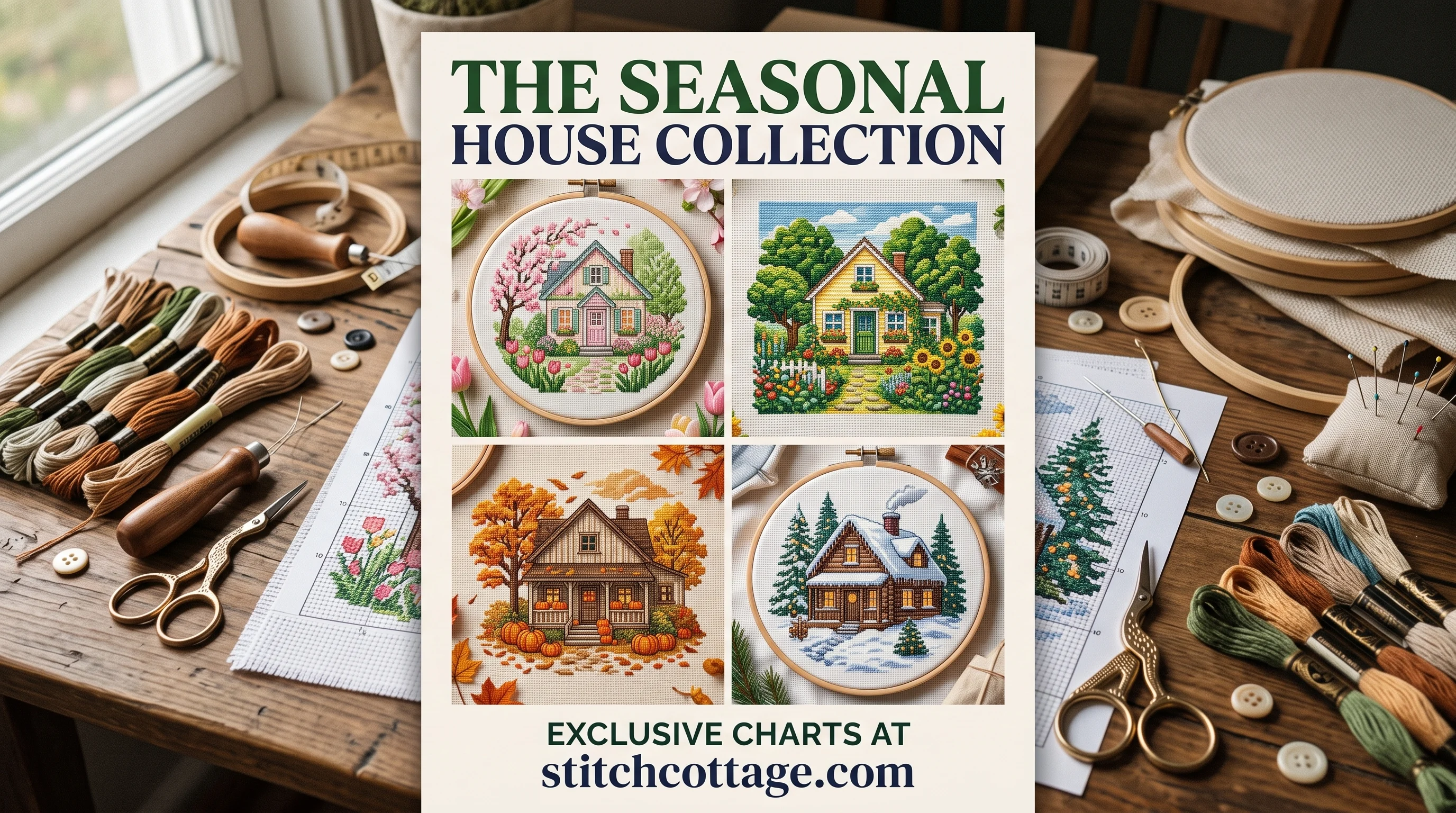
House cross stitch for the wall: 3 ideas
A wall piece is a house you intend to frame. The border, the margin and the glass all take inches from your finished size, so the chart needs to be larger than the picture in your head.
| Idea | Stitches | Finished size | Watch for |
|---|---|---|---|
| Framed house with border | 154 × 126 | 11 × 9 inches | Border repeat at the corners |
| Home sweet home | 126 × 140 | 9 × 10 inches | Lettering symbols in grey |
| House at dusk | 168 × 140 | 12 × 10 inches | Discontinued floss numbers |


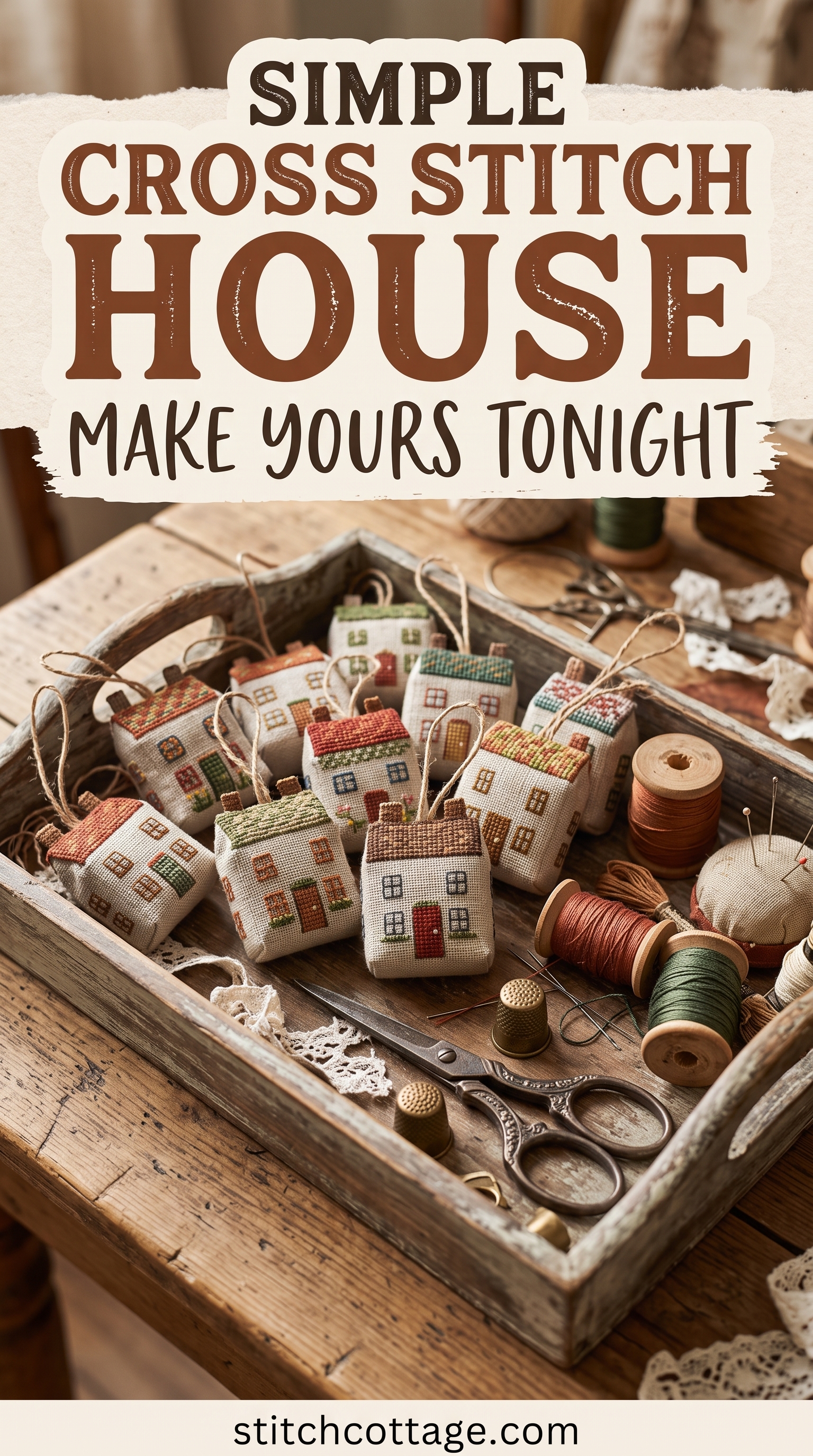
10. The framed house with a sampler border
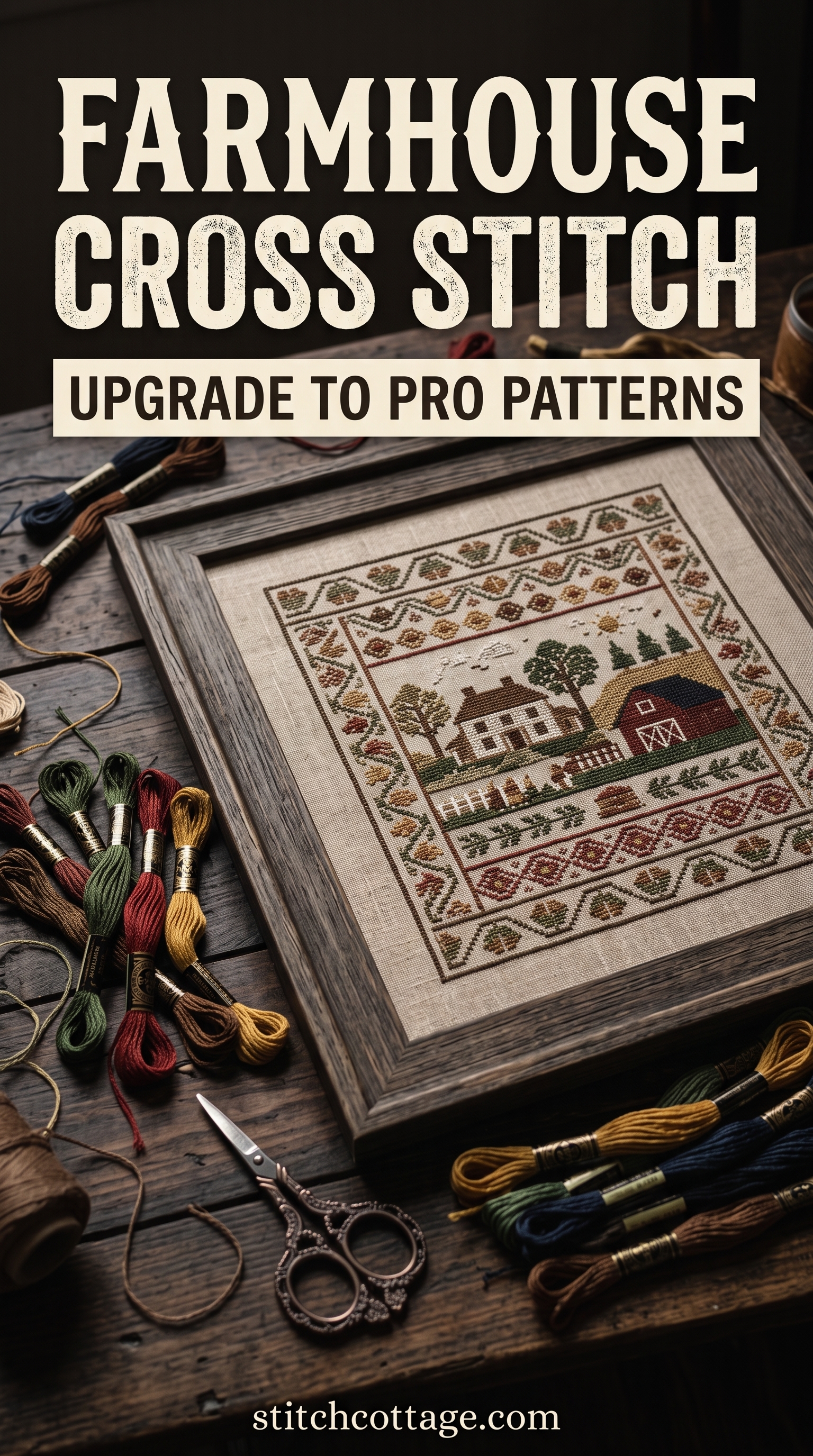
154 stitches wide and 126 tall, 11 by 9 inches. The house sits in the middle and a border of repeating motifs runs around it.
I find the border the easy part. It repeats, and it lets you check your count at every corner.
11. Home sweet home
126 stitches wide and 140 tall, 9 by 10 inches. A small house sits above a line of lettering.
Lettering is where symbols that differ only by colour cause trouble, because every letter has to be read in grey on a printed page. Print the chart in black and white before you buy the fabric.
12. The house at dusk
168 stitches wide and 140 tall, 12 by 10 inches. This is the twelve-colour version: a sky gradient, glowing windows, a dark roof.
It is also the idea most likely to arrive with a floss colour that is no longer made. Check the colour list against your thread box before you commit. I once got halfway up a roof before I found a floss number I could not buy.
If you plan to hang it or give it away, the licence matters too. A house chart with a stated licence is the only kind you can stitch for a gift stall.
Check the chart before you buy a house pattern
Cross stitch house patterns fill the catalogues and are thinly checked. One large catalogue holds 80 charts with a house, cottage or village in the title. Two of them carry a review, and the most saved has 74 saves.
People want the motif, and almost nobody reports back on whether the chart works. So the checking falls to you. Every fault below can be caught in about a minute, before your needle goes in.
- Find the stitch count. Width and height in stitches, stated by the designer. No count means the chart is a picture.
- Divide by 14. That is your width in inches on 14 ct. Add two inches each way for the hoop.
- Print one page in grey. If two symbols become the same symbol, the chart fails for windows and lettering, however good the preview looks.
- Check the page edges. Every page of the PDF should carry its own grid border. A missing border on one side is how a column of the design goes blank.
- Read the colour list against your thread box. A discontinued floss number halfway through a roof means you are guessing a substitute.
| Check | Pass | Fail |
|---|---|---|
| Stitch count | Width and height stated | Photo only |
| Grey print | Every symbol distinct | Two symbols merge |
| Page edges | Grid border on each page | Blank column |
| Licence | Stated in the file | Silent |
Free charts rarely pass more than two of those five. Add the licence question, which most skip, and a free chart costs you more with every wasted evening. The same five checks apply before you print my star cross stitch patterns or any other small motif.
Questions people ask about cross stitch houses
How to print cross stitch patterns at home?
Open the PDF and print at 100 percent, with “fit to page” switched off. Measure the scale square on the first page against a ruler. If it matches the size the designer states, your printout is true.
I print one page in black and white first, to see whether the symbols still read without colour.
How to print your own cross stitch pattern?
Draw it on graph paper or in chart software with a heavier grid line every ten squares, then export a PDF. Give the legend its own page. Keep the design inside the print margin, so no column of it is cut off.
Which house cross stitch pattern is best for a beginner?
One 28 to 40 stitches square, with three colours and full crosses only. You finish it at 2 to 3 inches on 14 ct in an evening, and it teaches you how a door and a window frame sit on the grid.
My crescent moon cross stitch patterns sit at the same small size for a second beginner chart ready to go.
How many colours does a cross stitch house need?
Three for a tiny house: roof, wall and door. Six or seven for a cottage with a chimney, windows and a garden. Anything above ten belongs to a village or a dusk scene, and a chart sold as easy with that many colours is mislabelled.
What fabric count should I use for a house?
14 ct aida for your first one. The holes are easy to see, two strands fill a cross properly, and the sum from chart to finished size is one division.
Where do I start stitching a house?
At the centre of the chart and the centre of your fabric, then outward. Stitch the roofline or the base line first, because it keeps everything else straight. Count that first row twice.
Can I sell a house I stitch from a free chart?
Not unless the chart says so. Most free house charts are silent on it, and silence is not permission. A chart with a stated licence is the only safe one to stitch for someone else.
Key takeaways
- Stitch count divided by 14 is the finished width in inches on 14 ct. A house 84 stitches wide is 6 inches.
- First house: 28 to 40 stitches square, three colours, full crosses. It finishes at 2 to 3 inches in an evening.
- A cottage 70 to 98 stitches wide adds a chimney, shutters and a path, and needs six or seven colours.
- Streets and villages need 120 stitches or more and a shared colour list. Count the gap between houses twice.
- Wall pieces lose inches to border, margin and glass, so pick a chart larger than the picture in your head.
- Of 80 house charts in one catalogue, two carry a review. Nobody has checked the rest for you.
- Print one page in grey before you start. Symbols that differ only by colour fail on paper.
- When you would rather stitch than audit, start from charts that state count, colours and licence.
