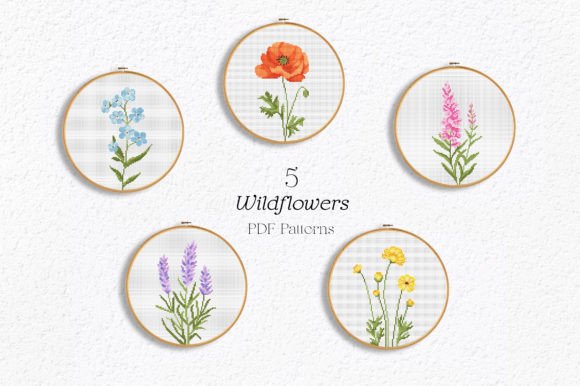
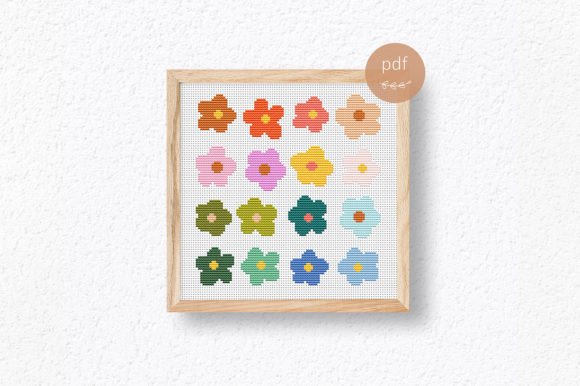
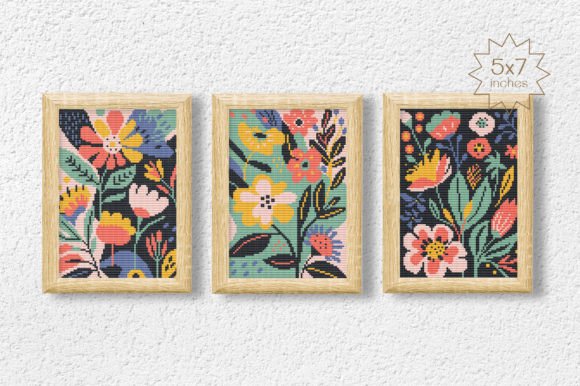
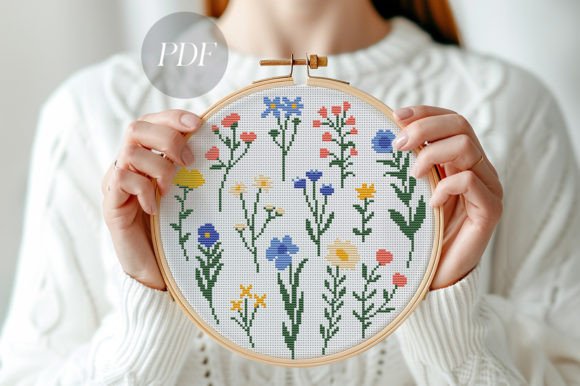
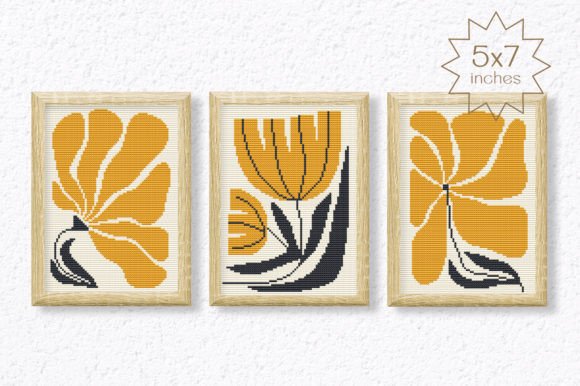
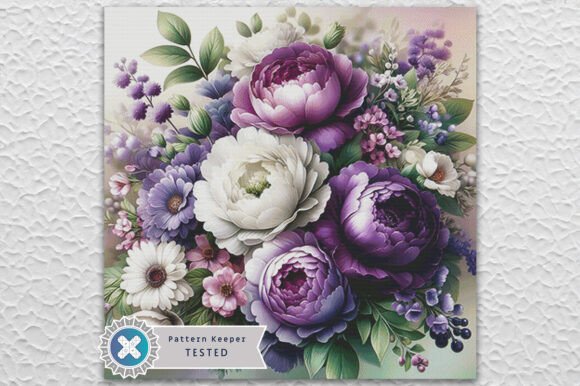
A cross stitch pattern of flowers works when every petal reads from three feet away, and that comes from size, not detail. Here are 38 flower charts sorted by where they end up. Each lists its count, so you can pick one in a minute.
A wrong chart costs you evenings you never get back. Every idea below gives the size on 14 ct aida and the DMC colours first.
Quick answer: for a first flower, pick a single bloom under 60 stitches wide with five DMC colours or fewer. Divide the width by 14 to get inches on 14 ct aida.
Choose a flower chart by stitch count and colour count first, and by the photo last.
What is a cross stitch pattern of flowers?
A cross stitch pattern of flowers is a counted chart where each square is one stitch and each symbol is one DMC colour. It shows blooms, leaves, stems and the size in stitches.
A flower chart differs from a motif in shading: petals need two or three tones of one colour to look round. You can start with our star cross stitch designs, then move to bouquets.
Every kit in this row ships with fabric, sorted floss and a needle, so a cross stitch pattern of flowers hoop can start the day it arrives. Picked by rating and number of reviews, not by price.
Printed kits suit a first project, counted kits suit a stitcher who reads charts.
TINDTOP Hummingbird and Flower Embroidery Kit for Adults

TINDTOP Hummingbird and Flower Embroidery Kit for Adults
Dimensions Stamped Cross Stitch Baby Quilt 34" X 43"

Dimensions Stamped Cross Stitch Baby Quilt 34" X 43"

1. Single red rose bud for a Valentine card
A single red rose bud fits the front of a Valentine card you post on 14 February. Framed in a 4-inch hoop, it also sits on a bedside shelf all year.
The design shows one closed bud on a straight stem with two leaves. You see no background and no outline.
You need DMC 321 for the petals, 815 for the shadow, 987 for the leaves and 989 for highlights.
The chart runs 40 by 56 stitches, about 2.9 by 4 inches on 14 ct aida. The tricky spot is the petal tip, where 815 and 321 swap every stitch.
I stitch the darker shade first there. Then you fill the red around it.
- Best for: beginners making a quick Valentine card
- Avoid for: a large wall piece
2. Sunflower hoop for a late-summer kitchen
A sunflower hoop hangs in the kitchen from August to the first frost. You can also stitch it as a harvest gift for a neighbour with a vegetable patch.
The design shows one open sunflower head facing front, with a seed centre and twelve petals. Two leaves sit below.
You need DMC 973 and 972 for petals, 801 and 938 for the seed centre, and 988 for leaves.
The chart runs 70 by 70 stitches, 5 inches square on 14 ct aida. The tricky spot is the centre, a speckle of two browns.
I stitch all the 938 first, then fill 801 around it. You will miscount less that way.
- Best for: a late-summer kitchen hoop
- Avoid for: a card under 5 inches
3. Lavender sprig bookmark for a herb gardener
A lavender sprig bookmark slips into a gardening book as a birthday gift for a mum who grows herbs. It also works as a thank-you for a teacher in June.
The design shows three tall stems of lavender, each with a column of small buds. Nothing else crowds the strip.
You need DMC 209 and 208 for the buds, 3013 for the stems and 3348 for leaf tips.
The chart runs 20 by 110 stitches, about 1.4 by 7.9 inches on 14 ct aida band. The tricky spot is the bud rows, which step left and right.
I count each bud pair aloud. You can also mark finished rows in pencil.
- Best for: a gift for a herb gardener
- Avoid for: stitchers who dislike narrow bands
4. Daisy chain border for a tea towel
A daisy chain border runs across an aida-band tea towel for a summer kitchen. You can also stitch it onto a jar topper for a farmers’ market gift.
The design shows a repeating line of white daisies with yellow centres, linked by a thin green stem.
You need blanc for petals, 744 for centres, 3348 for the stem and 762 to edge the white.
The chart runs 140 by 20 stitches, about 10 by 1.4 inches on 14 ct aida. The tricky spot is the repeat: one slip and the chain drifts.
I stitch the centres along the whole band first. Then you add petals around fixed points.
- Best for: dressing a summer tea towel
- Avoid for: stitchers who hate repeats
5. Red poppy hoop for Remembrance
A red poppy hoop goes up for Remembrance in November, on a hall wall or a church display. Small, it fits a 3-inch card you send to a veteran.
The design shows two poppies on one stem, one open and one still a bud. The open bloom has a black centre.
You need DMC 666 and 321 for petals, 310 for the centre and 3346 for the stem.
The chart runs 60 by 60 stitches, about 4.3 inches square on 14 ct aida. The tricky spot is the black centre, which can shed fibres onto the red.
I stitch the 310 last. You keep the red clean that way. Use a fresh needle.
- Best for: a November Remembrance display
- Avoid for: a cheerful birthday gift
6. Rose wreath with a heart for a wedding
A rose wreath with a heart centre suits a wedding sampler or a tenth anniversary gift. Add initials inside the heart and you have a keepsake for a named couple.
The design shows a ring of pink roses and leaves, with a small red heart in the middle.
You need DMC 3326, 899 and 335 for roses, 988 and 3346 for leaves, and 321 for the heart.
The chart runs 100 by 100 stitches, about 7.1 inches on 14 ct aida. The tricky spot is closing the ring evenly.
I stitch the wreath in quarters from the top and check each one. For more heart ideas, see our Valentines cross stitch patterns.
- Best for: a wedding or anniversary gift
- Avoid for: a first project
7. Tulip trio for the Easter mantel
A tulip trio stands on the spring mantel from Easter to May. You can also frame it for a friend’s new flat in April.
The design shows three tulips in a row, pink, yellow and purple, on straight stems with long leaves.
You need DMC 3801, 742 and 553 for the cups, 702 for stems and 3345 for leaf shadow.
The chart runs 54 by 70 stitches, about 3.9 by 5 inches on 14 ct aida. The tricky spot is the cup notch, a single stitch gap at the top of each tulip.
I mark the three notches before I start. Miss one and the tulip turns into an egg.
- Best for: an Easter mantel
- Avoid for: a winter display
8. Cherry blossom branch for a long frame
A cherry blossom branch fills a long frame over a bed or a sofa. It suits a spring housewarming, or a gift for someone who loves Japanese gardens.
The design shows one dark branch crossing from left to right, with clusters of pale pink flowers along it.
You need DMC 818 and 3326 for petals, 3865 for highlights and 3371 for the branch.
The chart runs 150 by 60 stitches, about 10.7 by 4.3 inches on 14 ct aida. The tricky spot is the pale petals, which vanish on white fabric.
I stitch this on cream aida instead. You keep the pink visible. Then a 3371 backstitch outlines each flower.
- Best for: a long frame over a sofa
- Avoid for: white aida
9. Forget-me-not ornament for a memory tree
A forget-me-not ornament hangs on a memory tree at Christmas or rests in a sympathy card. You can finish it round with felt backing in an evening.
The design shows a tight cluster of five-petal blue flowers with yellow eyes, in a 3-inch circle.
You need DMC 3755 and 334 for petals, 744 for eyes, blanc for highlights and 3347 for leaves.
The chart runs 42 by 42 stitches, 3 inches across on 14 ct aida. The tricky spot is the tiny eye: one stitch of 744 per flower.
I place every yellow eye first. You then build petals around each one. No guessing.
- Best for: a sympathy card or memory tree
- Avoid for: stitchers who dislike tiny details
10. Peony pillow for a reading chair

A peony pillow sits on a reading chair from May through summer. It makes a lasting gift for a grandmother who keeps peonies by the gate.
The design shows one large open peony, layered petals in three pinks, with leaves at the corners.
You need DMC 3708, 3706 and 3705 for petals, 3801 for the depth, and 3346 and 3345 for leaves.
The chart runs 112 by 112 stitches, 8 inches square on 14 ct aida, so a 12-inch pillow form leaves a border. The tricky spot is petal layers that share shades.
I stitch from the centre outward. You keep layers in order that way.
- Best for: an intermediate pillow front
- Avoid for: a one-evening project
11. Wildflower meadow sampler for a hallway
A wildflower meadow sampler is a winter project you frame for a long hallway wall. It also suits a retirement gift for a keen gardener.
The design shows a row of mixed wildflowers, poppies, cornflowers, daisies and clover, rising from grass.
You need about 15 colours, among them DMC 666, 798, blanc, 3608 and 3346. Check the key twice.
The chart runs 168 by 84 stitches, about 12 by 6 inches on 14 ct aida. The tricky spot is the grass line, with stems crossing in every direction.
I stitch the grass last, after the flowers. You place each stem against a finished bloom. Expect several months.
- Best for: a winter-long project for experienced stitchers
- Avoid for: beginners
12. Hollyhocks by a cottage door for new homeowners
Hollyhocks by a cottage door suit a framed piece for a new homeowner. Hang it by the front door in July, when real hollyhocks bloom.
The design shows a white cottage door with two tall hollyhock spires, pink and plum. A stone step sits below.
You need DMC 3608 and 3607 for flowers, 718 for depth, 3346 for leaves and 3782 for stone.
The chart runs 70 by 100 stitches, about 5 by 7.1 inches on 14 ct aida. The tricky spot is the door frame, a straight backstitch line.
I use a ruler on the chart. For more doors and roofs, see our house cross stitch patterns.
- Best for: a housewarming gift
- Avoid for: stitchers who skip backstitch
13. Bluebell woodland for a study wall
A bluebell woodland scene hangs in a study or a hallway from April. It makes a quiet gift for a walker who knows the spring woods.
The design shows a carpet of bluebells under two thin tree trunks, with soft green behind.
You need DMC 340 and 333 for bells, 3346 and 3012 for leaves, and 3790 for trunks.
The chart runs 80 by 60 stitches, about 5.7 by 4.3 inches on 14 ct aida. The tricky spot is the bells: half-stitches that hang down.
I work each bell as a quarter and a half stitch. You get the droop without crowding the row. Practise one first.
- Best for: practising fractional stitches
- Avoid for: full-cross-only beginners
14. Potted geranium for a kitchen windowsill
A potted geranium sits in a small frame on a kitchen windowsill. You can stitch it fast as a Mother’s Day gift in March or May.
The design shows one red geranium in a terracotta pot, round flower heads above wide green leaves.
You need DMC 666 and 321 for flowers, 905 for leaves, 3776 for the pot and 3830 for its shadow.
The chart runs 50 by 60 stitches, about 3.6 by 4.3 inches on 14 ct aida. The tricky spot is the round flower heads, made of scattered single stitches.
I stitch the 321 dots first. You fill 666 around them. Keep your tension even. It takes two evenings.
- Best for: a quick Mother’s Day gift
- Avoid for: a large frame
15. Snowdrop hoop for a January windowsill
A snowdrop hoop brightens a January windowsill, when nothing else flowers. It also suits a get-well card for someone stuck indoors in winter.
The design shows three snowdrops nodding from thin stems, white bells with a green mark inside.
You need blanc for petals, 3866 for petal shadow, 3363 and 3364 for leaves, and 3865 for highlights.
The chart runs 44 by 54 stitches, about 3.1 by 3.9 inches on 14 ct aida. The tricky spot is white on white: the bells vanish on white aida.
I use pale blue or grey aida here. You will see every petal at once. Test one bell first.
- Best for: a January hoop
- Avoid for: white aida
16. Poinsettia ornament for teacher gifts
A poinsettia ornament hangs on the tree from the first week of December. Stitch three and you have teacher gifts before school breaks up.
The design shows one poinsettia from above, red bracts in a star around a yellow centre.
You need DMC 321 and 815 for bracts, 973 for the centre and 699 and 701 for leaves.
The chart runs 40 by 40 stitches, about 2.9 inches on 14 ct aida. The tricky spot is the bract veins, single rows of 815 inside the red.
I stitch the veins first, then fill. You avoid counting across solid red. Back it with felt the same evening.
- Best for: teacher gifts in December
- Avoid for: a summer display
17. Christmas rose for a once-a-year card
A Christmas rose on a folded card goes to someone you write to only once a year. It also fits a 3-inch tree ornament.
The design shows one open hellebore, five white petals with a green tinge and a gold centre.
You need blanc, 3747 for the petal tint, 3348 for the green blush, 726 for stamens and 3363 for leaves.
The chart runs 36 by 48 stitches, about 2.6 by 3.4 inches on 14 ct aida. The tricky spot is the stamens, French knots in a ring.
I swap the knots for single cross stitches if time is short. You lose little at card size. Nobody will notice.
- Best for: a Christmas card list
- Avoid for: stitchers who dislike French knots
18. Purple bearded iris for a 4 by 6 card
A purple iris suits a framed gift for a garden club friend, or a 4 by 6 card for a June birthday.
The design shows one bearded iris on a tall stem, three falls hanging down and three standards up.
You need DMC 552 and 553 for petals, 726 for the beard, 3346 for leaves and 550 for depth.
The chart runs 48 by 70 stitches, about 3.4 by 5 inches on 14 ct aida, so it fits a 4 by 6 card. The tricky spot is the beard.
It is a short yellow line across the falls. I stitch it before the purple. You keep it crisp.
- Best for: a 4 by 6 card
- Avoid for: a 3-inch ornament
19. Lily of the valley for a May birthday
Lily of the valley goes on a May birthday card, or on a small frame for a bride’s dressing table. It is the May birth flower.
The design shows two arched stems of tiny white bells, tucked against one broad leaf.
You need blanc for bells, 3865 and 3024 for shadow, 988 for the leaf and 3346 for its vein.
The chart runs 30 by 44 stitches, about 2.1 by 3.1 inches on 14 ct aida. The tricky spot is the bell shape: three stitches that must hang under the stem.
I stitch the stem before any bell. You then hang each bell from it. Cream aida helps.
- Best for: a May birthday card
- Avoid for: a busy gallery wall
Halfway through the list is a good moment to pick a kit for the next evening. These sets keep the colours already matched to the chart.
Check the fabric count on the listing before you buy, since 11, 14 and 16 count stitch up at different sizes.
Bradove Alphabet Embroidery Kit for Beginners with Patterns

Bradove Alphabet Embroidery Kit for Beginners with Patterns
Bradove Classic Embroidery Learning Kit for Adults and Kids

Bradove Classic Embroidery Learning Kit for Adults and Kids
Bonroy 4 Sets Embroidery Set for Beginners Art Crafts Easy Sewing Incl

udes Embroidery Clothes with Pattern, Hoop, Instruction Manual, Color Stitch Set (Assorted 1)
20. Magnolia bloom for a dining room frame
A magnolia bloom fills a large frame over a dining table. It suits a gift for a couple who planted their first tree together.
The design shows one open magnolia, cream inner petals and pink outer ones, on a bare grey branch.
You need DMC 3713 and 761 for the pink, 3865 for the cream, 3024 for shadow and 3781 for the branch.
The chart runs 130 by 130 stitches, about 9.3 inches square on 14 ct aida. The tricky spot is the soft shading, with three pinks side by side.
I print the chart in colour for this one. You cannot tell those symbols apart in black and white.
- Best for: a large dining room frame
- Avoid for: black-and-white printing
21. Rose monogram for one named person
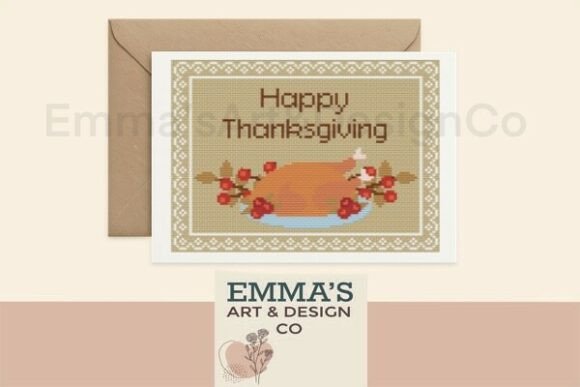
A rose monogram is a gift for one named person, say Anna for her 30th or Grandma on Mother’s Day. It hangs on a bedroom door or a dressing table.
The design shows one capital letter with climbing roses wound around the left stroke.
You need DMC 310 or 3371 for the letter, 3350 and 3354 for roses, and 3347 for leaves.
The chart runs about 60 by 70 stitches, 4.3 by 5 inches on 14 ct aida. The tricky spot is where roses overlap the letter.
I stitch the letter first. You then lay the roses over it and do not need to count gaps.
- Best for: a personal gift for one named person
- Avoid for: a batch of quick gifts
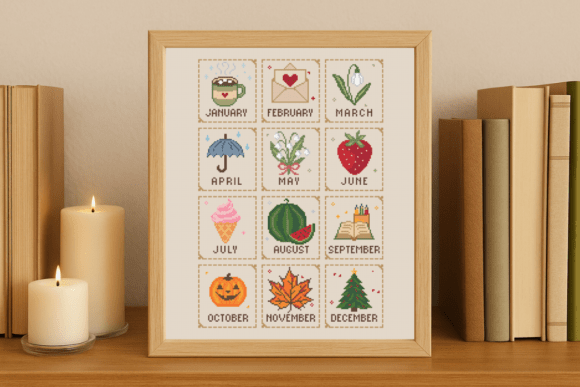
22. Birth month flower sampler for a family
A birth month flower sampler hangs in a family living room. Swap one flower for each person’s birth month and you have a gift that fits only them.
The design shows twelve small flowers in a grid, from January’s carnation to December’s holly, each with its month underneath.
You need about 20 DMC colours, including 321, 3607, 742, 340 and 3346.
The chart runs 156 by 120 stitches, about 11.1 by 8.6 inches on 14 ct aida. The tricky spot is spacing: every square must keep the same gap.
I baste a grid of guide lines first. Each square is 39 stitches wide. You remove the lines at the end.
- Best for: a family gift with everyone’s month
- Avoid for: a quick finish
23. Baby name with buttercups for a nursery
A baby name with buttercups goes on the nursery wall before the due date. You can also frame it as a christening or naming day gift.
The design shows a first name in simple capitals, with a line of buttercups and grass running underneath.
You need DMC 973 for buttercups, 783 for shadow, 704 and 702 for grass, and 3799 for letters.
The chart runs about 120 by 40 stitches for a five-letter name, around 8.6 by 2.9 inches on 14 ct aida. The tricky spot is centring the name.
I count the letters’ total width first. You then start from the middle. Leave one stitch between letters.
- Best for: a nursery wall or naming day
- Avoid for: names over ten letters
24. Daffodil pair for a March hallway
A daffodil hoop greets March on a hallway table, and it suits a St David’s Day gift for a Welsh friend.
The design shows two daffodils, one facing front and one side-on, with a deep yellow trumpet each.
You need DMC 744 and 743 for petals, 742 and 740 for the trumpet, and 989 and 3346 for stems.
The chart runs 50 by 64 stitches, about 3.6 by 4.6 inches on 14 ct aida. The tricky spot is the side-on trumpet, which uses three-quarter stitches.
I practise one on scrap aida. You then know how the curve sits before it counts. Five minutes is enough.
- Best for: a March hallway hoop
- Avoid for: full-cross-only stitchers
25. Cornflower jar topper for a summer fair
A cornflower jar topper dresses a jam jar for a summer fair or a hostess gift. A round 2.5-inch insert slips under the lid ring.
The design shows two cornflowers with ragged blue petals and thin silver-green stems.
You need DMC 798 and 799 for petals, 820 for the dark centre and 3052 for stems.
The chart runs 34 by 34 stitches, about 2.4 inches across on 14 ct aida. The tricky spot is the ragged petal edge: odd single stitches around each bloom.
I stitch the solid blue first. You add the ragged tips last, checking each one against the chart. It finishes in two evenings.
- Best for: a jam jar gift for a fair
- Avoid for: a wall frame
26. Pansy face for a coaster set
A pansy coaster set sits on a coffee table or goes to a friend for a birthday. Four coasters make a gift set.
The design shows one pansy face, purple top petals and a yellow lower petal with dark whiskers.
You need DMC 552 and 550 for purple, 725 for yellow, 310 for whiskers and 3346 for a leaf.
The chart runs 50 by 50 stitches, about 3.6 inches square on 14 ct aida, sized for a 4-inch coaster insert. The tricky spot is the whiskers.
They are backstitch lines that fan out. I stitch them last, one strand only. You keep them fine. Vary the colours per coaster.
- Best for: a set of four coasters
- Avoid for: a child’s first project
27. Marigold garland for an autumn mantel
A marigold garland hangs on an autumn mantel through October and into early November. It also suits a Day of the Dead display.
The design shows a swag of round orange and gold marigolds strung on a green cord.
You need DMC 970 and 971 for orange blooms, 740 and 972 for gold, and 3346 for the cord.
The chart runs 120 by 30 stitches, about 8.6 by 2.1 inches on 14 ct aida. The tricky spot is the frilled bloom: two shades in a ruffled ring.
I stitch the darker ring first. You then fill the lighter centre and the frill shows. Work one bloom at a time.
- Best for: an October mantel
- Avoid for: a spring display
28. Bronze chrysanthemum for a November birthday
A chrysanthemum hoop marks a November birthday, as the month’s flower. It also fills a kitchen wall after the summer pieces come down.
The design shows one large bronze bloom made of many thin curled petals, with two leaves.
You need DMC 920, 921 and 922 for petals, 3776 for the centre and 3362 for leaves.
The chart runs 72 by 72 stitches, about 5.1 inches on 14 ct aida. The tricky spot is the petal count: dozens of narrow strokes radiate from one point.
I stitch them in rings, like a clock. You count one ring at a time. Mark each ring in pencil.
- Best for: a November birthday
- Avoid for: a first chart
29. Dandelion seed clock for a desk frame
A dandelion seed clock suits a desk frame at the office or a graduation card. It reads as calm, not fussy.
The design shows a round seed head with a few seeds floating away to the right.
You need only three colours: DMC 3866 for the seeds, 642 for the stem and 3011 for the base.
The chart runs 60 by 80 stitches, about 4.3 by 5.7 inches on 14 ct aida. The tricky spot is the seed lines, all in backstitch.
I stitch the stem first, then the lines out from the centre. You keep the circle even. Use one strand. Grey aida shows the white best.
- Best for: a calm office desk frame
- Avoid for: stitchers who want bold colour
30. Blackwork tulip for a modern living room
A blackwork floral fits a modern living room, framed in plain oak. It suits a stitcher who likes pattern more than colour.
The design shows a single tulip filled with geometric fill patterns, all in one colour.
You need DMC 310 only. One skein covers it.
The chart runs 80 by 100 stitches, about 5.7 by 7.1 inches on 14 ct aida. The tricky spot is that blackwork is backstitch, not cross stitch.
Each fill pattern is a repeat of short lines. I stitch one full repeat, then check it. You spot errors early.
A mistake in row one repeats forty times. Slow down there.
- Best for: a modern one-colour piece
- Avoid for: stitchers who only do full crosses
31. Floral wreath with “Home” for a first flat
A floral wreath with “Home” in the centre is a housewarming gift you hang by the front door. It also suits a first-flat gift for a son or daughter.
The design shows a ring of small roses, daisies and berries around the word in plain script.
You need DMC 3350, blanc, 744, 815 and 3346, plus 3371 for the word.
The chart runs 90 by 90 stitches, about 6.4 inches on 14 ct aida. The tricky spot is the script letters in backstitch.
I stitch the word before the wreath. You then centre the flowers around fixed letters. Change the word to a family name if you like.
- Best for: a first-flat gift
- Avoid for: stitchers new to backstitch lettering
32. Hydrangea head for a July porch
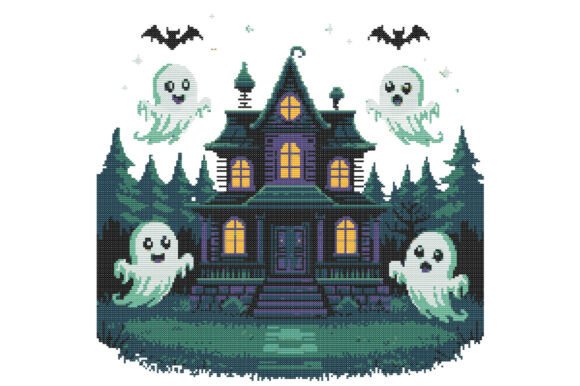
A hydrangea hoop fits a porch or sunroom in July. You can also stitch it as a gift for a mother who grows them by the fence.
The design shows one round hydrangea head of many small four-petal florets, blue fading to lilac.
You need DMC 3839 and 3840 for blue, 340 for lilac, 3747 for highlights and 988 for leaves.
The chart runs 70 by 70 stitches, 5 inches square on 14 ct aida. The tricky spot is the fade, with blue and lilac mixed in scattered stitches.
I stitch one colour across the whole head first. You then fill the second in the gaps.
- Best for: a July porch hoop
- Avoid for: stitchers who dislike scattered stitches
33. Morning glory vine for a bell pull
A morning glory bell pull hangs beside a doorway or down a narrow wall. It suits a long winter project for summer display.
The design shows a vine of blue trumpet flowers climbing upward, with heart-shaped leaves and curling tendrils.
You need DMC 798, 799 and 800 for flowers, 3346 and 3347 for leaves, and blanc for throats.
The chart runs 30 by 200 stitches, about 2.1 by 14.3 inches on 14 ct aida band. The tricky spot is keeping the vine centred over the length.
I mark the band’s centre line with a tacking thread. It takes ten minutes. You check against it every ten rows.
- Best for: a narrow wall beside a door
- Avoid for: a small hoop
34. Lotus on still water for a calm corner
A lotus flower sits in a meditation corner or yoga room. It makes a calm gift for a friend starting a new chapter.
The design shows one lotus open on still water, pink petals pointing up, with a pale ripple line below.
You need DMC 3354, 3733 and 3687 for petals, 3348 for the pad and 3753 for water.
The chart runs 60 by 50 stitches, about 4.3 by 3.6 inches on 14 ct aida. The tricky spot is symmetry: petals must mirror left and right.
I stitch the centre petal, then pairs outward. You check each pair before the next. A mirror error shows at once.
- Best for: a yoga room or calm corner
- Avoid for: a Christmas display
35. Cactus flower for a student care package
A cactus flower suits a dorm room desk or a care package for a student. Small, it fits a 3-inch hoop.
The design shows a round green cactus in a striped pot, topped with one hot pink flower.
You need DMC 3609 and 604 for the bloom, 988 and 3346 for the cactus, and 3776 for the pot.
The chart runs 30 by 40 stitches, about 2.1 by 2.9 inches on 14 ct aida. The tricky spot is the spines, single straight stitches over the green.
I add them last in 3865, one strand. You keep them light. It is a good first chart. Most finish it in one evening.
- Best for: a student care package
- Avoid for: a large frame
36. Mini flower charms for gift tags
Mini flower charms become gift tags, needle minders or tiny ornaments for a party table. Stitch a set of six for a stitching group swap.
The design shows six single flowers, a rose, daisy, tulip, violet, bluebell and sunflower, each in its own square.
You need eight DMC colours, including 321, blanc, 744, 553, 340 and 3346. Scraps of floss are enough.
Each charm runs 15 by 15 stitches, about 1.1 inches on 14 ct aida. The tricky spot is finishing: tiny pieces fray when you cut them.
I glue each charm to felt before trimming. You lose no edge stitches that way. Leave two squares around each.
- Best for: a stitching group swap
- Avoid for: framing on a wall
37. Vase of spring flowers for a Mother’s Day table
A vase of spring flowers goes on a Mother’s Day table, then into a frame for the dining room. It also suits a 40th birthday.
The design shows a blue jug holding tulips, daffodils and blossom, with a few petals fallen on the table.
You need about 12 colours, including DMC 3801, 742, 818, 334 and 3346.
The chart runs 80 by 110 stitches, about 5.7 by 7.9 inches on 14 ct aida. The tricky spot is the stems seen through the jug.
A pale blue overlay sits on top of green. I stitch those cells slowly. You check each symbol twice. Fallen petals go last.
- Best for: a Mother’s Day table
- Avoid for: a first project
38. Full-coverage rose garden for an heirloom
A full-coverage rose garden is an heirloom piece for a large frame above the fireplace. Plan it as a long project you return to each winter.
The design shows climbing roses covering an arch, with a path and lawn below. Every square is stitched.
You need over 40 DMC colours, from 3865 to 3371, with many pinks between 3326 and 309.
The chart runs 200 by 200 stitches, about 14.3 inches square on 14 ct aida. The tricky spot is confetti: single stitches of one colour scattered everywhere.
I work in 10 by 10 blocks, one page at a time. You park threads instead of cutting them. Grid lines help.
- Best for: experienced stitchers wanting an heirloom
- Avoid for: a gift with a deadline
Pick a kit and stitch one of these cross stitch pattern of flowers ideas tonight. A complete kit saves the trip for floss and fabric.
Gift sets with two or three hoops work well for a stitching friend.
ITSTITCH Printed Cross Stitch Kits for Adults 11CT 17×22 in DIY Embroi

dery Starter Kits Easy Patterns Embroidery for Girls Crafts DMC Stamped Supplies Needlework Fairy Tales Cat Ra


How do you choose a flowers cross stitch pattern?
Three checks decide whether a flower chart is worth your evenings. You can run all three in a minute.
- Size in stitches. Divide the width by 14 for inches on 14 ct aida. Free charts often leave the count off.
- Number of DMC colours. Five or fewer for a first flower. Free charts rarely say until you open the key.
- A readable chart. Symbols must stay distinct in black and white. Free PDFs often rely on colour alone.
If it goes wrong
- The design runs off the fabric. You started off-centre or the count was wrong. Fold the aida in four, mark the centre, and add 3 inches each side.
- Two symbols look the same. The chart was made for screens. Print it in colour, or mark one symbol with a highlighter.
- A DMC number no longer exists. Check the current DMC list and pick the nearest shade before you start, not halfway.
- Pale petals disappear. White and pastel flowers need cream, blue or grey aida. Stitch a test petal first.
- Your count drifts by row 30. I mark every tenth row on the printout. You then recount from a fixed line, not the edge.
Key takeaways
- Divide the stitch width by 14 for inches on 14 ct aida.
- Start with one bloom under 60 stitches and five DMC colours or fewer.
- Stitch pale flowers on cream, blue or grey aida, never white.
- Print the chart in colour when shades sit side by side.
- Stitch fixed points first: centres, stems, letters.
When the free version isn’t enough
A free chart gives you the picture, but not the fabric, the right floss or a checked key. That gap costs you evenings.
A full kit closes it: pre-cut 14 ct aida, floss sorted by symbol and a chart someone has already stitched. You open the bag and start counting.
For gift pieces with tested charts, see our Valentines cross stitch patterns and gift kits and our house cross stitch patterns.
Common questions
Where can I find a flowers cross stitch pattern free of mistakes?
A flowers cross stitch pattern free of mistakes states its stitch count, colour list and symbol key on the file.
Before you stitch, check the width against your fabric. Then print one page in black and white and compare the symbols.
Are free flowers cross stitch patterns good for beginners?
Free flowers cross stitch patterns suit beginners only when they are small and simple. Look for under 60 stitches wide and five colours or fewer.
Skip any free chart without a count. You cannot plan your fabric without one.
Are flowers cross stitch patterns free to sell as finished pieces?
Most flowers cross stitch patterns free to download are for personal use only. Selling the finished piece usually needs the designer’s permission.
Read the licence line on the file before you stitch for a craft fair.
What size is a cross stitch pattern of flowers on 14 ct aida?
Divide the stitch count by 14. A 70-stitch sunflower finishes at 5 inches on 14 ct aida.
Add at least 3 inches of fabric on each side for framing or a hoop.
How many DMC colours does a flower chart need?
A single small flower needs three to five DMC colours: two petal tones, one centre and one or two greens.
Large bouquets and full-coverage gardens can need 40 or more. I start with five.