Mushroom embroidery reads right when the cap is wider than the stem is tall, and three DMC colours can carry it. Below are 38 ideas with the place each one lives, its colours, its size on 14 ct aida and the one row that trips you.
You know the worry: a chart that seems written by AI, and three lost evenings before you notice.
Every idea here gives you a stitch count first, so you can pick one in a minute. We run the same check on our sunshine cross stitch patterns.
Quick answer: for a first mushroom, pick a red toadstool about 50 stitches wide in three or four DMC colours. Divide the width by 14 for inches on 14 ct aida, so 50 stitches is about 3.6 inches. Check the symbol key before your first stitch.
Divide the stitch count by 14 and you know the finished mushroom size before you cut your aida.
What is mushroom embroidery?
Mushroom embroidery is any stitched design built around caps and stems, from a single toadstool to a full forest floor. On this site it means counted cross stitch on 14 ct aida with DMC floss.
A chart gives one symbol per stitch, its width in stitches and its colours. That lets you work out size and floss before you start. Beginner charts use three colours, heirloom ones forty or more.
Every kit in this row ships with fabric, sorted floss and a needle, so a mushroom embroidery hoop can start the day it arrives. Picked by rating and number of reviews, not by price.
Printed kits suit a first project, counted kits suit a stitcher who reads charts.
TINDTOP Hummingbird and Flower Embroidery Kit for Adults

TINDTOP Hummingbird and Flower Embroidery Kit for Adults
Bradove Alphabet Embroidery Kit for Beginners with Patterns

Bradove Alphabet Embroidery Kit for Beginners with Patterns
Bradove Classic Embroidery Learning Kit for Adults and Kids

Bradove Classic Embroidery Learning Kit for Adults and Kids
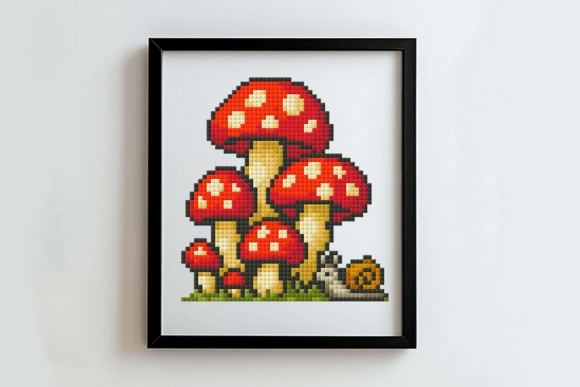
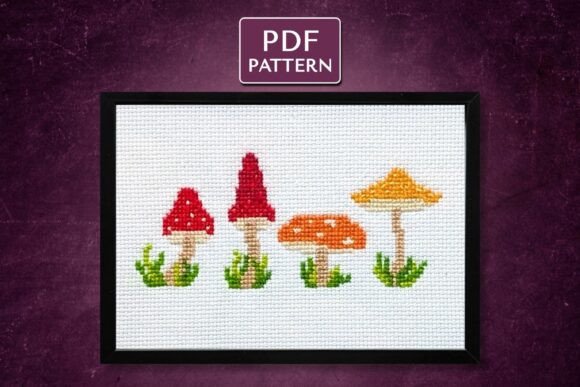
1. Red fly agaric in a 4-inch hoop
A red fly agaric hoop belongs on the mantel from September to November. You can also stitch it as a teacher’s gift for the first week of school.
The design shows one scarlet cap with white spots on a cream stem. Two blades of grass sit at the base.
You need DMC 321 for the cap, 815 for its shadow, blanc for spots, 3865 for the stem and 988 for grass.
At 50 by 56 stitches, you get about 3.6 by 4 inches on 14 ct aida. The tricky spot is the spots.
Keep them off the centre line. I stitch the biggest spot first, then place the small ones around it.
- Best for: beginners making a first autumn hoop
- Avoid for: a card under 3 inches
2. Toadstool bookmark on a long strip
A toadstool bookmark slips into a gift for the friend who reads every night. Tuck it inside a new paperback for a birthday.
Three small mushrooms climb the strip from bottom to top, each a different height. A ladder of grass ties them together.
You need DMC 321, 3865, 3011 for grass and 3371 for a thin backstitch outline.
At 22 by 110 stitches, you get about 1.6 by 7.9 inches on 14 ct aida. The tricky spot is the back.
A bookmark shows both sides, so loose tails show through. I weave every tail under three stitches and back it with felt. You get a clean edge that survives a handbag.
- Best for: a two-evening reading gift
- Avoid for: anyone who hates finishing the back
3. Mushroom fairy house for a nursery
A mushroom fairy house hangs on a nursery wall, framed at 8 by 10 inches. It also makes a christening gift.
The cap becomes a roof, with a round door and two windows cut into the stem. A path of stones leads to the step.
You need DMC 350 for the roof, 3865 for walls, 433 for the door, 726 for lit windows and 3346 for grass.
At 80 by 95 stitches, you get about 5.7 by 6.8 inches on 14 ct aida. The tricky spot is the backstitch around the windows.
Finish all full crosses first, then outline. I use one strand of 3371 so the frames stay crisp. You will find more doors in our house cross stitch patterns.
- Best for: a nursery or christening gift
- Avoid for: stitchers who skip backstitch
4. Golden chanterelle cluster
A chanterelle cluster belongs on a kitchen wall in a plain wooden frame. It suits the cook in your family as an October gift.
Five golden funnels lean together on a bed of moss. Their wavy rims curl outward.
You need DMC 741 for the bright faces, 742 for highlights, 3820 for shade and 3363 for moss.
At 70 by 60 stitches, you get about 5 by 4.3 inches on 14 ct aida. The tricky spot is the false gills under each rim.
They run as thin ridges in 3820. Mark them with a pencil first. I stitch every ridge column top to bottom so you never lose the angle.
- Best for: a confident beginner who likes warm colours
- Avoid for: a one-evening piece
5. Spring morel for a forager
A morel motif is the spring gift for a forager friend, stitched in April when the real ones appear. It fits a 3-inch hoop on a bookshelf.
One tall honeycomb cap sits on a short pale stem. The pits give it texture without any backstitch.
You need DMC 3790 for the ridges, 3782 for the pits and 822 for the stem.
At 30 by 48 stitches, you get about 2.1 by 3.4 inches on 14 ct aida. The tricky spot is the honeycomb.
Two close browns sit side by side in every row. I stitch all 3790 first, then fill the gaps. You count once instead of twice.
- Best for: stitchers who like texture over colour
- Avoid for: a chart printed in black and white
6. Snow-capped toadstool tree ornament
A snow-capped toadstool ornament hangs on the Christmas tree beside the glass baubles. Stitch three and you have stocking fillers for December.
A red cap wears a drift of snow, with a sprig of holly at the stem. The shape is round to fit a flat ornament frame.
You need DMC 321, blanc, 762 for snow shadow, 3865 and 699 for holly.
At 36 by 36 stitches, you get about 2.6 inches across on 14 ct aida. The tricky spot is where snow meets red.
A wavy line looks drifted, a straight one looks painted. I follow the chart’s snow edge exactly. Our star cross stitch designs make good tree partners.
- Best for: a batch of handmade ornaments
- Avoid for: a large wall hoop
7. Mushroom alphabet sampler
A mushroom alphabet sampler hangs in a playroom where a child is learning letters. It is a slow gift, started in January for a summer birthday.
Each of the 26 letters gets a tiny mushroom beside it. The caps change colour row by row.
You need DMC 310 for letters, plus 321, 973, 3846 and 553 for the rainbow caps.
At 140 by 180 stitches, you get about 10 by 12.9 inches on 14 ct aida. The tricky spot is letter spacing.
One stitch off and the row drifts. I grid the aida every 10 stitches with a water-soluble pen. You check each letter against the grid, not the last letter.
- Best for: an intermediate stitcher with time
- Avoid for: a deadline under two months
8. Tiny mushroom for a birthday card
A tiny mushroom fits a birthday card for the friend who forages, collects or simply loves them. You can stitch it the night before the party.
One small cap with three dots sits on a stub of stem. Nothing else is on the chart.
You need DMC 321, blanc and 3865. Three colours keep it readable at this scale.
At 20 by 24 stitches, you get about 1.4 by 1.7 inches on 14 ct aida. The tricky spot is the round cap edge.
At this size a single stray stitch turns a curve into a step. I skip any chart with half stitches here. Mount it in a card with a window aperture.
- Best for: a last-minute birthday card
- Avoid for: a wall hoop, where it looks lost
9. Tea towel border on aida band
A mushroom border on an aida band dresses a plain tea towel for the kitchen. Give a pair as a housewarming gift in autumn.
Small toadstools and acorns alternate along a straight line of grass. The motif repeats every 24 stitches.
You need DMC 321, blanc, 3865, 435 for acorns and 3346 for grass.
At 14 stitches high, you get a 1-inch border on 14 ct aida band, as long as your towel. The tricky spot is the repeat.
Start in the centre of the band and work out to both ends. I count every repeat before I cut. You want the ends to match at the hems.
- Best for: a set of matching kitchen gifts
- Avoid for: towels washed hot every week
10. Snail climbing a mushroom stem
A mushroom with a snail sits on a child’s shelf in a small round frame. It suits an Easter basket better than another chocolate egg.
A slow snail climbs the stem of a pale brown mushroom. Its shell spirals in two shades.
You need DMC 3864 for the cap, 3865 for the stem, 976 and 3826 for the shell, and 3348 for grass.
At 60 by 45 stitches, you get about 4.3 by 3.2 inches on 14 ct aida. The tricky spot is the shell spiral.
Two browns twist round each other. I stitch the darker line first as a guide. You fill the lighter colour in after.
- Best for: a gift for kids aged 4 to 8
- Avoid for: stitchers who dislike two close shades
11. Porcini for a dining room
A porcini mushroom hangs in a dining room, framed square. It is the gift for the friend who cooks risotto every Sunday.
One fat brown cap sits on a thick, pale, bulbous stem. A small knife lies beside it.
You need DMC 433 and 435 for the cap, 3865 and 822 for the stem, and 318 for the blade.
At 55 by 65 stitches, you get about 3.9 by 4.6 inches on 14 ct aida. The tricky spot is the cap’s shine.
A band of 435 runs across the 433 like light. I stitch it as one diagonal before the dark fill. You keep the curve smooth that way.
- Best for: a food lover’s wall
- Avoid for: a bright cartoon room
12. Spotted mushroom pin cushion
A mushroom pin cushion lives on your sewing table, right next to the scissors. It also makes a thank-you gift for a sewing teacher.
A spotted cap fills the square top, ready to stuff and sew into a cushion.
You need DMC 816 for the cap, blanc for spots and 3865 for the stem. A border of 3346 frames the seam.
At 40 by 40 stitches, you get about 2.9 inches square on 14 ct aida. The tricky spot is the seam allowance.
Leave five unstitched squares on every side. I tack the backing on before I trim. You get crisp corners when you turn it out.
- Best for: using up leftover reds
- Avoid for: anyone who has never sewn a seam
13. Glow-in-the-dark Halloween mushrooms
A glow-in-the-dark mushroom hoop hangs by the front door on Halloween night. Children spot it as they walk up for sweets.
Three tall mushrooms rise from dark moss, their caps lit in pale green. The background stays plain black aida.
You need DMC E940 for the glow, 3345 for moss and 3865 for stems. E940 handles differently, so use shorter lengths.
At 48 by 52 stitches, you get about 3.4 by 3.7 inches on 14 ct aida. The tricky spot is counting on black fabric.
The holes vanish under lamplight. I stitch by a daylight lamp with a white towel on my lap. You will see every hole clearly.
- Best for: a Halloween porch display
- Avoid for: evening stitching without good light
14. Mushroom moon phase banner
A mushroom moon phase banner runs along a bedroom shelf or above a headboard. It suits a teenager’s room through every season.
Seven mushrooms stand in a row, each with a moon above it from new to full. The caps grow as the moon fills.
You need DMC 310 for outline, 3865 for moons, 921 for caps and 3768 for stems.
At 200 by 40 stitches, you get about 14.3 by 2.9 inches on 14 ct aida. The tricky spot is equal spacing.
Each moon sits 28 stitches from the next. I stitch the middle moon first and count out both ways. You avoid a lopsided row.
- Best for: a long narrow wall space
- Avoid for: a standard round hoop
15. Fairy ring with initials
A fairy ring hoop is a quiet anniversary gift for a couple who married outdoors. It hangs well in an 8-inch round hoop by the bed.
Twelve small mushrooms stand in a circle, with their initials in the middle. Tiny flowers fill the gaps.
You need DMC 3712 for caps, 3865 for stems, 3013 for grass and 3354 for flowers.
At 84 by 84 stitches, you get about 6 inches across on 14 ct aida. The tricky spot is the circle.
Each mushroom tilts slightly outward. I stitch the four at twelve, three, six and nine o’clock first. You then fill the gaps between fixed points. Leave the centre empty until the ring is done.
- Best for: an anniversary or wedding gift
- Avoid for: stitchers who hate circles
16. Large toadstool sofa cushion
A mushroom cushion brightens a sofa from October through the first frost. It is the big project for someone who stitches on the train every day.
One large toadstool fills the front panel, surrounded by falling leaves. The cap alone covers half the design.
You need DMC 321, 815, blanc, 3865, 920 and 976 for the leaves.
At 140 by 140 stitches, you get about 10 inches square on 14 ct aida. The tricky spot is fabric size.
A 10-inch design needs 16-inch aida to leave room for seams. I cut 3 extra inches on every side. You also need a scroll frame, since a hoop crushes finished stitches.
- Best for: an experienced stitcher with a winter free
- Avoid for: a first project
17. Set of four mushroom coasters
A set of four mushroom coasters makes a housewarming gift that gets used every morning. Each slips into a clear acrylic coaster blank.
Four different mushrooms, one per coaster: a toadstool, a chanterelle, a bolete and an ink cap.
You need DMC 321, 741, 433, 310, blanc and 3865, shared across all four.
At 40 by 40 stitches each, you get about 2.9 inches square on 14 ct aida. The tricky spot is matching centres.
A coaster blank shows the edges, so an off-centre motif stands out. I fold each square in four and mark the middle with a pin.
You start from that pin every time, then check the gap to each edge.
- Best for: a matched housewarming set
- Avoid for: a single-evening deadline
18. Grey oyster mushrooms on a log
An oyster mushroom shelf on a log sits well in a study or home office. It is a quiet piece for someone who dislikes bright red.
Fan-shaped grey caps stack up the side of a mossy log. There are no spots and no faces.
You need DMC 648, 647 and 3024 for the caps, 840 for bark and 3363 for moss.
At 75 by 50 stitches, you get about 5.4 by 3.6 inches on 14 ct aida. The tricky spot is three close greys.
Under a warm lamp they look identical. I label each bobbin with its symbol before I start. You never thread the wrong grey that way.
- Best for: a calm, neutral room
- Avoid for: stitching under yellow light
19. Frog sheltering from the rain
A frog sheltering under a toadstool brightens a bathroom wall all year. Stitched small, it fits a get-well card for a rainy week.
A green frog sits under a red cap while raindrops fall around it. Its eyes peek out under the rim.
You need DMC 702 and 699 for the frog, 321 for the cap, 3865 for the stem and 813 for rain.
At 65 by 70 stitches, you get about 4.6 by 5 inches on 14 ct aida. The tricky spot is the frog’s eyes.
Each eye is two 310 stitches with one blanc highlight. I add the highlight last so it sits on top. You can move the eyes one square to change his mood.
- Best for: a cheerful bathroom or get-well card
- Avoid for: a realistic forest look
Halfway through the list is a good moment to pick a kit for the next evening. These sets keep the colours already matched to the chart.
Check the fabric count on the listing before you buy, since 11, 14 and 16 count stitch up at different sizes.
Bonroy 4 Sets Embroidery Set for Beginners Art Crafts Easy Sewing Incl

udes Embroidery Clothes with Pattern, Hoop, Instruction Manual, Color Stitch Set (Assorted 1)
ITSTITCH Printed Cross Stitch Kits for Adults 11CT 17×22 in DIY Embroi

dery Starter Kits Easy Patterns Embroidery for Girls Crafts DMC Stamped Supplies Needlework Fairy Tales Cat Ra

20. Denim jacket patch on waste canvas
A mushroom patch on a denim jacket goes everywhere you go, from a spring festival to the school run. It turns a plain jacket into a gift for a teen.
A single toadstool sits inside a stitched oval, like an old badge.
You need DMC 321, blanc, 3865 and 310 for the oval line.
At 30 by 30 stitches, you get about 2.1 inches on 14 count waste canvas. The tricky spot is pulling the canvas out after.
Dry threads snap or fight you. I spray the canvas with water and pull each thread out with tweezers. You stitch firmly, but never tight enough to pucker the denim.
- Best for: a teen who wears one jacket all year
- Avoid for: stretch denim
21. Forest floor with fern and moss
A forest floor scene with mushrooms, fern and moss suits a guest room or a weekend cabin. It reads as calm rather than cute.
Two brown mushrooms grow under an arching fern, with a cushion of moss below. Small grey stones edge the ground.
You need DMC 3046 and 3045 for caps, 3347, 3346 and 3345 for greens, and 646 for stones.
At 60 by 80 stitches, you get about 4.3 by 5.7 inches on 14 ct aida. The tricky spot is the fern.
Its fronds are lines of single stitches on the diagonal. I stitch each frond from the stem outward. You keep the curve and the count together.
- Best for: stitchers who like quiet greens
- Avoid for: a bright child’s room
22. Mushroom keyring in an acrylic fob
A mushroom keyring goes on the keys of a new driver, inside a clear acrylic fob. It is a pocket-sized gift for a graduation in June.
One plump cap with two spots fills the oval. There is no background.
You need DMC 351 for the cap, blanc for spots and 3865 for the stem.
At 18 by 22 stitches, you get about 1.3 by 1.6 inches on 14 ct aida. The tricky spot is the backing.
Loose aida frays inside the fob within a week. I iron fusible interfacing on the back before I cut. You trace the fob insert onto it first, so the motif sits centred.
- Best for: a fast graduation gift
- Avoid for: a detailed design
23. Toadstool in a mason jar
A mushroom in a glass jar sits on a pantry shelf among real jars of jam. It suits a spring kitchen when the windows open again.
A small toadstool grows inside a mason jar, with moss at the bottom and a cloth lid tied with string.
You need DMC 321, blanc, 3865, 3347 for moss and 3756 with 3752 for the glass.
At 45 by 65 stitches, you get about 3.2 by 4.6 inches on 14 ct aida. The tricky spot is the glass.
Pale blue blends into white aida and looks unfinished. I outline the jar in one strand of 3768. You get a clear edge without filling the glass.
- Best for: a cottage kitchen shelf
- Avoid for: dark aida
24. Shaggy ink cap for a Halloween mantel
A shaggy ink cap belongs on a Halloween mantel next to the candles. It looks eerie without a single skull.
One tall white cap drips black ink at its ragged edge. The stem is thin and long.
You need DMC blanc and 762 for the cap, 310 for the ink and 644 for the stem.
At 35 by 75 stitches, you get about 2.5 by 5.4 inches on 14 ct aida. The tricky spot is white on white.
Blanc on white aida vanishes. I stitch this one on grey or black aida instead. You keep the same count, so the size stays the same.
The drips then read from across the room.
- Best for: a Halloween display with no gore
- Avoid for: white aida
25. Repeat pattern for a market tote
A mushroom repeat on a cotton tote goes to the farmers market every Saturday. Stitch it on an aida panel and sew it to the bag front.
Small mushrooms march in staggered rows, like a printed fabric. Every second row is offset by half a motif.
You need DMC 3777, 3865 and 3011. Three colours keep the repeat calm.
Each motif is 12 by 14 stitches. A panel of 84 by 98 stitches gives you 6 by 7 inches on 14 ct aida. The tricky spot is the offset.
Miss it once and the whole row shifts. I stitch the first motif of every row before filling any. You see a mistake while it costs one motif.
- Best for: a practical gift that gets seen
- Avoid for: stitchers who tire of repeats
26. One-colour woodcut mushroom
A one-colour mushroom hangs in a minimalist bedroom or a white hallway. It suits a modern home where red spots would shout.
A single toadstool is drawn in solid black, with open aida for the spots and gills. It looks like a woodcut print.
You need DMC 310 only, about two skeins.
At 50 by 60 stitches, you get about 3.6 by 4.3 inches on 14 ct aida. The tricky spot is the empty spots.
A missed square looks like a hole, an extra one fills a spot. I highlight each empty area on the printout before I start. You can see the shape you are leaving out.
- Best for: a modern, neutral home
- Avoid for: colour practice
27. Gnome in a mushroom hat
A gnome wearing a mushroom cap is the Christmas gift for a gardener. Frame it for the potting shed or hang it on the tree.
A round-nosed gnome hides under a red spotted cap, his white beard falling to his boots.
You need DMC 321, blanc, 762 for beard shadow, 945 for the nose and 3799 for boots.
At 55 by 70 stitches, you get about 3.9 by 5 inches on 14 ct aida. The tricky spot is the beard.
White beard against white spots merges into one blob. I stitch a row of 762 under the cap to separate them. You lose the merge and gain a little depth.
- Best for: a gardener’s Christmas gift
- Avoid for: stitchers who dislike white floss
28. Mushroom birth sampler with a name
A mushroom birth sampler with a name and date is the new-baby gift that stays on the wall. Families hang it above the changing table.
A row of small mushrooms frames the baby’s name, with the date and weight below. You fill in the letters from the chart’s alphabet.
You need DMC 3755 or 3326 for the name, 3864, 3865 and 523 for leaves.
At 90 by 110 stitches, you get about 6.4 by 7.9 inches on 14 ct aida. The tricky spot is a long name.
I chart the name on graph paper first and count its width. Over 70 stitches, you drop to the smaller alphabet. For a February baby, see our Valentines cross stitch patterns.
- Best for: a personalised new-baby gift
- Avoid for: a gift due next week
29. Kawaii mushroom with a smile
A kawaii mushroom with a smiling face cheers up a student’s desk during exam season. Stitched in a 3-inch hoop, it travels in a backpack.
A round pastel cap tops a chubby stem with two dot eyes and a small smile. Pink cheeks finish the face.
You need DMC 3326 for the cap, 819 for spots, 3865 for the stem and 310 for the face.
At 30 by 32 stitches, you get about 2.1 by 2.3 inches on 14 ct aida. The tricky spot is the face.
One square too wide and it looks surprised. I stitch both eyes before the smile and check the gap. You want two empty squares between them.
- Best for: a cheer-up gift for a student
- Avoid for: a grown-up, realistic room
30. Nine-species field guide sampler
A mushroom field guide sampler fills a hallway gallery wall or a home library. It is an heirloom piece you work on through a whole winter.
Nine species sit in a three-by-three grid, each with its name stitched below. Think fly agaric, chanterelle, morel and oyster in one frame.
You need around 22 DMC colours, with 310 for names and 3371 for outlines.
At 160 by 200 stitches, you get about 11.4 by 14.3 inches on 14 ct aida. The tricky spot is keeping the grid square.
Stitch the grid lines first, all nine boxes. I finish one species before starting the next. You then always have a done square to show.
- Best for: an advanced stitcher after an heirloom
- Avoid for: a first or second project
31. Hedgehog beside a red mushroom
A hedgehog with a mushroom is the autumn gift for a grandmother who feeds hedgehogs at the back door. It sits well on a windowsill in a standing frame.
A small hedgehog curls beside a red-capped mushroom, with two fallen leaves.
You need DMC 3863 and 3790 for spines, 950 for the face, 321 for the cap and 920 for leaves.
At 70 by 55 stitches, you get about 5 by 3.9 inches on 14 ct aida. The tricky spot is the spines.
They alternate two browns in a broken pattern. I work them in diagonal rows, top left to bottom right. You keep the bristle look without counting each one twice.
- Best for: a grandparent’s autumn gift
- Avoid for: fans of big single-colour blocks
32. Tiny toadstool needle minder
A mushroom needle minder sits on your project, holding the needle while you check the chart. It makes a small thank-you for a stitching group friend.
A tiny toadstool is glued to a round magnet cover. That is the whole design.
You need DMC 321, blanc and 3865, plus one strand of 3371 if you outline it.
At 14 by 16 stitches, you get about 1 by 1.1 inches on 14 ct aida. The tricky spot is the spot count.
That width leaves room for three single-stitch spots only. I drop any chart showing more. Glue it with fabric glue, not hot glue, so the stitches stay flat.
- Best for: a quick gift for a stitching friend
- Avoid for: a wall piece
33. Enoki bundle in a tall frame
An enoki mushroom bundle hangs in a ramen lover’s dining nook in a tall, thin frame. It also suits a birthday for someone who cooks Japanese food.
A tight bunch of long white stems ends in tiny round caps. A paper band ties the base.
You need DMC blanc, 3865, 822 for shading and 3778 for the band.
At 30 by 80 stitches, you get about 2.1 by 5.7 inches on 14 ct aida. The tricky spot is the parallel stems.
Long lines of one colour drift sideways easily. I count each stem from its cap down, not from the base. You stitch it on grey aida so the white shows.
- Best for: a food lover with a narrow wall
- Avoid for: white aida
34. Mushroom and acorn door wreath
A mushroom wreath hoop hangs on the front door from September to Thanksgiving. Swap it for a winter piece once December starts.
Mushrooms, acorns and oak leaves circle an empty centre, the way a real wreath does. A small bow sits at the bottom.
You need DMC 321, 3865, 435, 3829, 3051 and 920 for leaves, plus 816 for the bow.
At 100 by 100 stitches, you get about 7.1 inches across on 14 ct aida. The tricky spot is closing the circle.
Errors pile up as you go round. The last leaf then misses the first.
I stitch the bow first, then work both ways to meet at the top. You catch any slip before it closes.
- Best for: an autumn front door
- Avoid for: a first project
35. Mouse reading under a toadstool
A mouse reading under a toadstool is a Mother’s Day gift for a bedside table. It fits a 5-inch hoop or a standing frame.
A grey mouse sits on a pebble with an open book, under a wide brown cap.
You need DMC 3023 and 3022 for the mouse, 3779 for ears, 3862 for the cap and 3865 for pages.
At 52 by 48 stitches, you get about 3.7 by 3.4 inches on 14 ct aida. The tricky spot is the book.
Its pages are backstitch lines that are easy to place a square off. I stitch them last, after the mouse’s paws are in. You can then line each page to a paw.
- Best for: a Mother’s Day or bedside gift
- Avoid for: anyone who skips backstitch
36. Patchwork quilt-block mushroom
A patchwork mushroom framed square is the gift for a quilter friend, hung beside their cutting table. It looks like a quilt block in thread.
The cap is built from triangles in four colours, like half-square triangle blocks. The stem is a plain rectangle.
You need DMC 3778, 3712, 3328 and 3865, with 3768 for the background squares.
At 64 by 64 stitches, you get about 4.6 inches square on 14 ct aida. The tricky spot is the diagonal line inside each block.
Each block is split corner to corner. I mark every diagonal with a pencil tick on the chart. You stitch block by block, never colour by colour.
- Best for: a quilter who stitches too
- Avoid for: fans of soft, rounded shapes
37. Christmas stocking cuff
A mushroom cuff on a Christmas stocking hangs from the fireplace every December. Stitch the child’s name in the middle and it comes out every year.
Red toadstools and green sprigs run round the cuff, with snowflakes between.
You need DMC 321, blanc, 3865 and 699, all on a 50-stitch aida band.
At 50 stitches high, you get a cuff about 3.6 inches deep on 14 ct aida band. Its length matches the stocking top, often 16 inches. The tricky spot is the seam join.
The repeat must close neatly round the back. I measure the stocking first and pick a length that fits whole repeats. You hide any gap at the back seam.
- Best for: a family stocking kept for years
- Avoid for: a stocking with a fixed cuff
38. Full-coverage mushroom forest panorama
A mushroom forest panorama hangs above the sofa as the big piece of the house. It is the project you start in November and frame by spring.
A whole woodland floor stretches across the frame: toadstools, boletes, ferns, a fox and falling light. It is full coverage, with no bare aida.
You need around 45 DMC colours, so a sorted floss organiser matters.
At 250 by 150 stitches, you get about 17.9 by 10.7 inches on 14 ct aida. The tricky spot is confetti stitches.
Single stitches of one colour scatter everywhere. I park my threads instead of ending them, one 10 by 10 block at a time. You save floss and hours.
- Best for: an advanced stitcher after a long project
- Avoid for: anyone new to full coverage
Pick a kit and stitch one of these mushroom embroidery ideas tonight. A complete kit saves the trip for floss and fabric.
Gift sets with two or three hoops work well for a stitching friend.


How do you choose mushroom embroidery patterns?
Three checks decide it, and each takes you a minute before you buy floss.
- Size in stitches. Divide by 14 for inches on 14 ct aida. Free charts often skip the count, and you run off the fabric.
- Number of DMC colours. An easy chart lists three to six. An unstated count can hide fifty.
- Readable symbols. Print one page in black and white. If two shades look alike, you will mix them.
If it goes wrong
- The motif runs off your aida. Start from the centre of fabric and chart, and cut 3 inches extra each side.
- Two symbols look the same. Highlight one in colour on the printout before you thread.
- The cap looks flat. Add one row of a darker red, such as 815, under the rim.
- A floss number no longer exists. Match it against a DMC colour card in daylight, not on a screen.
- Your count drifts by row 40. Grid the aida every 10 stitches and mark rows off as you go.
Key takeaways
- Divide the stitch count by 14 to get your size on 14 ct aida.
- Pick the place first: card, ornament, hoop, cushion or wall.
- Start from the centre of the fabric and the chart.
- Add a darker shade under the cap rim so it curves.
- Stitch white mushrooms on grey or black aida.
When the free version isn’t enough
A free mushroom chart shows you a picture, not a checked count. A full kit with 14 ct aida and floss sorted by symbol takes the guessing away.
Already own fabric? A checked chart with a stated stitch count and colour list does the same job. I would rather pay once than unpick an evening.
Common questions
How big is a mushroom embroidery design on 14 ct aida?
Divide the stitch count by 14 to get inches. A 50 by 56 stitch mushroom finishes near 3.6 by 4 inches. Add 3 inches of aida on every side so you can hoop and frame it.
How many DMC colours does a mushroom cross stitch need?
A simple red toadstool needs three: 321 for the cap, blanc for spots and 3865 for the stem. Add 815 under the rim and the cap gains a curve. Full scenes run to 20 colours or more.
Is mushroom embroidery good for beginners?
Yes, if you pick a small chart in full crosses only. A 30 to 50 stitch mushroom with three colours finishes in one or two evenings. Leave half stitches and backstitch for your second piece.
What aida colour works best for white mushrooms?
Grey or black aida works best for white caps like ink caps and enoki. Blanc on white fabric disappears. Keep the same 14 count, so your finished size does not change.
How do I know mushroom embroidery patterns are correct before I stitch?
Check three things first: a stated stitch count, a full DMC colour list and symbols that still differ in black and white. Then compare the preview edges to the grid, where a missing column shows up.